
iPhone Air One Year Later: The Most Beautiful iPhone Is a Painful Buy
Is the iPhone Air worth buying a year on? It is 5.64mm thin, but one camera, a mono speaker and a 3,149mAh battery cost more now. Our verdict.

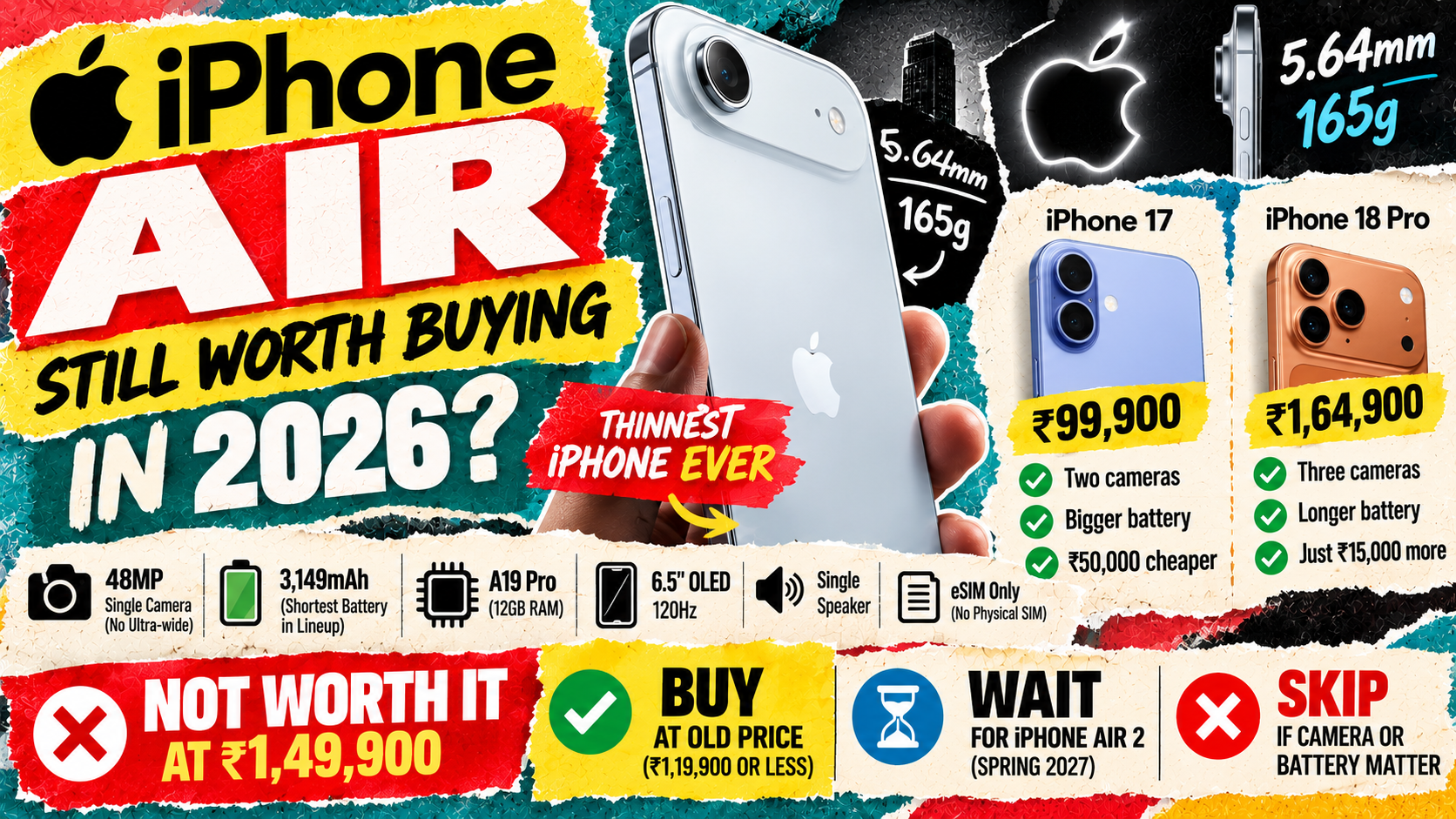
The iPhone Air is one year old, and it is still the thinnest iPhone Apple has ever made. At 5.64mm and 165g, nothing else in the lineup comes close. But a year on, the iPhone Air costs more than it did at launch, not less.
That is the odd part. Apple raised its price in September 2026, so the iPhone Air now starts at Rs 1,49,900 on Apple’s own store. Meanwhile, the iPhone 17 starts at Rs 99,900, and it has two cameras and a bigger battery.
So is the iPhone Air still worth buying in late 2026? Our answer is no, unless you find old stock at the old price. Below, we explain why, and who should still buy it.
We have not tested the phone ourselves. Instead, this verdict rests on Apple’s official specs, lab tests from GSMArena and long-term reviews. Every number links to its source.
The Short Version
- It is still the thinnest, lightest iPhone. It is 5.64mm thick and weighs 165g.
- The compromises have not changed. It has one rear camera, one speaker and the smallest battery in the lineup.
- It now costs Rs 50,000 more than the iPhone 17. That gap is too wide for a phone that does less.
- A successor is reportedly coming. Bloomberg says the iPhone Air 2 arrives in spring 2027 with a second camera.
- Our call: buy old stock at the old price, wait if you want the thin design, and skip it if photos or battery matter most.
What the iPhone Air Still Does Well
First, the design is still special. According to Apple’s spec sheet, the iPhone Air is 5.64mm thick and weighs 165g. By contrast, the iPhone 17 is 7.95mm and 177g. Reviewers agree this is the main reason to buy it.
Second, the build is tough for its size. GSMArena’s spec sheet lists a grade 5 titanium frame, Ceramic Shield 2 on the front and IP68 water resistance.
Third, it is fast. It uses the A19 Pro chip, the same family as last year’s Pro models, with 12GB of RAM. In other words, speed is not a reason to pick a different iPhone.
Finally, the screen is excellent. It is a 6.5-inch OLED with a 120Hz ProMotion refresh rate and up to 3,000 nits of peak brightness. That is larger than the 6.3-inch screen on the iPhone 17.
Where the iPhone Air Falls Short
The camera is the first problem. The iPhone Air has a single 48MP main camera. It offers a 2x zoom, but that is a crop from the main sensor, not a separate lens. As a result, there is no ultra-wide camera and no true telephoto.
To be fair, the main camera is good. Expert Reviews found it matched the iPhone 17 Pro’s main camera in good and poor light. Still, it listed “only one camera” as a con, and it would steer buyers to the iPhone 17 or 17 Pro instead.
The speaker is the second problem. Expert Reviews notes that the iPhone Air has only one speaker, at the top edge. It gets loud enough. However, it lacks the fullness of the stereo speakers on other iPhones.
Third, there is no physical SIM. Apple lists the iPhone Air as dual eSIM only. For most people this is fine. However, it can be a hassle if you switch SIMs often or travel to countries with weak eSIM support.
iPhone Air Battery Life: Better Than It Looks, Still the Weakest
Battery life was the big worry at launch. The iPhone Air has a 3,149mAh battery, a figure that GSMArena’s lab test and 9to5Mac both report. That is smaller than the iPhone 17’s 3,692mAh battery.
In practice, it does better than its size suggests. GSMArena gave it an Active Use Score of 12 hours 44 minutes. In addition, Expert Reviews measured 27 hours 13 minutes of video playback, almost exactly what Apple claims.
Even so, it is the shortest-lasting iPhone you can buy new. Apple rates it at 27 hours of video, against 30 hours for the iPhone 17 and 34 hours for the iPhone 18 Pro.
Heavy users will notice that gap by evening. If battery is your priority, our list of phones with the best battery life is a better place to start.
Charging is slow too. GSMArena measured 33% in 15 minutes and 57% in 30 minutes. A full charge took 1 hour 33 minutes, at a peak of about 18W.
iPhone Air vs iPhone 17 vs iPhone 18 Pro
These are the three iPhones most buyers will weigh against each other. Prices are Apple’s own list prices, checked on 26 October 2026, for the base 256GB model. Specs are from Apple’s comparison page.
iPhone Air | iPhone 17 | iPhone 18 Pro | |
|---|---|---|---|
Price (256GB) | Rs 1,49,900 | Rs 99,900 | Rs 1,64,900 |
Chip | A19 Pro | A19 | A20 Pro |
Screen | 6.5-inch, 120Hz | 6.3-inch, 120Hz | 6.3-inch, 120Hz |
Thickness | 5.64mm | 7.95mm | 8.75mm |
Weight | 165g | 177g | 211g |
Rear cameras | One 48MP | Two 48MP | Three 48MP |
Optical zoom options | 1x, 2x | 0.5x, 1x, 2x | 0.5x to 8x |
Video playback (Apple) | Up to 27 hours | Up to 30 hours | Up to 34 hours |
Put side by side, the problem is clear. The iPhone 17 costs Rs 50,000 less. Yet it adds an ultra-wide camera and three more hours of video playback. You give up only the thin body and the faster chip. Our iPhone 17 vs Pixel 11 comparison covers that phone in more depth.
On the other hand, the iPhone 18 Pro costs just Rs 15,000 more than the iPhone Air. For that, you get the newer A20 Pro chip, three cameras with up to 8x zoom and the longest battery life of the three.
See our iPhone 18 Pro price and specs guide for the full breakdown.
In short, the iPhone Air is squeezed from both sides. It is too expensive next to the iPhone 17, and too close in price to the iPhone 18 Pro.
Should You Wait for the iPhone Air 2?
There is a second reason to hold off. Bloomberg’s Mark Gurman reported in June that the iPhone Air 2 is likely to debut in spring 2027 with a second rear camera, as GSMArena reported. On 12 October, Bloomberg narrowed that window, according to 9to5Mac.
The new camera is reportedly an ultra-wide, which fixes the biggest complaint. In addition, 9to5Mac cites a supply chain leak of a 3,500mAh battery. That would be more than 10% larger. Apple has confirmed none of this, so treat it as expected, not certain.
There is also a warning sign. 9to5Mac reports the original iPhone Air sold worse than Apple expected. That does not make it a bad phone. However, it suggests Apple knows the trade-offs went too far, and the next model is designed to fix them.
iPhone Air Price in India and Offers
This section is for readers in India, where the price story is unusual.
At launch, the iPhone Air started at Rs 1,19,900 for 256GB. Then, on 10 September 2026, BusinessToday reported that Apple raised it by Rs 30,000.
Apple’s India store still lists Rs 1,49,900 for 256GB, Rs 1,74,900 for 512GB and Rs 2,24,900 for 1TB, as checked on 26 October 2026.
That rise is part of a wider trend of smartphone prices rising in 2026. It hit every model, including the iPhone 17, which went from Rs 82,900 to Rs 99,900.
However, older stock is still around. On 26 October 2026, Flipkart’s listings still carried the old MRPs. The 256GB model showed Rs 99,900 against an MRP of Rs 1,19,900, but every colour was out of stock. A few 512GB and 1TB units remained, at Rs 1,19,900 and Rs 1,39,900.
Flipkart also showed exchange offers of up to Rs 71,650, depending on your old phone. Bank offers were listed without details, so check the page on the day you buy. Apple’s October 28 event could also shift prices again. Stock this low will not last long.
Who Should Buy, Who Should Wait, Who Should Skip
Buy it if you find old stock at Rs 1,19,900 or less, and thinness matters more to you than anything else. At that price, it is a light, fast iPhone with a great screen. That is a fair deal for the right person.
Wait if you love the idea but not the price. At Rs 1,49,900 the iPhone Air is poor value. If the reports are right, the iPhone Air 2 should fix the camera and battery in about six months.
Skip it if you take a lot of photos. One camera is not enough at this price, and the iPhone 17 gives you an ultra-wide for Rs 50,000 less. Also skip it if you are a heavy user, because it has the shortest battery life of any new iPhone.
Skip it too if you were going to spend Rs 1,49,900 anyway. In that case, add Rs 15,000 and buy the iPhone 18 Pro. It is a much better phone for a small step up.
Quick Answers
Is the iPhone Air worth buying in 2026?
Only at the old price of Rs 1,19,900 or below. At Apple’s new price of Rs 1,49,900, the iPhone 17 and iPhone 18 Pro are better value.
How good is the iPhone Air battery life?
Better than its 3,149mAh size suggests. GSMArena measured 12 hours 44 minutes of active use. Still, it trails every other new iPhone.
Does the iPhone Air have an ultra-wide camera?
No. It has a single 48MP main camera with a 2x crop zoom. The iPhone Air 2 is reportedly getting an ultra-wide in 2027.
When is the iPhone Air 2 coming?
Bloomberg reports spring 2027, alongside the standard iPhone 18. Apple has not confirmed it.
The Bottom Line
The iPhone Air is still the most striking iPhone you can hold. Its titanium frame, 5.64mm body and bright 6.5-inch screen feel unlike anything else Apple sells. Moreover, its battery holds up better than critics feared.
But a year on, the maths has turned against it. One camera, one speaker and the weakest battery in the lineup now cost Rs 50,000 more than the iPhone 17. That is not a trade worth making.
So our verdict is clear. The iPhone Air is a great idea at a bad price. What we cannot know yet is whether Apple will cut it when the iPhone Air 2 arrives, or whether the new model will keep the price high.
Read next
iPhone 18 Pro or Pixel 11 Pro? The Best Phone for Your Money Right Now
Pixel 11 Pro vs iPhone 18 Pro: $1,099 against $1,199. We compare chip, camera, battery and updates, and say who should buy which phone.
Wait for the Galaxy S27 Ultra? The Surprising Truth You Need to Know Now
Galaxy S27 Ultra leaks point to a bigger battery, one less camera and a higher price. Here is who should wait, who should buy the S26 Ultra now.
Is the iPhone 18 Pro Max Really Better Than the Galaxy S26 Ultra? The Truth You Need to Know
iPhone 18 Pro Max vs Galaxy S26 Ultra in India, with up to Rs 55,000 between them. We compare price, battery, speed and cameras, then pick one.