
Pixel 11 vs OnePlus 15: The Painful Truth About 7 Years of Better Updates
Pixel 11 vs OnePlus 15 on software support: 7 years against 4 OS upgrades. See what the extra Rs 17,000 buys and who should pay it.

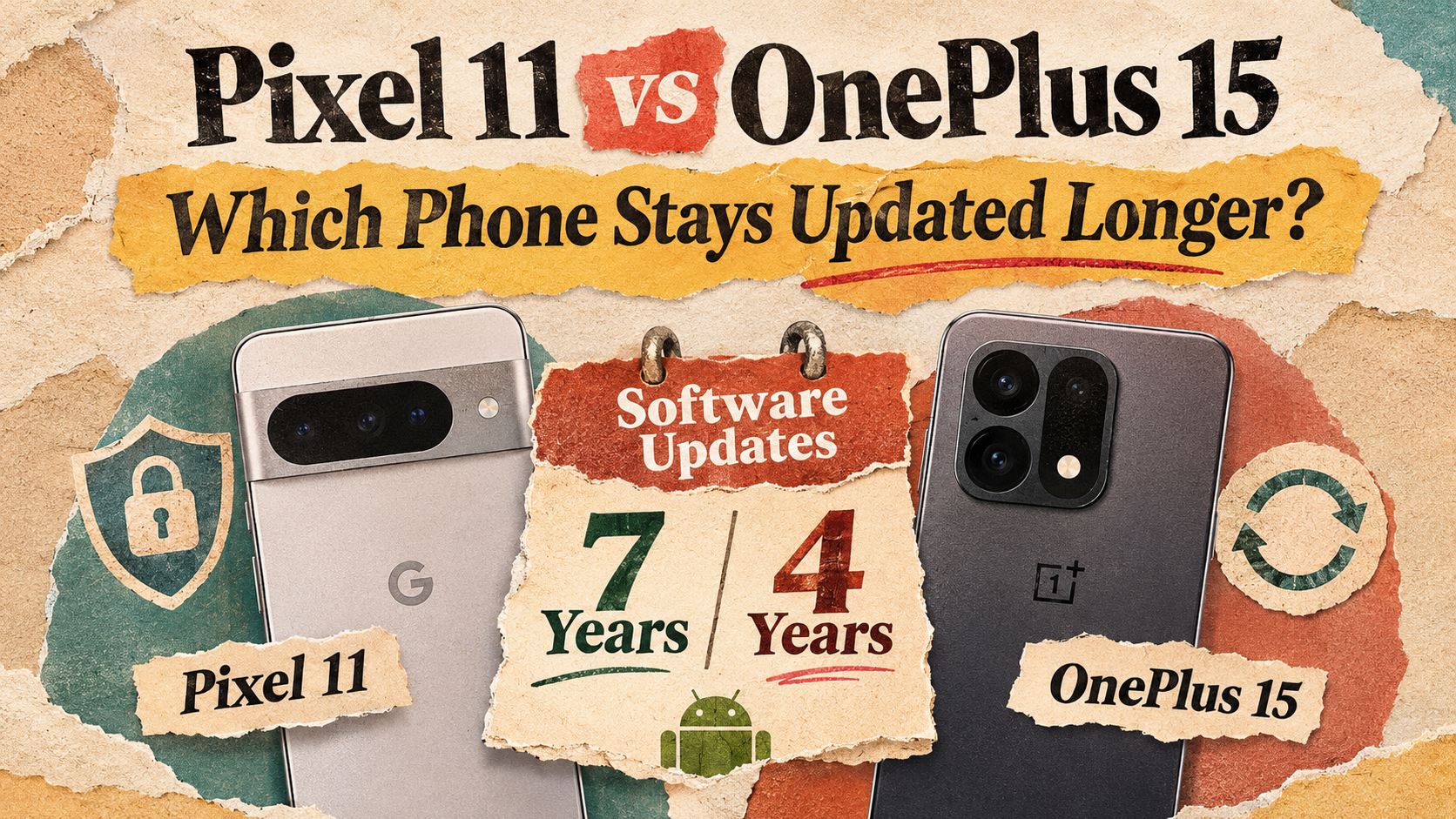
A flagship phone is only as good as the software it still gets in year five. That is where the Pixel 11 vs OnePlus 15 contest is really decided. Google promises seven years of updates. However, OnePlus promises four Android upgrades.
Most buyers compare cameras and chips. Still, very few compare the update promise, even though it decides how long the phone stays safe and current. Here is what the promises actually say, what they cost, and who should pay for the longer one.
What Each Brand Actually Promises
Beebom’s update policy guide, published on 13 October 2026, lists the current numbers. Here are the ones that matter for a Rs 70,000-plus phone.
Phone | OS upgrades | Security patches |
|---|---|---|
Google Pixel 11 | 7 | 7 years |
Samsung Galaxy S26 | 7 | 7 years |
Nothing Phone (3) | 5 | 7 years |
OnePlus 15 | 4 | 6 years |
Nothing Phone (3a) | 3 | 6 years |
Google confirms the Pixel number on its own page. Republic World and Gizbot both back the Samsung number. BGR confirms Nothing’s spread and notes the brand has no single policy.
One caution on OnePlus. The 15’s exact numbers come from Beebom. Reviews only say the phone is “said to” match the older one. The official wording is for the OnePlus 13. 9to5Google quotes OnePlus promising four years of Android updates and six years of security. Check OnePlus’s own page before you pay.
Pixel 11 vs OnePlus 15: What the Gap Really Is
Count what the Pixel gives you that the OnePlus does not. It is three extra Android versions and one extra year of security patches.
That second part is the one that matters for safety. Security patches keep a phone usable for banking and email. Both phones get them for at least six years. After year six, only the Pixel keeps going.
The extra Android upgrades are about features. Therefore they are nice, not essential. A phone on an older Android version with current patches is still a safe phone.
So the gap is real but smaller than “7 against 4” sounds. So anyone who quotes it that way is selling the Pixel.
Which Is the Better Value for Your Money?
Pricing is where the painful truth shows. In India the Pixel 11 launched at Rs 89,999 for 256GB, according to FoneArena. The OnePlus 15 launched at Rs 72,999 for 12GB and 256GB, per the Free Press Journal.
That is a gap of Rs 17,000. Divide each price by its years of security support and you get this:
Phone | Launch price | Security years | Cost per year |
|---|---|---|---|
Pixel 11 | Rs 89,999 | 7 | about Rs 12,857 |
OnePlus 15 | Rs 72,999 | 6 | about Rs 12,167 |
As a result, per year of security, the OnePlus is slightly cheaper. The Pixel only wins if you actually use year seven.
Launch prices are not today’s prices. Sale prices have moved both phones since. Our own Pixel 11 verdict covers where the Pixel sits now.
The Galaxy S26 Is the Quiet Third Option
Samsung also promises seven years of OS upgrades and seven years of patches. Reports put the Galaxy S26 launch price at Rs 87,999 or Rs 89,999. The two sources disagree by Rs 2,000.
At that price, the cost per year lands between Rs 12,571 and Rs 12,857. That is the same as the Pixel. If you want seven years, you can choose the camera and design you like better.
Our Pixel 11 vs Galaxy S26 comparison goes through that contest in full.
A Promise Is Not a Delivery
A written promise guarantees nothing about timing. Notebookcheck reports that Samsung brought stable One UI 9 to the Galaxy S24 on 7 October 2026. That was about three months after the Fold 8 and Flip 8 launched with it. The same report says Samsung moved a Galaxy S26 release date in Thailand, then removed it without explanation.
Google’s own record has a blemish too. Google promised the Pixel 6 and 6 Pro five years. They have now reached end of life. Owners also reported skipped monthly updates along the way.
None of this means the promises are empty. Instead, it means you should treat “7 years” as a ceiling.
One more fact many buyers miss. The clock starts at launch, not at purchase. Google says the seven years run from when the phone first went on sale in the US. Beebom makes the same point. Buy late and you get fewer years.
Who Should Buy What
Buy the Pixel 11 or Galaxy S26 if you keep a phone until it breaks. Also pick one if you plan to hand it down to a family member. The longer window helps most in years five to seven.
Buy the OnePlus 15 if you swap phones every three to four years. You save Rs 17,000 and lose nothing you would use. Our OnePlus 16 vs OnePlus 15 piece helps if you are weighing the newer model.
Skip the cheapest tier if long life is the goal. Beebom lists Redmi phones at about 2 OS upgrades. Moto G phones get up to 2. The Redmi figure is only “reported”. A phone that stops at year two is not a Rs 20,000 bargain.
Quick Answers
Is a 7-year update promise worth paying more for?
Only if you will keep the phone that long. Most people replace a flagship within four years, so the last three years go unused.
Does the OnePlus 15 really get only 4 Android upgrades?
Reports say so, and OnePlus said the same of the OnePlus 13. We could not find OnePlus’s own page for the 15, so verify it.
Do update years start on the day I buy?
No. They start at launch. A phone bought a year after release has a year less support.
Which brand has the weakest promise?
Nothing has no single policy. The Phone (3) gets 5 OS upgrades. The Phone (3a) gets 3.
The Bottom Line
Do not pay Rs 17,000 extra for a number you will not use. If you change phones every three or four years, buy the OnePlus 15 and keep the money. If you keep phones for six years, buy the Pixel 11 or the Galaxy S26 and enjoy the full window.
What we do not know yet is how well any brand keeps the final years of its promise. The Pixel 6 shows that the later years can get thin. We also could not confirm the OnePlus 15 numbers from OnePlus itself. Check the official page before you decide.
Read next

Galaxy S27 Price Leak: The Painful Truth About Every 4-Model Hike You Need to Know Now
The Galaxy S27 price leak was revised up for all four models. Here is what each rise means, and who should wait, buy or skip.
vivo X500 India Launch Teased: One Big Money Warning
The vivo X500 India launch is officially teased. See the tipped 25 November date, the specs, and why the price may top Rs 1 lakh before you buy.
Galaxy S27 Chipset Split: The Truth About India’s Best Snapdragon
The Galaxy S27 chipset split is clearer: Pro and Ultra may get the fastest Snapdragon. See what is official, what is rumour and what India may get.