
Galaxy S27 Chipset Split: The Truth About India’s Best Snapdragon
The Galaxy S27 chipset split is clearer: Pro and Ultra may get the fastest Snapdragon. See what is official, what is rumour and what India may get.


The Galaxy S27 chipset story got clearer this week, and it matters for your wallet. Leaks now say the Galaxy S27 Pro and S27 Ultra will get Qualcomm’s fastest Snapdragon, while the cheaper models may run Samsung’s own Exynos 2700.
Samsung has confirmed no Galaxy S27 chipset details. Still, the pattern is consistent across several outlets, and Qualcomm has already announced the chips themselves.
So what does that mean for Indian buyers? Below you will find what is official, what is rumour, which phone India will probably get, and whether you should wait for early 2027.
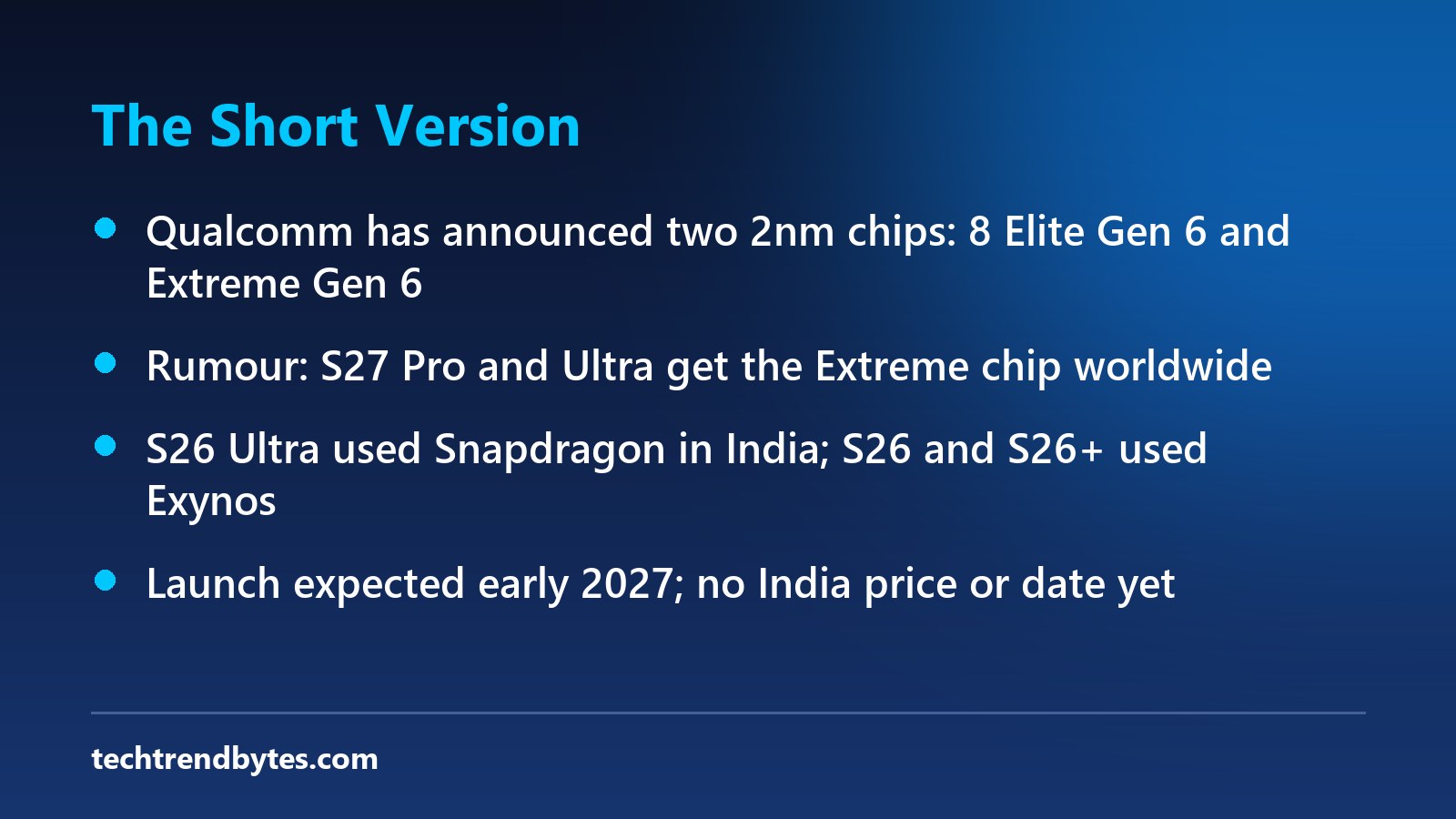
The Short Version
- Official: Qualcomm has announced the Snapdragon 8 Elite Gen 6 and the faster 8 Elite Extreme Gen 6, both on a 2nm process.
- Rumoured: The S27 Pro and S27 Ultra get the Extreme chip globally. The S27 and S27+ get it only in some markets.
- Likely for India: Snapdragon on the Ultra, going by how the S26 series was sold here. Exynos on the others is possible.
- Timing: Early 2027, with no India price yet.
What Has Qualcomm Actually Announced?
Qualcomm showed two 2nm chips at Snapdragon Summit 2026. SamMobile reports that these are the Snapdragon 8 Elite Gen 6 and the Snapdragon 8 Elite Extreme Gen 6.
Qualcomm claims the standard chip has a CPU 10% faster than last year’s, with 37% better power efficiency. It also claims a 35% faster GPU.
The Extreme version goes further. Qualcomm claims a 13% faster CPU and a 44% faster GPU. It also uses an Adreno 850 GPU with 18MB of dedicated memory.
These are Qualcomm’s own numbers. Independent tests will come only after the phones ship.
Which Galaxy S27 Chip Goes in Which Phone?
The Galaxy S27 chipset list is still rumour. SamMobile says the S27 Pro and S27 Ultra could use the Extreme Gen 6 worldwide. The S27 and S27+ would use a Snapdragon only in China and North America.
For Europe, a separate SamMobile report says the Ultra gets the Snapdragon. The S27, S27+ and S27 Pro would get the Exynos 2700. That report relies on the tipster Ice Universe.
Older reports disagree. In July, Beebom cited a Korean report saying the S27 Pro would use the Exynos 2700 in India. That claim is months old and unconfirmed.
So the picture has shifted, but it has not settled.
What Does the Galaxy S27 Chip Split Mean for India?
Look at last year’s pattern first. The Galaxy S26 Ultra launched in India with the Snapdragon 8 Elite Gen 5. The S26 and S26+ used Samsung’s Exynos 2600, according to Fone Arena.
If Samsung repeats this, Indian buyers of the S27 Ultra get a Snapdragon. Indian buyers of the cheaper models get an Exynos.
Here is how the two years compare.
Model | S26 series in India | S27 series (rumoured) |
|---|---|---|
Base model | Exynos 2600 | Exynos 2700 in most markets |
Plus model | Exynos 2600 | Exynos 2700 in most markets |
Pro | Did not exist | Extreme Gen 6, or Exynos in some regions |
Ultra | Snapdragon 8 Elite Gen 5 | Extreme Gen 6 |
Prices matter too. The S26 Ultra launched in India at Rs 1,39,999 for 12GB and 256GB. The S26 range started at Rs 87,999. One report says Samsung later raised prices, so check Samsung India before you buy.
That is why the Galaxy S27 chipset matters. You may pay the same flagship money for a different processor, depending on the model.
Is the Exynos 2700 Actually Worse?
Not necessarily. The same SamMobile report says the Exynos 2700 reportedly beats the Snapdragon in some tests. It also notes that the Exynos 2600 has done well on efficiency.
However, these are leaked numbers. Real heat and battery results in Indian summers are what count. We will only know after reviews.
Here is what to watch when reviews arrive:
- Sustained gaming performance after 20 minutes.
- Phone temperature while charging and filming video.
- Battery life on mobile data, not Wi-Fi.
- Camera processing speed in low light.
If the Exynos passes all four, the Galaxy S27 chipset name matters much less.
Will the Galaxy S27 Pro and Ultra Charge Faster?
Possibly. SamMobile also reports that only the S27 Pro and S27 Ultra should get 60W wired charging. The base S27 would stay at 25W, and the S27+ at 45W.
Battery sizes are rumoured at 5,200mAh for the Pro and 5,700mAh for the Ultra. These figures come from leaks and regulatory documents.
So the Galaxy S27 chipset is not the only gap. The top two models look like the real upgrades.
Should You Wait for the Galaxy S27?
It depends on what you carry today. Here is a simple guide.
Buy a Galaxy S26 Ultra now if your phone is more than three years old and you want a Snapdragon flagship today. Our Galaxy S26 Ultra verdict covers the one catch you should know about.
Wait for the S27 Ultra if you already own an S25 Ultra or S26 Ultra. The jump is probably too small to justify the cost. Our S27 Ultra wait-or-buy guide explains why.
Skip the cheaper S27 models for now if raw speed is your priority. Wait for Exynos 2700 reviews first.
On timing, our Galaxy S27 release date post covers the January 2027 window. Reports point to an early 2027 launch, with no India date yet.
What Should You Watch Next?
Three things will settle this story.
- Samsung’s launch event: the official Galaxy S27 chipset list for each model.
- India listings: whether Samsung India names a chip per model on its website.
- First benchmarks: independent tests of the Exynos 2700 against the Extreme Gen 6.
We will update this post when any of these arrive.
The Bottom Line
The Galaxy S27 chipset split looks like last year’s, with the Ultra and the new Pro getting the best Snapdragon. The chips are official. Who gets which one is still rumour.
For most Indian buyers, the safest move is to wait for reviews. Do not pay extra for a model until you know which chip is inside.
Would you accept an Exynos in a Galaxy S27 if it cost Rs 10,000 less? Tell us in the comments.
Read next

Snapdragon 8 Elite Gen 6 vs Extreme: The Painful Truth You Need to Know Now
Snapdragon 8 Elite Extreme Gen 6 vs the standard Gen 6: a 44% faster GPU, a small CPU gap and a clear answer on who should pay extra.

Lava Price Hike of Rs 3,000: How to Avoid a Painful Money Mistake Before 15 November
The Lava price hike of up to Rs 3,000 starts 15 November. Here is which Lava phones are worth buying before the date, and which to leave alone.

Oppo Reno 17 India Launch: Is the New Pro Out?
The Oppo Reno 17 India launch may skip the Pro. See the leaked specs, the 8,000mAh battery, expected Rs price, and whether you should wait.