
Snapdragon 8 Elite Gen 6 vs Extreme: The Painful Truth You Need to Know Now
Snapdragon 8 Elite Extreme Gen 6 vs the standard Gen 6: a 44% faster GPU, a small CPU gap and a clear answer on who should pay extra.

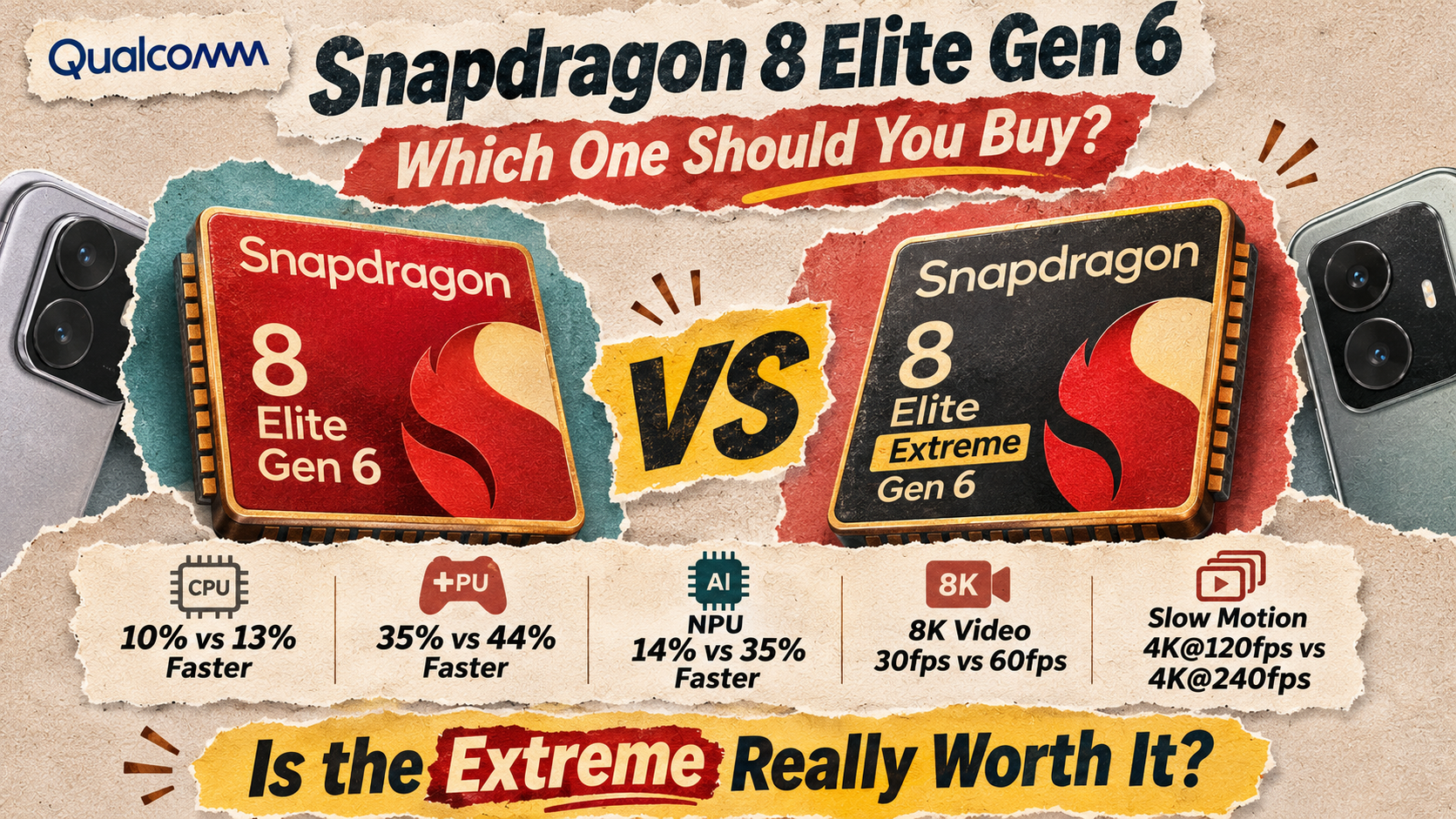
Qualcomm launched two flagship chips in September, and most phone buyers will never notice the difference between them. The Snapdragon 8 Elite Extreme Gen 6 is the faster one. Meanwhile, the standard Snapdragon 8 Elite Gen 6 sounds like the cheaper option. The gap is real, but it sits in places most people do not use.
So the question is not which chip is better. Instead, it is whether the Extreme is worth chasing, and whether a phone with the standard chip is a downgrade. Here is what the sources say, and what we would do.
Snapdragon 8 Elite Extreme Gen 6 vs the Standard Chip: What Is Shared
Start with what is the same, because it is most of the chip. According to Digit, both chips use TSMC’s 2nm process and the same Oryon CPU layout. They also share the X105 5G modem and Wi-Fi 8.
Beebom lists the same clock speeds. 91mobiles says the Prime cores reach 5.0GHz and the Performance cores 4.0GHz.
Qualcomm also claims 37% better CPU power efficiency on both, per Digit. As a result, battery life should not be the reason to pay extra.
Where the Extreme Is Actually Faster
The gap shows up in three places. These are Qualcomm’s own claims against the Snapdragon 8 Elite Gen 5, as reported by Digit.
Area | Standard Gen 6 | Extreme Gen 6 |
|---|---|---|
CPU | 10% faster | 13% faster |
GPU | 35% faster | 44% faster |
NPU (AI) | 14% faster | 35% faster |
Video | 8K at 30fps | 8K at 60fps |
Slow motion | 4K at 120fps | 4K at 240fps |
In short, the CPU difference is three percentage points. That is the number to remember. Qualcomm is not selling the Extreme on raw processor speed.
However, the graphics and AI gaps are larger. The Extreme also adds dedicated GPU memory and a bigger shared pool for on-device AI models, which Digit says is 50% larger.
What About the Leaked Benchmarks?
Early Geekbench scores do show a wider gap. Beebom reports 3,582 single-core and 12,247 multi-core for the Extreme in a Xiaomi 18 Pro Max. The standard chip scored 3,220 and 9,646 in a Xiaomi 18 Pro.
Treat those with care, because they are leaked, they come from two different phones, and phone cooling affects the result. Beebom itself concludes that the Extreme is better but “not huge” in margin.
Our reading is simple. The Extreme is faster when pushed hard, such as in a long gaming session. For daily use, however, you are unlikely to feel it.
Who Should Pay for the Extreme
Digit’s verdict matches ours. The Extreme suits four kinds of buyers:
- Serious mobile gamers who want sustained high frame rates.
- Video creators who want 8K at 60fps or the newer APV format.
- AI early adopters who want to run larger models on the phone.
- Long-term keepers who hold a phone for four to five years.
If none of those is you, then the standard Gen 6 is the sensible pick. Digit calls it “the sensible flagship most people will buy”, and 91mobiles says it should cover the needs of most premium buyers. We agree.
Which Phones Get Which Chip
Because the chip name does not always match the price tag, check the phone, not the badge. The Xiaomi 18 Pro uses the standard Gen 6. The Xiaomi 18 Pro Max uses the Extreme, according to GSMArena. Both are confirmed for a global launch this year.
The Motorola Signature 27 uses the Extreme, as Beebom’s phone page and Digit both list. Beebom also expects the OnePlus 16 and iQOO 16 to use it.
Samsung is further out, though. The Shortcut expects the Extreme in the Galaxy S27 Pro and S27 Ultra and the standard chip in the S27 and S27 Plus in the US. That is a rumour, and Samsung has confirmed nothing. Our Galaxy S27 release date guide tracks what is known.
Pricing: The Chip Tier Does Not Set the Price
This is where the badge misleads. The Signature 27 has the Extreme chip, yet Digit lists an expected price of Rs 69,999 to Rs 89,999 for the 12GB and 256GB model. Beebom expects Rs 69,999. Motorola has not confirmed any of it. Our Signature 27 price guide has the detail.
On the other side, the Xiaomi 18 Pro has the standard chip. Digit reports a tip from Yogesh Brar that it could cost Rs 95,000 to Rs 1,00,000 when it reaches India, around December. Xiaomi has not confirmed that either.
Therefore, a phone with the cheaper chip may cost Rs 5,000 to Rs 30,000 more than one with the Extreme. Camera, display, battery and brand pricing matter far more than the chip tier. Our Xiaomi 18 Pro global launch story covers what Xiaomi is charging for.
One more warning from Digit is worth repeating. Brands may use the chip’s on-chip memory gains to justify less RAM at the same price. Check the RAM on the spec sheet before you pay.
Quick Answers
Is the Snapdragon 8 Elite Extreme Gen 6 much faster than the standard Gen 6?
Not in the CPU, since Qualcomm’s claims differ by three points, 13% against 10%. The GPU and AI gaps are bigger.
Will I notice the difference in daily use?
Almost certainly not, because messaging, UPI, streaming and photos run the same on both. Long gaming sessions are where it shows.
Should I wait for a phone with the Extreme chip?
Only if you game heavily or shoot 8K video. Otherwise, buy the best phone you can afford, whichever Gen 6 chip it carries.
Is the standard Gen 6 a downgrade from last year?
No. Qualcomm claims 10% faster CPU, 35% faster GPU and 14% faster AI than the Gen 5.
The Bottom Line
Do not pay extra for the Extreme badge unless you game hard, film in 8K or keep your phone for years. For everyone else, the standard Snapdragon 8 Elite Gen 6 is the better value and the smarter pick.
Pick the phone first and the chip second. The camera, battery and price of the phone you actually want will matter more than a three-point CPU gap.
Several things are still unknown. All performance numbers are Qualcomm’s claims or leaks, not independent tests. Retail phones may throttle differently, and none of the India prices above are official. We will update this once reviewers test both chips in finished phones.
Read next

Galaxy S27 Chipset Split: The Truth About India’s Best Snapdragon
The Galaxy S27 chipset split is clearer: Pro and Ultra may get the fastest Snapdragon. See what is official, what is rumour and what India may get.

Lava Price Hike of Rs 3,000: How to Avoid a Painful Money Mistake Before 15 November
The Lava price hike of up to Rs 3,000 starts 15 November. Here is which Lava phones are worth buying before the date, and which to leave alone.

Oppo Reno 17 India Launch: Is the New Pro Out?
The Oppo Reno 17 India launch may skip the Pro. See the leaked specs, the 8,000mAh battery, expected Rs price, and whether you should wait.