
Xiaomi 17 Ultra After 8 Months: Is the Best Camera Phone Worth Buying Now?
Is the Xiaomi 17 Ultra still worth buying? A 200MP zoom and a 6,000mAh battery, plus the three catches, and who should buy, wait or skip.

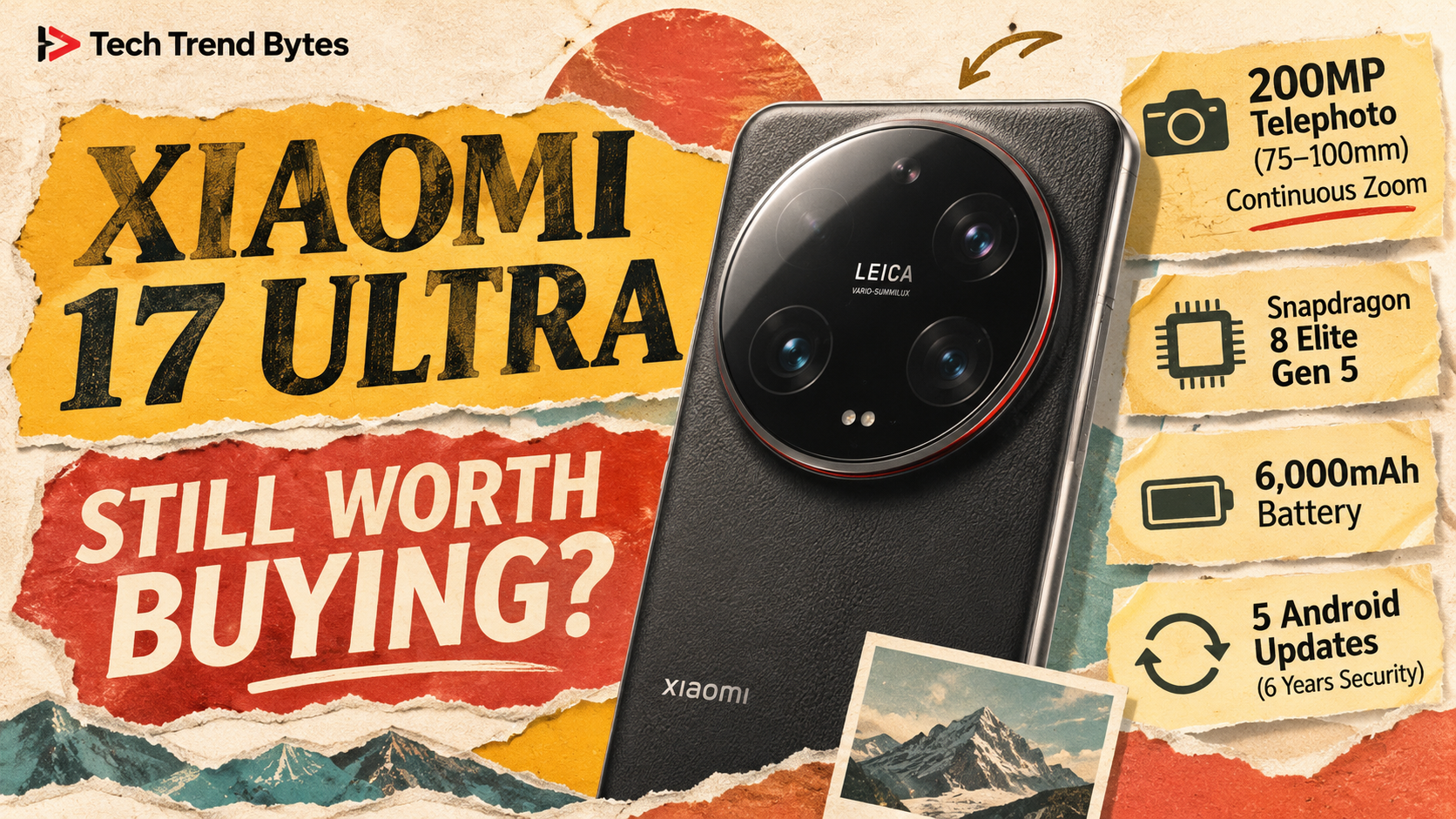
The Xiaomi 17 Ultra has a 200MP telephoto that zooms smoothly between 75mm and 100mm, a 1-inch main sensor and a 6,000mAh battery. Reviewers rated the camera system among the best on any phone when it arrived.
It has now been on sale for about eight months, and a newer Xiaomi 18 series already exists. So the question is no longer whether it is good. It is whether it is still the right flagship to buy.
Here is what the reviews found, where they disagree, and who should buy, wait or skip.
The Short Version
- Best part: The camera system, especially the continuous optical zoom
- Battery: Lasts a full day of heavy camera use, according to 91mobiles
- Chip: Snapdragon 8 Elite Gen 5, fast with no slowdown after two months, per Digit
- Catch 1: Software support is shorter than Google’s and Samsung’s
- Catch 2: It is heavy and thick, so long one-handed use gets tiring
- Catch 3: Reviewers disagree on whether its battery beats the Galaxy S26 Ultra
- Verdict: Buy it for photography. Skip it if you want the longest software support
What the Xiaomi 17 Ultra Actually Is
The Xiaomi 17 Ultra is a camera phone first. Xiaomi built the whole phone around the camera, and the large round module on the back makes that obvious.
In Digit’s long-term review, the specs read like this:
- Display: 6.9-inch LTPO OLED, 120Hz, 3,500 nits peak
- Chip: Snapdragon 8 Elite Gen 5, with 16GB RAM and 512GB storage
- Battery: 6,000mAh silicon-carbon, 90W wired, 50W wireless
- Build: 8.29mm thick, about 218g, IP68 rating
Digit’s reviewer used the phone daily for more than two months. That matters, because it is a longer test than most launch reviews.
The Camera Is the Reason to Buy It
The main camera is a 50MP sensor, one inch in size, with a Leica-tuned lens. Digit calls its daylight results crisp and natural, with strong low-light performance too.
The telephoto is the real trick. It is a 200MP sensor with continuous optical zoom from 75mm to 100mm. Most rivals jump between fixed lenses instead.
According to Digit, digital zoom still holds up at 8.6x. By 17.2x, though, the pictures look soft. That is a fair limit for a phone, and it is honest to say so.
The ultrawide is the weak link. It is sharp in good light but drops off clearly in dim scenes, Digit found.
The 50MP selfie camera has autofocus. Digit says it struggles in harsh sun and dim rooms, which is a small flaw next to the rear setup.
91mobiles agrees with the overall picture. It rates the phone 8.7 out of 10 and calls it “unapologetically a camera-first flagship”. Its reviewer shot more than 500 photos on a week-long trip and found the cameras as good as advertised.
We have not tested this phone ourselves. These findings come from the two reviews we link here.
Battery Life: Strong, but the Reviews Disagree
The battery is the surprise. At 6,000mAh, it is smaller than some rivals. Even so, 91mobiles reports about 50 percent left after a full day of heavy camera use in hot weather.
It also reports 8 to 9 hours of screen-on time. Digit measured 7 to 8 hours, which is lower but still a full day.
The charging is good too. 91mobiles says 20 to 100 percent took under 40 minutes, and a 100W charger comes in the box. Digit puts 1 to 100 percent at about 45 minutes. Wireless charging runs at 50W, though Digit says that charger is sold separately.
Here is the 91mobiles battery test, which runs from 100 to 20 percent:
Phone | Battery | PCMark battery test |
|---|---|---|
vivo X300 Pro | 6,510mAh | 16.0 hours |
OPPO Find X9 Pro | 7,500mAh | 16.0 hours |
Xiaomi 17 Ultra | 6,000mAh | 15.5 hours |
Samsung Galaxy S26 Ultra | 5,000mAh | 14.4 hours |
Now the disagreement. Digit ran its own PCMark test and got 20 hours 54 minutes for the Xiaomi. It puts the Galaxy S26 Ultra slightly ahead at 21 hours, and the vivo X300 Ultra well ahead at 24 hours.
So one outlet says the Xiaomi beats the Samsung, and the other says it trails slightly. The two tests may use different settings, so the numbers cannot be compared directly.
The fair reading is simple. The battery is among the best in this class, and it is not clearly number one. That is the first catch.
Speed and Software
The Snapdragon 8 Elite Gen 5 is a top chip. Digit recorded an AnTuTu score of about 3.78 million. 91mobiles measured over 3.6 million on its unit and noted the Galaxy S26 Ultra scored higher, above 3.9 million.
Real use matters more than scores. Digit says gaming and daily use felt smooth, with no noticeable slowdown by day 60.
There is one cooling note. Digit found that the phone reaches its limit during long video recording while other tasks run at the same time. Most people will never hit that.
Software is the second catch. Digit lists five major Android upgrades and six years of security patches. That is decent, but Digit and 91mobiles both say it trails what Google and Samsung offer.
If you keep phones for five or six years, this is the point that matters most.
The Catches in Plain Words
Three things hold this phone back:
1. Support length: Rivals promise longer updates, so the Xiaomi ages out sooner.
2. Weight and thickness: 91mobiles calls it heavy and bulky for long use. Digit also notes that the photography grip is an optional extra.
3. Unclear battery lead: It is great, but not the clear winner the spec sheet suggests.
None of these ruins the phone. All of them are real, and a buyer should weigh them against a camera that reviewers rank so highly.
Also note a spec mismatch. Smartprix’s listing shows a 6,800mAh battery and a 230g weight. Digit and 91mobiles both report 6,000mAh and about 218g for the Indian unit. We used the reviewers’ figures, since they tested the phone.
How It Compares With Its Rivals
Here is how the Ultra sits against the phones most buyers cross-shop. All figures come from the reviews above and 91mobiles’s price pages.
Xiaomi 17 Ultra | Galaxy S26 Ultra | vivo X300 Ultra | |
|---|---|---|---|
Strength | Zoom camera, battery | Software support, polish | Battery, camera |
Weakness | Update length, weight | Smaller battery (5,000mAh) | Price |
Listed price | Rs 1,39,999 | Not checked for this piece | Rs 1,59,999 |
For the Samsung side of this fight, read our Galaxy S26 Ultra verdict. For Apple, see our iPhone 17 Pro Max verdict. For the cleanest Android software, see our Pixel 11 verdict.
Should You Wait for the Xiaomi 18 Pro?
Xiaomi’s next flagship is already out in China. We covered its leaked global changes in our Xiaomi 18 Pro global launch post. Leaked EU energy labels show a smaller 6,000mAh battery in the global model, against 7,000mAh in China.
That is a leak, not a final spec. It does show that newer does not always mean a bigger battery.
The 18 Pro is also a different phone. It has a 6.4-inch screen, so it is more compact. The Ultra is the one with the large 1-inch sensor and the long zoom.
If you want the best zoom today, the 17 Ultra is the better fit. If you want a smaller phone, waiting for the 18 Pro makes sense. For how Android updates are shaping up, our Android 17 update guide shows which brands lag.
What It Costs in Rupees
This section is for buyers in India. Prices change often, so these were checked on 18 November 2026.
91mobiles lists the Xiaomi 17 Ultra at Rs 1,39,999 for the single 16GB and 512GB model, at both Amazon and Croma. That matches the launch price Digit and 91mobiles quote.
Smartprix lists a lower starting price of about Rs 1,08,861 on the same date. We could not confirm that this is a real, in-stock deal in India. Its page also carries the mismatched 6,800mAh spec, so treat it with caution.
Check the live listing before you pay. If a verified price near Rs 1,10,000 to Rs 1,15,000 exists, the phone becomes a much better buy than at Rs 1,39,999.
At the full tag, 91mobiles says it competes head-on with the Galaxy S26 Ultra and the iPhone 17 Pro. The vivo X300 Ultra, listed at Rs 1,59,999, costs Rs 20,000 more.
Who Should Buy, Wait or Skip
Buy it if you shoot a lot of photos and video and want real zoom. Digit recommends it mainly to photographers and videographers, and we agree.
Buy it if you want a battery that lasts through a heavy day, and you charge often enough that updates beyond five years do not matter.
Wait if you want a smaller phone, or you want to see the final Xiaomi 18 Pro price and battery before spending this much.
Skip it if you keep phones for six years or more and software support is your top priority. Samsung and Google promise longer.
Skip it if you hate heavy phones. 91mobiles flags the bulk, and Smartprix lists it at 230g.
Quick Answers
Is the Xiaomi 17 Ultra still worth buying?
Yes, for photography. The camera and battery reviews still hold up eight months on.
How long will it get updates?
Digit lists five major Android upgrades and six years of security patches.
Is its battery better than the Galaxy S26 Ultra’s?
It depends on the test. 91mobiles says yes, and Digit says it is slightly behind.
Is the 17 Ultra better than the 18 Pro?
They suit different people. The Ultra has the bigger sensor and the longer zoom, and the 18 Pro is more compact.
The Bottom Line
The Xiaomi 17 Ultra is still one of the best camera phones you can buy. The zoom is its signature, and the battery is strong enough to remove daily worry.
The catches are shorter software support, a heavy body and a battery lead that is not proven. If those do not bother you, buy it, ideally below the full launch price.
What we do not know yet is how the 18 Pro will land outside China, or whether the 17 Ultra’s price will fall further. We have not held either phone, so this verdict rests on the reviews and listings linked above.
Sources: Digit long-term review, 91mobiles review and price page, 91mobiles battery test, Smartprix listing.
Read next
Is the One UI 9.5 Beta Worth It? Big Warning Here
The One UI 9.5 beta is open in India for the Galaxy S26 series. See new features, how to join, and why going back wipes your phone.
Xiaomi 17T Price Is Now Rs 64,990: The Painful Truth About the Rs 5,000 Hike You Need to Know
The Xiaomi 17T price is Rs 64,990 on Amazon India, up from Rs 59,999 at launch. See what changed, and who should buy, wait or skip.
vivo V80 Price Hike: Why Rs 62,999 Is the Last Good Price You Need to Grab Now
The vivo V80 price hike reportedly adds Rs 5,000, taking it to Rs 67,999. Stores still show Rs 62,999. Here is who should buy now, wait or skip.