
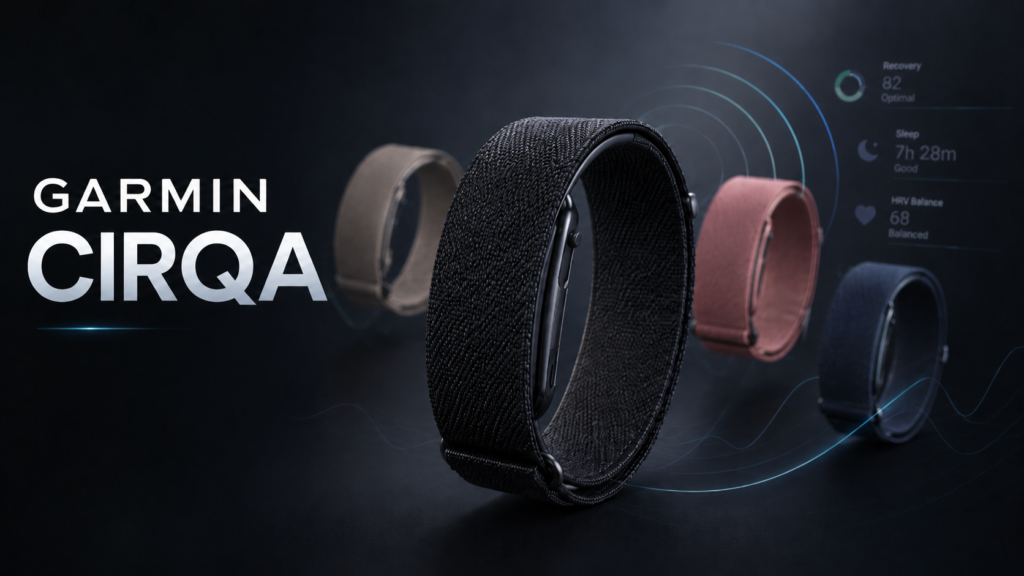

Garmin Cirqa is Garmin’s first screen-free smart band. It tracks health and fitness data around the clock, works with Garmin Connect, lasts up to 10 days on a charge, and does not require a subscription. Garmin announced it on July 21, 2026, with a suggested retail price of $199.99.
That puts it directly in the growing space between Fitbit and Whoop.
Fitbit is chasing simpler screen-free tracking. Whoop is known for recovery-first coaching and subscriptions. Garmin is now entering with something different: fitness credibility, long battery life, and no mandatory monthly fee.
What Is Garmin Cirqa?
Garmin Cirqa is a screen-free smart band made for 24/7 health monitoring and fitness tracking.
There is no display on the band. You do not check your steps, heart rate, or sleep score on your wrist. Instead, the data goes into the Garmin Connect app.
Garmin says Cirqa provides advanced health monitoring and fitness features with no subscription required. It also claims up to 10 days of battery life between charges.
Reports say that Cirqa uses heart rate, blood oxygen, skin temperature, and motion sensors to track your health and activity. It also says the band can be worn on the wrist or as an armband.
That makes the product simple to understand.
Cirqa looks simple on your wrist.
But the real experience lives inside Garmin Connect.
Why Fitbit And Whoop Should Pay Attention
Garmin Cirqa matters because it enters a category that was already heating up.
Screen-free fitness trackers are no longer a strange idea. They are becoming a real alternative for people who want health data without a smartwatch screen.
Whoop made this type of wearable popular among recovery-focused users. Fitbit Air is targeting the simpler, lower-cost side of the market. Garmin Cirqa enters from a different position.
Garmin already has strong trust among runners, cyclists, outdoor users, and serious fitness buyers.
People know Garmin for sports watches, GPS devices, training data, and long battery life. So when Garmin makes a screen-free fitness tracker, it does not feel like a random experiment.
It feels like Garmin is answering a new question:
What if users want Garmin health data without wearing a Garmin watch?
Why Screen-Free Fitness Trackers Are Having a Moment
People still want health data.
They want to know how they slept.
How recovered they are.
Stress level indications.
How active they were.
Whether their body is improving or warning them to slow down.
But not everyone wants another screen.
For some users, a smartwatch becomes another device asking for attention. It buzzes during work and lights up during rest. It turns fitness tracking into one more interface to manage.
That is why screen-free devices are becoming interesting.
Smart rings, Whoop-style bands, and now Garmin Cirqa all point toward the same idea:
Health tracking does not always need to look like a smartwatch.
This connects with a wider shift in consumer tech.
People are still buying technology. But they are also becoming more careful about how much attention that technology takes.
They just do not always want another device asking to be checked.
What Garmin Cirqa Tracks
Garmin’s product page lists 24/7 health monitoring and fitness features, including Body Battery, stress tracking, Pulse Ox, women’s health tracking, and heart-rate broadcasting to compatible Garmin devices.
Useful tracking areas include:
- heart rate and stress
- Pulse Ox and skin temperature
- sleep and recovery-style insights
- activity tracking
- women’s health tracking
- heart-rate broadcasting to Garmin devices
That last point is especially useful for people already inside the Garmin ecosystem.
For example, if you use a compatible Garmin cycling computer, Cirqa can broadcast your heart rate so you can view it during an activity.
That gives Cirqa a role beyond casual tracking.
It can become a quiet health band for daily use, while still connecting to other Garmin devices when needed.
Garmin Cirqa vs Fitbit Air vs Whoop: The Simple Difference
The screen-free tracker category can get confusing fast.
So here is the simple version.
Feature | Garmin Cirqa | Fitbit Air | Whoop 5.0 |
|---|---|---|---|
Main appeal | Garmin-style tracking without a screen | Simpler budget screen-free tracking | Recovery-first coaching |
Price model | $199.99, no required subscription | Lower upfront price, optional premium | Hardware tied to membership |
Battery | Up to 10 days | Around 7 days | Around 14 days |
Screen | No | No | No |
Best for | Garmin users and screen-free health tracking | Budget-focused users | People who want subscription coaching |
No Required Subscription May Be Garmin’s Biggest Weapon
One of Garmin Cirqa’s strongest features may not be a sensor.
It may be the pricing model.
Garmin says Cirqa does not require a subscription. And subscription fatigue is real.
People already pay for music, video, cloud storage, productivity apps, AI tools, news, fitness apps, and more. Adding another monthly or yearly fee for health data can feel tiring.
Whoop’s model is strongly linked to membership. That works for users who want deep recovery coaching and are comfortable paying continuously. But it also creates a mental barrier for people who dislike subscription-first hardware.
In 2026, “no subscription required” is starting to sound like a feature, not a footnote. And this could be Garmin’s biggest advantage.
Not because subscriptions are always bad.
But because buyers want choice.
What You Gain By Losing the Screen
A screen-free tracker gives you less to look at.
You gain a quieter experience. There are fewer alerts. Fewer quick checks. Fewer small moments where your wrist pulls your attention away.
That is the emotional appeal of Cirqa.
What you gain:
- fewer distractions
- better sleep comfort
- longer battery life
- freedom to wear a normal watch
- health tracking without smartwatch overload
What You Lose Without the Screen
Of course, no screen also means real tradeoffs.
You cannot glance at workout stats.
Or see pace mid-run.
Nor can you control music from the band.
You have to open Garmin Connect to see most of your data.
That is fine for sleep and recovery. It is less ideal during a run, ride, or gym session where you want live feedback.
A screen-free tracker gives you less distraction, but also less control in the moment.
So if you want maps, live pace, music, running power, workout screens, or full smartwatch functions, a Garmin watch may still be the better choice.
Is Garmin Cirqa Good for Runners and Gym Users?
For runners, the missing onboard GPS matters.
If you want route tracking, pace, splits, training plans, and live workout screens, you will probably still want a Garmin Forerunner, Venu, Fenix, or similar watch.
But Cirqa could still be useful for runners who want background health data, sleep trends, Body Battery, stress tracking, and heart-rate broadcasting to compatible Garmin devices.
For gym users, the screen-free design may be more appealing.
A bulky watch can get annoying during lifting, boxing, kettlebell work, or machines. A simple band may feel less distracting.
That just means you should buy it for the right reason.
The Real Screen Is Garmin Connect
A good screen-free tracker needs a strong app because users cannot check data directly on the device.
Garmin Connect has to explain:
- sleep trends
- stress
- Body Battery
- activity
- health patterns
- recovery signals
The hardware disappears into your routine. The app becomes the place where you understand what your body is doing.
With no display, Garmin Connect becomes the real screen.
That is why the app experience matters as much as the band itself.
Health Data Is Useful, But It Still Needs Caution
Fitness trackers can be helpful.
They can show patterns. Help motivate you. They can help you notice changes in sleep, stress, heart rate, or activity.
But data can vary based on fit, sensor contact, skin tone, movement, sweat, device position, activity type, and how the algorithm interprets signals.
A 2026 study found that common smartwatch devices misestimated caloric expenditure compared with indirect calorimetry, and that error varied with factors such as body fat.
That does not mean wearable data is worthless. It means you should treat it carefully.
Use it to understand trends and build habits.
Use it to notice changes.
But do not panic over one score. Do not treat every number as medical truth. And do not ignore symptoms just because your tracker says things look normal.
Should You Buy Garmin Cirqa or Wait?
Garmin Cirqa will make sense for some people.
Cirqa is strongest if you want data without distraction.
It is less ideal if you want a full training device on your wrist.
That is the main difference.
Garmin Cirqa makes the most sense if you want fitness data without smartwatch behavior.
What Garmin Cirqa Says About the Future of Wearables
Garmin Cirqa is not just a new fitness band. It is part of a bigger shift.
The future of wearables may not only be bigger screens, brighter displays, and more notifications.
It may also be:
- less screen
- more sensors
- longer battery
- quieter tracking
- fewer subscriptions
- health data without attention drain
It joins the same wider movement as smart rings and screen-free bands. People want devices that work quietly in the background.
While some people will still want smartwatches, they are powerful and useful.
Others might want useful data, but not constant interruption.

