

For years, wearable tech meant something on your wrist.
A smartwatch. A fitness band.
But the next wearable that matters may not sit on your wrist at all. It may sit quietly on your finger.
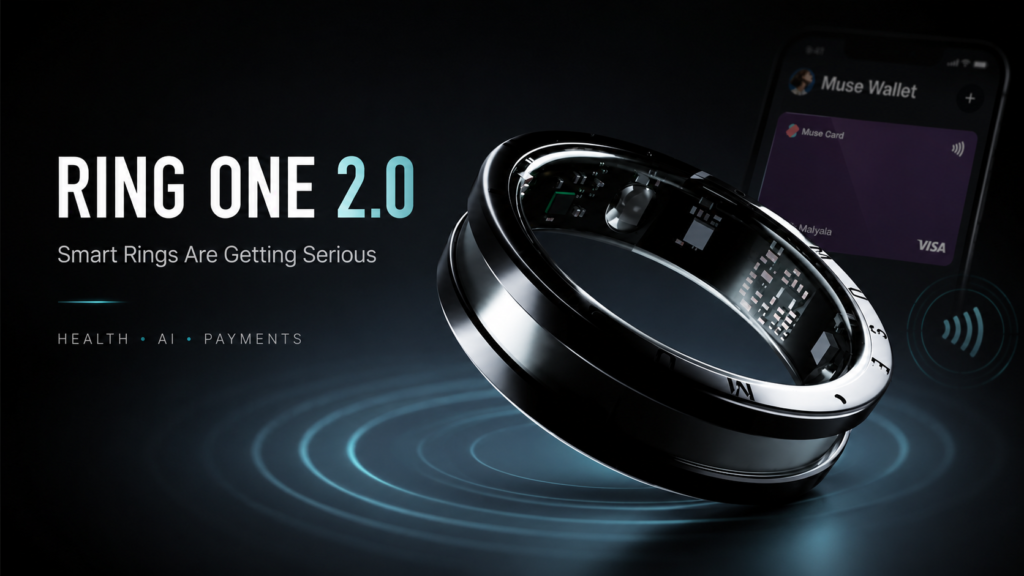
That is why Ring One 2.0 is worth watching. Muse Wearables says the new smart ring is launching on August 4 on Indiegogo, with health tracking, AI features, payments, and a focus on comfort and style.
But the bigger story is not only about one product.
Ring One 2.0 shows where smart rings are going. They are no longer trying to be tiny sleep trackers only. They are trying to become health devices, payment tools, AI assistants, and screen-free wearable companions.
Ring One 2.0 Is the Latest Sign That Smart Rings Are Growing Up
Ring One 2.0 comes from Muse Wearables, an IIT-Madras-incubated startup connected to the earlier Ring One smart ring.
The company’s launch page describes Ring One 2.0 as a smart ring refined for quality, powered by AI, and built to help users track health, pay effortlessly, and live better every day. It also says the product is launching on Indiegogo on August 4.
Ring One 2.0 is being positioned around three big ideas:
Ring One 2.0 focus | Why it matters |
|---|---|
Health tracking | Makes the ring useful every day and night |
AI insights | Turns raw health data into guidance |
Payments | Makes the ring a daily convenience tool |
This is why Ring One 2.0 feels more interesting than a normal wearable launch.
It is saying, “What if your ring could track your body, guide your habits, and help you pay?”
What Are Smart Rings?
A smart ring is a wearable device that sits on your finger and uses tiny sensors to collect health, activity, or interaction data.
Most smart rings can track things like:
- sleep
- heart rate and HRV
- temperature trends
- activity and recovery
- sometimes payments or gestures
The finger is a useful place for this kind of tracking. A 2025 systematic review on smart rings notes that fingers have many blood vessels and nerve endings, and people are already used to wearing rings. That makes the finger a strong location for continuous health monitoring in a comfortable form.
That is the main appeal.
A smartwatch is visible.
A fitness band feels sporty.
A smart ring feels more natural.
Why Smart Rings Are Becoming Popular Now
Smart rings are becoming popular because people still want health data, but not everyone wants another screen.
A smartwatch is powerful. It can show messages, calls, maps, workouts, music controls, apps, and alerts. But that also means it can become another device asking for attention.
A smart ring does not become a mini phone.
It quietly collects data in the background.
Battery life also helps. Wired’s smart ring guide notes that many current smart rings can last around five to eight days on one charge, which is longer than many smartwatches.
Smart Ring vs Smartwatch: What Actually Changes?
Feature | Smart ring | Smartwatch |
|---|---|---|
Screen | No screen or very limited interface | Full display |
Sleep comfort | Usually easier to wear overnight | Can feel bulky |
Battery life | Often longer | Often shorter |
Workout use | Better for passive tracking | Better for live workout data |
Notifications | Minimal or none | Strong |
Payments | Depends on model and region | More common |
Style | Discreet, jewelry-like | More visible |
This comparison does not make one better than the other. It means they solve different problems.
A smartwatch is better if you want calls, maps, music controls, workout screens, apps, and real-time stats.
A smart ring is better if you want a lighter device that tracks health without pulling your eyes to a screen.
Where Smart Rings Are Actually Better
Smart rings are strongest when the tracking is passive.
They are especially useful for sleep, recovery, and daily health trends.
That is because you do not need to interact with the ring constantly. You wear it, sleep with it, move through your day, and then check the app when you want to understand the pattern.
This is why smart rings make sense for people who care about:
- sleep quality
- recovery trends
- stress patterns
- resting heart rate
- body temperature changes
Smart rings also feel less distracting than smartwatches. There is no big screen. No constant notification panel. No temptation to check messages from your wrist.
That makes them interesting in a time when many people want technology that helps without interrupting too much.
Where Smart Rings Still Fall Short
Smart rings are promising, but they are not perfect. They still have clear limits.
If you are running, cycling, navigating, taking calls, controlling music, or checking workout zones, a smartwatch is usually better.
Smart rings can also struggle with sizing.
A watch strap can be adjusted easily. A ring must fit well. Your finger size can change with heat, exercise, salt intake, sleep, and weather. If the fit is poor, comfort and sensor accuracy can suffer.
There is also the health accuracy question.
Smart rings can be useful for trends, but they should not be treated as medical devices unless they are cleared and tested for that purpose. Consumer health data can guide you, but it should not replace medical advice.
Smart rings are great at passive tracking. They are not always great at active control.
Why Payments Make Ring One 2.0 More Interesting
Payments are where Ring One 2.0 becomes especially interesting.
Most smart rings focus mainly on health.
Ring One’s story is more ambitious because Muse has pushed payments as a key feature of the product line.
Muse’s FAQ says Ring One combines health tracking with NFC payment convenience. It also explains that card details are tokenized in the Muse app, and only a secure token, not the actual card details, is stored on the ring through Bluetooth.
A report said users could add a RuPay credit or debit card in the Muse app and make payments by tapping the ring.
Imagine entering a store and paying with a ring instead of pulling out your phone, card, or wallet.
That sounds convenient. But it also needs serious clarity.
Before trusting payment claims, buyers should ask:
Question | Why it matters |
|---|---|
Which banks are supported? | Payment features are useless if your bank is not included |
Which countries support it? | Payment systems vary by region |
Does it work without your phone? | This affects daily convenience |
How do you disable payments? | Important if the ring is lost |
Is the payment secure? | Health data and money both need protection |
The AI Part Needs a Reality Check
Ring One 2.0 is being marketed as powered by AI.
That sounds modern, but readers should look beyond the word “AI.”
AI in a smart ring only matters if it helps you make better decisions.
A useful AI health feature should not just give vague scores. It should explain what your data means in a way you can act on.
Wearables already collect a lot of numbers. Heart rate, HRV, sleep stages, temperature, readiness, stress, oxygen levels, activity, and more.
The problem is not only collecting data. The problem is making it useful.
The App May Matter More Than the Ring
A smart ring has no proper screen. So the app becomes the product interface.
A good smart ring app should:
- explain health trends simply
- avoid overwhelming you with random numbers
- show what changed and why it matters
- give practical suggestions
- respect your privacy and data control
A ring that gives you ten health scores but no clear explanation may create more confusion than value.
A ring that gives simple, honest, helpful guidance can become part of your routine.
So when people evaluate Ring One 2.0, they should not only look at the hardware.
They should look at the app, insights, payments setup, privacy settings, and long-term reliability.
The Crowdfunding Catch Buyers Should Not Ignore
Ring One 2.0 is launching on Indiegogo.
Crowdfunding is not the same as buying a finished product from a regular store.
When you buy from normal retail, you usually expect fixed delivery, clear warranty, tested hardware, reviews, return options, and customer support.
Crowdfunding is different.
You may get early pricing, but you also accept more uncertainty.
Timelines can change.
Features can change.
Shipping can take longer.
Support can be harder.
Final performance may differ from marketing claims.
Muse’s earlier Ring One Indiegogo campaign later posted an update saying all campaign orders had been fulfilled and shipped. That is a positive detail to note. But the general point remains true for any crowdfunding product.
A crowdfunding discount is also a risk tradeoff.
So if you are interested in Ring One 2.0, the safer approach is to wait for independent reviews unless you are comfortable backing early.
That does not mean the product is bad. It only means the buying model needs caution.
Is This Useful for India?
India is a very interesting market for smart rings.
That is because smart rings combine two things Indian users already care about:
health tracking and digital payments.
Fitness bands and smartwatches are already common. UPI and card payments are part of daily life. So a ring that can track health and also handle payments has real appeal.
But Indian buyers should still check the practical details before getting excited.
You should look for:
- supported banks and cards
- warranty and service support
- delivery timelines
- app quality
- payment limits and security
- whether features work in your city and daily use case
Should You Buy a Smart Ring Now or Wait?
Smart rings are promising, but you should buy them for what they do well, not what the marketing promises.
For some users, a smart ring makes a lot of sense.
It is quiet, small and comfortable.
It can track health without adding another screen to your day.
For others, a smartwatch is still the better choice.
It depends on whether you want a wearable that shows you things in real time or a wearable that quietly collects data in the background.
What Ring One 2.0 Says About the Future of Wearables
Ring One 2.0 shows that wearable tech is changing. Now the idea is becoming wider.
The next wave of wearables may focus on:
- passive health tracking
- contactless payments
- AI-based insights
- discreet design
- less screen time
It also means companies must earn trust.
Comfort matters.
Accuracy matters.
Security matters.
Privacy matters.
Reliable delivery matters.
If smart rings get these things right, they could become one of the most important wearable categories in the next few years.
Final Takeaway
Smart Rings are no longer just trying to count your sleep hours.
They are trying to track your health, guide your habits, handle payments, and fit into daily life without becoming another screen.
That is exciting.
But it also needs caution.
Smart rings still have limits. They are not perfect for serious workouts, live notifications, or full smartwatch replacement. Sizing matters. App quality matters. Health accuracy needs care. Payment support must be clear.
So the right question is
Are smart rings finally becoming useful enough to matter?
The answer is yes.
They may not replace your watch tomorrow.
But they are already changing what people expect from wearable tech.


