
AI Feels Weightless. Its Data Centers Are Not.

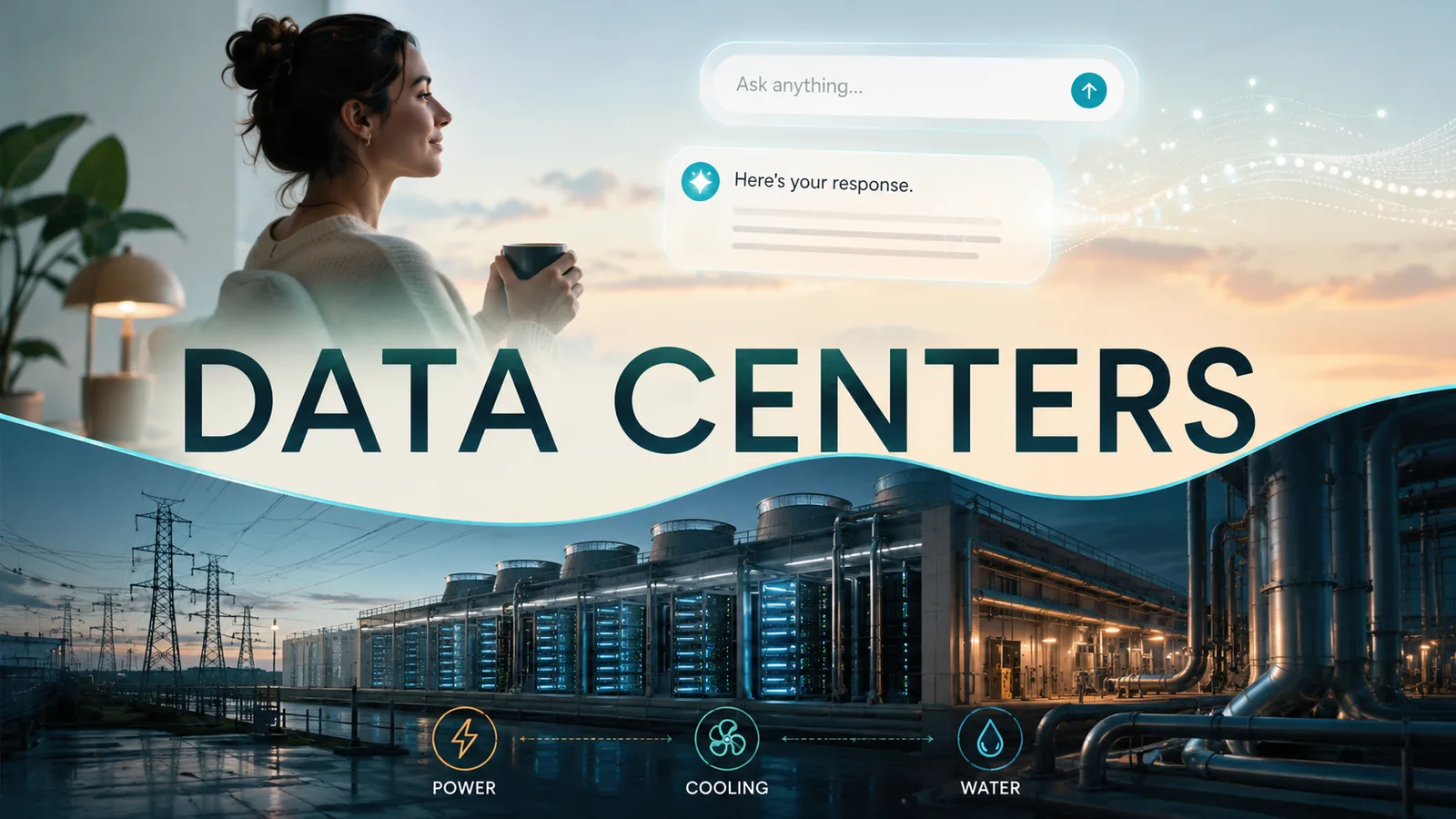
You type a prompt. A few seconds pass. An answer appears on your screen.
It feels clean, smooth, and almost invisible.
But that answer did not come from the air.
It came from a real building filled with servers, chips, cables, cooling systems, backup power, security systems, and workers keeping everything alive.[
The app may live on your phone or laptop, but the work happens somewhere else. It happens inside data centers.
That is the hidden side of AI, one of the most important parts of the modern tech industry.
Your AI Answer Comes From a Real Building
When you ask an AI tool a question, the process feels simple.
But behind that simple moment, a lot happens.
Here is the basic journey:
- You type a prompt into an AI app.
- Your request travels through the internet.
- It reaches servers inside a data center.
- Powerful chips process your request.
- Cooling systems remove the heat produced by those chips.
- The answer travels back to your screen.
This can happen in seconds.
That speed makes AI feel effortless. But it is not effortless. It depends on huge physical infrastructure.
Every AI answer may look weightless to you. But somewhere, electricity is being used, heat is being produced, and machines are doing the work.
What Do Data Centers Actually Do?
Data centers are not new.
Long before ChatGPT, Gemini, Claude, and AI image tools became popular, data centers were already powering the internet.
They helped run websites, email, video calls, banking apps, cloud storage, streaming platforms, maps, online games, and business software.
AI has simply made them more important.
A data center does several things at once:
Function | What it means |
|---|---|
Storage | Keeps files, apps, models, and databases available |
Compute | Runs AI prompts, searches, videos, and cloud tasks |
Networking | Moves data quickly between users and servers |
Cooling | Removes heat from chips and machines |
Backup power | Keeps systems running during outages |
Security | Protects the building, servers, and data |
Its just that AI is now adding a much heavier workload on top of that older digital foundation.
Data centers used to be invisible background infrastructure. Now, because of AI, they are becoming a public issue.
Why AI Data Centers Need So Much Electricity
AI needs compute.
Compute means processing power. And in modern AI, that often means powerful GPUs and AI accelerators running inside data centers.
These chips are designed to handle huge amounts of calculation. That is what allows AI models to generate text, write code, analyze images, summarize documents, and respond to millions of users.
But powerful chips need power.
AI data centers use electricity for:
- GPUs and AI accelerators
- servers
- storage systems
- networking equipment
- cooling systems
- backup power systems
- monitoring and security
Training a large AI model can require huge amounts of compute. But running AI for millions of users also adds up. Even if one prompt feels small, billions of prompts are not small.
The International Energy Agency projects that global electricity consumption from data centers could more than double to around 945 TWh by 2030, representing just under 3% of total global electricity consumption in its base case.
Why Water Becomes Part of the AI Story
Electricity is only one part of the story.
Servers and AI chips produce heat. If that heat is not removed, the machines can slow down, fail, or become unsafe to operate.
So data centers need cooling.
Some data centers use air cooling, others evaporative cooling.
Some use liquid cooling, or a combinations of these methods.
The exact water use depends on many factors:
- location
- climate
- cooling design
- chip density
- electricity source
- building efficiency
- whether recycled or non-potable water is used
So we should be careful here.
Not every data center uses the same amount of water. Some are designed to use very little. Others can use far more, especially in hot regions or water-intensive cooling setups.
But the tradeoff is real.
Saving electricity can sometimes mean using more water.
Saving water can sometimes mean using more electricity.
UN University researchers warned that AI’s rising demand could sharply increase pressure on power, water, land, and climate resources by 2030. Their report says global AI data centers are projected to consume 945 TWh of electricity by 2030 and highlights major water and land footprint concerns.
AI Feels Digital, But the Impact Is Local
AI is global.
You can use the same AI tool from Mumbai, New York, London, Tokyo, or Bengaluru.
But the data centers that power these tools are built in specific places.
A data center may bring investment. It may create jobs. Improve digital infrastructure, and help a region become part of the AI economy.
But local communities may also ask fair questions.
Does it strain our power grid?
Will it affect our water supply?
Will the facility create constant noise?
What about land that could serve another purpose?
Will local people benefit, or will the biggest gains go to tech companies?
These are not anti-technology questions. They are planning questions. That is why communities are starting to care.
Why Some Cities Are Pushing Back
Recent reports say that some authorities are restricting or slowing data center projects amid the AI boom because of concerns around energy use, water resources, land, and community impact. The report noted examples where local backlash and regulatory action have delayed or limited new data center development.
This does not mean data centers should not exist.
Its necessary for the modern internet. They power useful services. They support AI, banking, hospitals, education, cybersecurity, cloud software, and communication.
But the question is changing.
It is no longer only:
Can we build more data centers?
It is also:
Where should we build them, how should they be powered, and who carries the cost?
That is the real debate – planning, transparency, and local accountability.
Why India Should Care About Data Centers
AI, cloud services, fintech, digital public infrastructure, startups, online education, and software exports, all of that needs strong data center infrastructure.
But India cannot only think about apps, models, and startups. It also needs to think about the physical systems behind them.
That means:
- power supply
- grid capacity
- renewable energy
- cooling strategy
- land planning
- water management
- local permissions
- skilled workers
Reports show that India’s power ministry is planning for rising data center demand, with internal estimates projecting data center power requirements at 26 GW by 2032 and 35.7 GW by 2040.
India does not only need more AI startups. It also needs the power infrastructure behind them.
This could bring investment and jobs. But if it is not planned well, it could also put pressure on electricity systems and local resources.
The Hidden Costs People Forget
When people talk about AI’s impact, they often focus on carbon emissions.
But it is not the only hidden cost.
Data centers also involve:
- grid upgrades
- cooling systems
- land use
- construction materials
- backup diesel generators
- transmission lines
- e-waste
- chip replacement
- local noise
- security
- maintenance workers
- community trust
New infrastructure always has tradeoffs.
The real question is whether those tradeoffs are planned honestly.
Can Data Centers Become Greener?
Yes, data centers can become more responsible. But that does not happen automatically.
Greener data centers need better design, cleaner energy, smarter cooling, and clearer reporting.
Its not vague “green AI” branding, its measurable responsibility.
Some possible solutions include:
- renewable power
- better grid planning
- liquid cooling
- heat reuse
- efficient chips
- efficient AI models
- recycled or non-potable water
- smarter data center locations
- shifting workloads away from peak electricity hours
- public reporting on electricity and water use
There is also a second issue.
Efficiency can improve, but total demand can still rise if AI usage grows faster.
This is common in technology. When something becomes cheaper and more efficient, more people use it. That can cancel out some of the savings.
Companies should report power and water use clearly. Governments should plan grids and locations carefully. Data center operators should avoid putting heavy infrastructure in places that cannot support it.
The goal should not be less AI, but better AI infrastructure.
What This Means for You as an AI User
The point is not to stop using AI, not at all. It is to understand that AI is not weightless.
As users, we should ask better questions:
- Who powers the AI tools we use?
- Are companies transparent about energy and water use?
- Data centers built responsibly?
- Local communities included in planning?
- Are AI models becoming more efficient?
- Companies using clean energy in a meaningful way?
- Are governments planning before demand becomes a crisis?
The future of AI should not only be faster models, smarter chatbots, and better tools.
It should also be responsible infrastructure.
Because if AI becomes part of daily life, then its physical footprint becomes part of daily life too.
Final Takeaway
Data centers are the hidden body behind every AI answer.
They power tools we use every day. They support the internet, cloud services, business software, and now the AI boom.
But they also need power, water, chips, cooling, land, planning, and trust.
The future of AI will not be shaped only by smarter models.
It will also be shaped by how responsibly we build the infrastructure behind them.
AI does not float in the cloud. It runs on land, power, water, chips, cables, workers, and cooling systems.
If AI is going to become part of daily life, the world must build its infrastructure with the same care that it builds the models themselves.
Read next

The Best Laptops Under Rs 50,000: How to Get 16GB RAM for Less
We checked live prices on laptops under Rs 50,000. One 16GB MSI costs Rs 43,219, less than its 8GB twin. Here is what to buy and what to skip.

All 9 RTX Spark Laptops Ranked: Best and Worst Value
We ranked all 9 RTX Spark laptops on price, battery and game support. Buy the ASUS ProArt, skip the Dell XPS 16, and gamers should wait.

Apple October 28 Event: Will You Pay More Money Now?
The Apple October 28 event is confirmed, with a touchscreen MacBook Pro tipped. See the IST time, India prices and whether to buy a Mac now or wait.