
AI Tools in 2026: Adoption, Growth & Performance

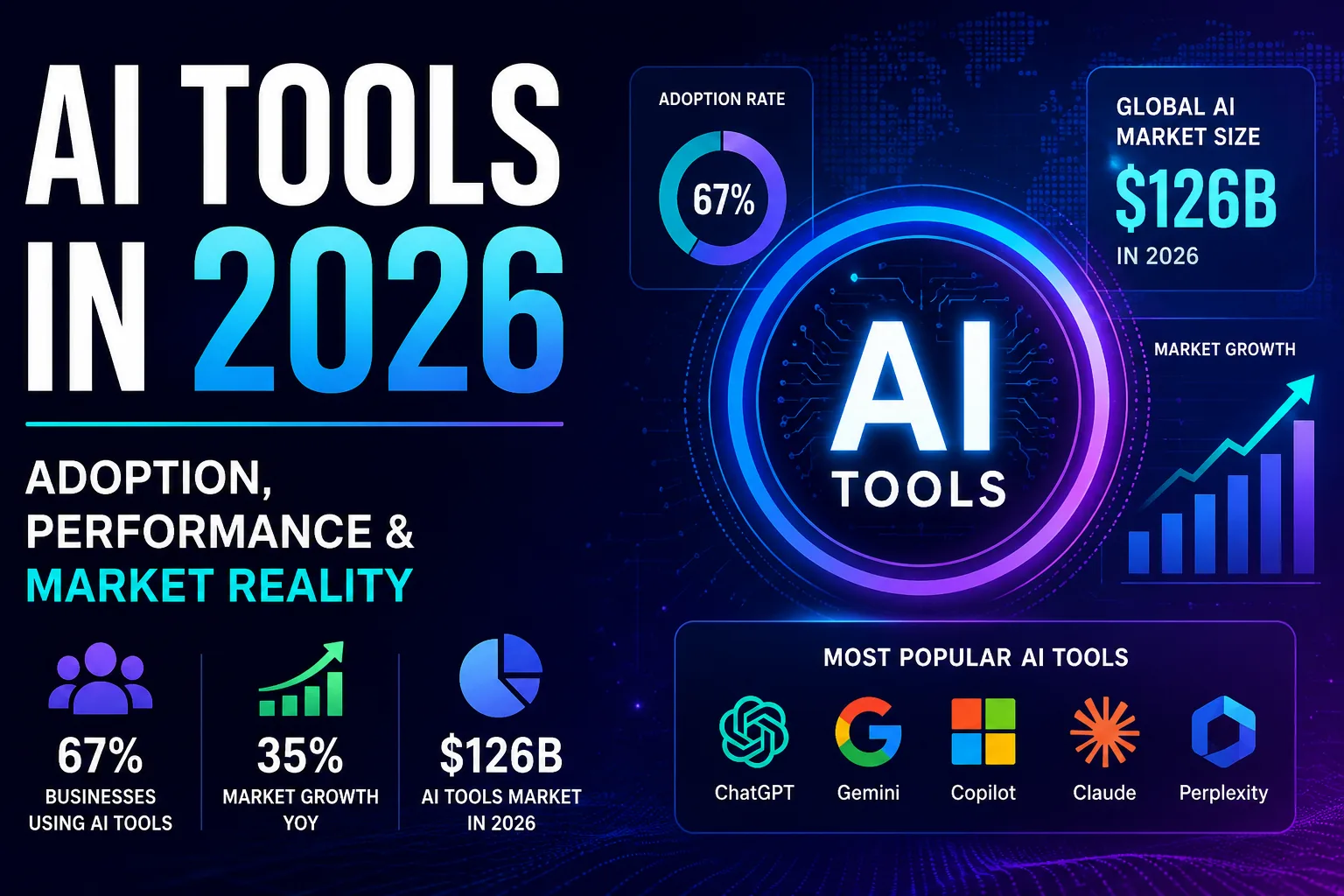
When 88% of organizations report using artificial intelligence in at least one business function, you’d think the future of AI was already written. But dig deeper into the data, and a different story emerges—one that reveals a massive gap between deployment and actual results.
The 2026 AI market has reached a critical inflection point. Adoption has moved from experimental technology to standard business practice. Yet paradoxically, only 6% of organizations are capturing significant business value from their AI investments. Understanding this gap matters for anyone evaluating AI tools or planning enterprise deployment.
The Adoption Paradox: Why Ubiquity Doesn’t Equal Value
The numbers initially seem impressive. Roughly 88% of organizations use AI in at least one business function as of 2026. 72% of enterprises have at least one AI workload in production as of Q1 2026. These figures suggest AI has achieved mainstream status.
The reality tells a darker story. Only about 6% qualify as high performers that attribute significant company-wide profit to their AI use. More concerning, estimates range from 80% to 95% of AI projects fail to deliver business value. This failure rate exceeds typical software implementation failures and indicates systemic problems beyond tool selection.
What changed between deployment and value capture? The answer lies in organizational capability, not technology. 52% of businesses cite data quality and availability as the biggest barriers to AI adoption. Gartner predicts organizations will abandon 60% of AI projects unsupported by AI-ready data by 2026. The bottleneck isn’t the tools—it’s the foundational work required to use them effectively.
Consumer Adoption: Explosive Growth With Modest Monetization
Consumer-facing AI tools show different patterns. ChatGPT reached 900 million weekly active users by late March 2026, up from 400 million in February 2025. This doubling of users in just fourteen months represents one of the fastest technology adoption curves in history. Generative AI reached 53% global population adoption within three years of its mass-market launch, outpacing the adoption curve of the personal computer and the internet over comparable timeframes.
Yet monetization remains constrained. ChatGPT has 50 million consumer subscribers plus 1 million+ business customers, which represents only a 5% conversion rate on weekly active users. This suggests that while awareness is near-universal, paid adoption concentrates among professionals and power users.
Developer Adoption: High Penetration, Declining Confidence
Developer adoption shows a different trajectory. 84% of developers use or plan to use AI tools, with 51% of professionals using them daily. This near-universal adoption among developers contrasts sharply with general workforce numbers.
However, quality concerns are rising. Only 29% of developers trust the accuracy of AI-generated code output, down from 40% in 2024, and 46% actively distrust it. This declining trust despite increasing usage suggests familiarity is breeding skepticism rather than confidence. GitHub Copilot reached 20 million users by July 2025, deployed at 90% of Fortune 100 companies, indicating enterprise confidence in the tool even as individual developers question its reliability.
Enterprise Deployment: Wide Adoption, Shallow Implementation
The enterprise story shows adoption without depth. The average enterprise runs 4.2 AI models in production, up from 1.9 in 2023. This growth indicates expanding AI use, but also fragmentation across multiple platforms rather than strategic consolidation.
Maturity remains limited. Only 28% of enterprises describe their AI adoption as “mature” with embedded AI across multiple business functions. This means 72% of enterprises—despite having AI deployed—remain in experimental, pilot, or early-stage phases. The gap between “we have AI” and “AI is embedded in how we work” remains vast.
Large enterprises lead in deployment. 83% of companies with 5,000+ employees have deployed AI, compared to 42% of firms with 50–499 employees. This 41-point gap reveals that AI adoption remains stratified by organizational size and resources. Small to mid-sized businesses, which constitute the majority of the economy, are substantially less advanced in AI adoption than headline statistics suggest.
The Productivity Paradox: Gains Exist, But Widely Scattered
Productivity improvements from AI are real, but inconsistently distributed. Employees using AI report an average 40% productivity boost, with controlled studies showing 25-55% improvements depending on the function. Harvard Business School research provides more granular findings: workers completed tasks 25.1% faster with over 40% higher quality output when using AI.
Yet when measured across complete workflows, the impact shrinks. Workers using generative AI saved only 5.4% of their total work hours on average. This discrepancy is instructive—task-specific productivity jumps don’t translate proportionally to overall time savings when measured across complete jobs. AI accelerates discrete activities but hasn’t fundamentally redesigned how work gets done.
Professional adoption shows demographic stratification. 27% of white-collar employees now use AI regularly at work, up from 15% in 2024. This rapid growth creates workplace dynamics where AI-proficient workers operate at higher productivity levels than non-users, potentially widening performance gaps within organizations.
Spending Continues Despite High Failure Rates
Organizations are doubling down on AI investment despite knowing that most projects fail. Global AI spending in 2026 is forecast to surpass $300 billion in software, hardware, and services combined. $2.52 trillion in worldwide AI spending is forecast for 2026, a 44% year-over-year increase.
This spending concentration reveals enterprise strategic thinking. Companies with $500 million or more in revenue are adopting AI at a faster pace than smaller firms. Large enterprises view AI as essential infrastructure despite implementation challenges, suggesting they’re betting on eventually solving deployment problems rather than reconsidering the technology itself.
Industry-Specific Adoption: Healthcare Leads, Retail Accelerates
Adoption velocity varies significantly by sector. Healthcare demonstrates measurable business impact. 80% of healthcare professionals report that AI has increased revenue in their organizations, and 45% saw measurable gains within a year. Clinical applications drive adoption—AI for diagnostics, imaging analysis, and predictive analytics show concrete ROI.
Marketing shows near-saturation adoption. 87% of marketers use generative AI in at least one workflow, with 62% citing content creation as the leading use case. Yet production workflow integration remains incomplete—organizations haven’t proportionally reduced team sizes or costs, suggesting AI functions as an enhancement tool rather than a replacement. AI Business
Retail spending is accelerating. Nearly 97% of retailers plan to increase spending on AI in the coming year, with the global AI in retail market projected to reach USD 20.63 billion in 2026 and grow to USD 131.66 billion by 2031.
The Workforce Impact: Skills Premium and Displacement Concerns
Labor market dynamics are shifting rapidly. Employees using AI see revenue growing three times faster, wages rising twice as quickly, and AI-skilled workers earning a 56% wage premium. This premium reflects urgent organizational demand for AI-proficient staff.
Simultaneously, displacement concerns materialize. Roughly 6–7% of the US workforce could be replaced by widespread AI adoption, with 40% of employers planning to cut staff in areas where AI can automate tasks. The timeline gap between displacement and new role creation creates labor market instability that will characterize the next 2-3 years.
Geographic Variation: Adoption Concentrates in Developed Economies
AI adoption remains stratified by economic development. The UAE leads with 64% of working-age adults using AI tools, while Singapore follows at 60.9%. These highly digitized economies show adoption rates that dwarf less developed regions. This geographic concentration suggests that AI advantages will accrue unevenly across the global economy, potentially widening economic disparities.
Conclusion: Deployment Is No Longer the Constraint
The 2026 AI statistics reveal a market that has resolved its initial adoption question. The technology works. Organizations know it exists. Most have deployed some form of AI. The question that dominates 2026-2027 is no longer “should we use AI?” but “how do we implement it effectively?”
With 80-95% of AI projects failing to deliver business value despite 88% of organizations using AI, the constraint has shifted from awareness to execution. Organizations capturing value in 2026 possess not better tools, but better foundational preparation—superior data quality, clearer governance structures, and realistic expectations about implementation timelines.
The winners won’t be those with the most AI deployments. They’ll be those who prepared their organizations before deployment began. The data makes this clear: technology adoption is now nearly universal. Organizational readiness remains scarce.
Read next

Alexa+ Is Now in India With Hindi. Here’s What It Costs and What It Actually Does
Amazon's Alexa+ is live in India with Hindi and Hinglish support. Here's the price after early access, what it can do, and whether it is worth Rs 2,000 a month.
New Spotify AI Assistant Is Not Just About Playlists
Your next playlist may not start with a search. It may start with a conversation. That is the bigger story behind the new Spotify AI Assistant.…
Codex Micro : Why OpenAI’s First Hardware Feels So Strange
It is not the mysterious Jony Ive AI device people have been waiting for.OpenAI Made a small $230 keyboard-style controller called Codex Micro. At first, that…