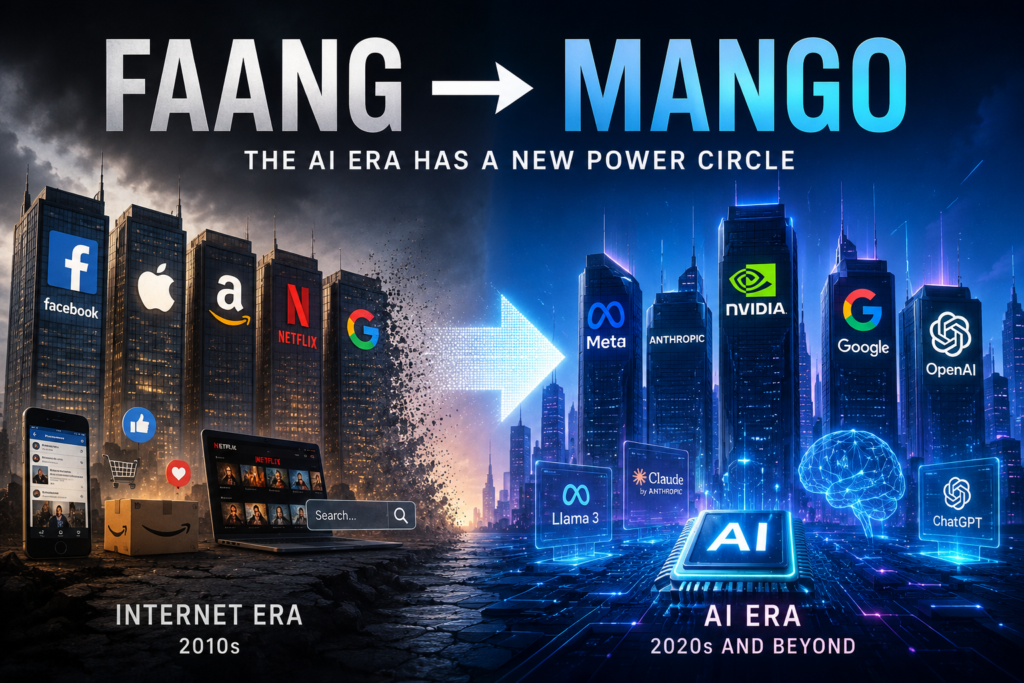

A few years ago, if you asked someone which companies were shaping the future of technology, the answer was predictable.
Apple.
Google.
Amazon.
Netflix.
Meta.
Together, they became known as FAANG and came to represent the internet era.
Today, the conversation looks different.
Artificial intelligence has moved from research labs into classrooms, offices, smartphones, hospitals, factories, and software used by millions of people every day.
As AI becomes more important, so do the companies building the models, chips, and infrastructure behind it.
That shift has given rise to a new acronym:
MANGO.
The term groups together Meta, Anthropic, NVIDIA, Google, and OpenAI – five companies that sit at the center of today’s AI race.
Whether MANGO becomes as influential as FAANG remains to be seen.
What matters more is why people started using it in the first place.
The rise of MANGO reflects a larger change in technology.
It shows where investment is flowing.
It highlights which skills are becoming more valuable.
And it offers a glimpse into how AI could reshape industries, careers, and daily life over the coming years.
So why are people replacing FAANG with MANGO?
And what does that tell you about the future of technology?
Let’s take a closer look.
What Is MANGO?
If you came here looking for a quick answer, here it is.
MANGO stands for:
Company | Why It Matters in AI |
|---|---|
Meta | Open-source AI models and global scale |
Anthropic | Advanced AI systems and AI safety research |
NVIDIA | Hardware powering modern AI |
Google | AI research, infrastructure, and products |
OpenAI | Creator of ChatGPT and a major force in generative AI |
Unlike FAANG, which reflected the companies dominating the internet and mobile era, MANGO focuses on organizations leading the AI era.
This distinction is important.
The companies in MANGO are not simply building websites, apps, or devices.
They are building the foundation on which future technologies may depend.
That includes:
- Large language models
- AI assistants
- Data centers
- AI chips
- AI infrastructure
- Next-generation software platforms
The growing popularity of the acronym suggests that many people believe the center of technological influence is shifting.
To understand why, we first need to look at the rise of FAANG.
Before MANGO, There Was FAANG
For much of the last decade, FAANG was one of the most recognized acronyms in technology.
The term referred to:
- Apple
- Amazon
- Netflix
Each company helped define a major part of the digital economy.
Facebook transformed social networking.
Apple revolutionized smartphones.
Amazon changed online shopping and cloud computing.
Netflix reshaped entertainment.
Google became the gateway to information on the internet.
Together, these companies influenced how people communicate, work, shop, learn, and consume content.
They also became some of the most valuable businesses in the world.
For students and professionals, landing a FAANG job often represented the pinnacle of success.
For investors, FAANG stocks symbolized growth, Startups, these companies set the standard everyone wanted to follow.
The influence of FAANG became so widespread that the acronym evolved beyond finance.
It became a symbol of technological leadership.
But every technological era eventually gives way to another.
And over the last few years, something significant changed.
Why FAANG Is No Longer Enough
It is important to clarify something.
The rise of MANGO does not mean FAANG companies suddenly became irrelevant.
Many of them remain incredibly powerful.
Apple continues to dominate consumer technology.
Amazon remains a giant in e-commerce and cloud computing.
Google still processes billions of searches every day.
The issue is not decline.
The issue is focus.
For much of the 2010s, the industry’s biggest opportunities revolved around:
- Smartphones
- Social media
- Streaming
- E-commerce
- Cloud services
Today, the conversation has shifted toward:
- Generative AI
- AI agents
- AI infrastructure
- Machine learning models
- Advanced semiconductors
The release of ChatGPT accelerated this transition.
Suddenly, AI was no longer something discussed only by researchers and engineers.
Students began using it for learning.
Professionals integrated it into their workflows.
Businesses rushed to adopt AI tools.
Governments started debating AI regulations.
Investors redirected billions of dollars toward AI-related companies.
As a result, attention moved toward the organizations building the technologies behind this transformation.
That is where MANGO enters the picture.
If FAANG represented the internet era, MANGO represents the companies competing to shape the AI era.
Why These Five Companies Made the List
Not every technology company earned a place in MANGO.
Each company plays a different but critical role in the AI ecosystem.
Meta
Meta has become one of the strongest advocates of open AI development.
Its Llama family of models helped make advanced AI technology more accessible to developers around the world.
Instead of keeping everything behind closed doors, Meta embraced a more open approach.
This strategy helped accelerate experimentation and adoption across the industry.
Today, many developers, startups, and researchers build on technologies inspired by Meta’s AI efforts.
Anthropic
A few years ago, Anthropic was relatively unknown outside AI circles.
Today, it is considered one of the leading AI companies in the world.
Its Claude models have gained popularity among businesses and professionals looking for reliable AI systems.
Anthropic has also focused heavily on AI safety and responsible development.
That combination of performance and trust has helped it earn a prominent place in the AI conversation.
NVIDIA
Few companies have benefited from the AI boom as much as NVIDIA.
Modern AI systems require enormous computing power.
Much of that power comes from NVIDIA’s graphics processing units, commonly known as GPUs.
These chips have become the backbone of AI training and deployment.
Whether you use ChatGPT, Claude, Gemini, or many other AI tools, NVIDIA hardware is likely involved somewhere behind the scenes.
Its importance has become so great that many analysts now view NVIDIA as critical infrastructure for the AI economy.
Google has been investing in AI long before the recent explosion of public interest.
Many breakthroughs that power today’s AI systems can be traced back to research conducted by Google’s teams.
Through products like Gemini, Google Cloud, and DeepMind, the company remains deeply involved in the future of AI.
Its influence spans research, infrastructure, enterprise solutions, and consumer products.
That breadth makes Google one of the most important players in the field.
OpenAI
OpenAI arguably did more than any other company to bring AI into the mainstream.
Before ChatGPT, AI often felt distant and highly technical.
After ChatGPT, millions of people experienced AI directly.
Students use it for learning.
Professionals use it for productivity.
Businesses use it to automate tasks.
Developers build products around it.
OpenAI helped turn AI from a specialized technology into a global phenomenon.
That impact alone secures its place in MANGO.
MANGO vs FAANG: The Biggest Shift in Tech Since Smartphones
The rise of MANGO is not really about replacing one acronym with another.
It reflects a broader shift in priorities across the technology industry.
The comparison becomes clearer when you look at the dominant themes of each era.
FAANG Era | MANGO Era |
|---|---|
Social media | Artificial intelligence |
Mobile apps | AI assistants |
Streaming platforms | Generative AI |
Consumer internet | AI infrastructure |
Cloud growth | Foundation models |
User attention | Intelligent automation |
This transition affects more than technology companies.
It influences:
- Hiring trends
- Education priorities
- Investment decisions
- Startup opportunities
- Government policies
For the first time since the smartphone revolution, many experts believe the industry is entering a completely new phase.
And if that is true, one company may be more important than all the others.
NVIDIA.
Its rise helps explain why MANGO exists in the first place.
Why NVIDIA May Be the Most Important Company in MANGO
When most people think about AI, they think about tools like ChatGPT, Claude, Gemini, or AI image generators.
What many do not see is the infrastructure that makes those tools possible.
Behind every advanced AI model is an enormous amount of computing power.
Training a modern AI system requires processing vast amounts of data across thousands of powerful chips.
That is where NVIDIA comes in.
For years, NVIDIA was best known for gaming graphics cards.
Today, it sits at the center of the AI economy.
Its GPUs have become the preferred hardware for training and running AI models.
In simple terms, if AI is the new gold rush, NVIDIA supplies many of the tools needed to dig for gold.
This is one reason the company’s rise has been so remarkable.
Unlike some businesses that depend on a single AI product succeeding, NVIDIA benefits whenever the entire AI ecosystem grows.
Whether a company is building a chatbot, an AI assistant, a self-driving system, or a scientific research model, it often needs powerful computing infrastructure.
That demand has turned NVIDIA into one of the most influential companies in technology.
Its success also highlights a larger trend.
The AI era is not only creating new software.
It is creating demand for entirely new layers of infrastructure.
And that brings us to one of the biggest debates surrounding MANGO.
If AI is so important, why are Apple and Microsoft missing?
The Missing Names: Why Aren’t Apple and Microsoft in MANGO?
Whenever people discuss MANGO, the conversation quickly shifts to who was left out.
Two names come up more than any others:
- Apple
- Microsoft
Considering their size and influence, that reaction makes sense.
Why Apple Is Missing
Apple remains one of the world’s most valuable companies.
Its products are used by billions of people.
Its ecosystem remains incredibly strong.
However, Apple has taken a different approach to AI compared to many companies in MANGO.
While others raced to release public AI models and assistants, Apple moved more cautiously.
Its strategy has focused heavily on:
- Privacy
- On-device processing
- Integration into existing products
That approach may prove successful in the long run.
But when people discuss the companies driving today’s AI race, Apple is often viewed as a follower rather than a leader.
That perception plays a major role in its absence from MANGO.
Why Microsoft’s Absence Surprises People
Microsoft may be the most controversial omission.
After all, Microsoft:
- Invested heavily in OpenAI
- Built Copilot
- Operates Azure, one of the world’s largest cloud platforms
- Integrates AI into many of its products
So why isn’t it included?
The answer is partly because acronyms are imperfect.
MANGO is not an official ranking.
It is a shorthand used to describe the companies many people see as being at the center of AI innovation.
A strong argument can be made that Microsoft belongs in the conversation.
The fact that so many people debate its absence shows how difficult it is to capture the AI landscape in a single acronym.
But focusing too much on who belongs in MANGO can distract from a more important question.
How does this shift affect you?
What MANGO Means for Students, Professionals, and Job Seekers
This is where the conversation becomes personal.
Most discussions about MANGO focus on companies.
What they often ignore is what these changes mean for people.
Technology trends eventually shape careers.
The skills that become valuable today often influence opportunities tomorrow.
For Students
If you are still studying, the rise of AI does not mean you need to become an AI researcher.
It does mean that understanding AI will become increasingly important regardless of your field.
Whether you study:
- Engineering
- Business
- Design
- Healthcare
- Finance
- Law
AI is likely to become part of your future workplace.
Learning how AI works, where it can help, and where its limitations exist will become a valuable skill.
The goal is not simply to use AI tools.
The goal is to understand how to work alongside them effectively.
For Software Developers
The software industry is already changing.
Developers are increasingly using AI to:
- Generate code
- Debug applications
- Automate repetitive tasks
- Accelerate development
This does not eliminate the need for developers.
Instead, it changes what developers spend their time doing.
Understanding system design, problem solving, architecture, and user needs becomes even more important when AI can handle routine tasks.
For Engineers
The opportunities extend beyond software.
The AI boom is creating demand in areas such as:
- Semiconductor design
- VLSI
- Embedded systems
- Edge computing
- Robotics
- Data center infrastructure
Every AI breakthrough requires hardware underneath it.
That means engineers working on chips, electronics, networking, and infrastructure could play a critical role in the next phase of technological growth.
The Most Valuable Skill in the AI Era
Many people ask which programming language they should learn.
Or which AI tool they should master.
Those questions matter.
But there is a more important skill.
Adaptability.
Technology changes quickly.
The people who succeed are often those who can learn, adjust, and apply new tools effectively.
That was true during the internet era.
It remains true in the AI era.


