
Why People Are Turning Against Google’s AI Search

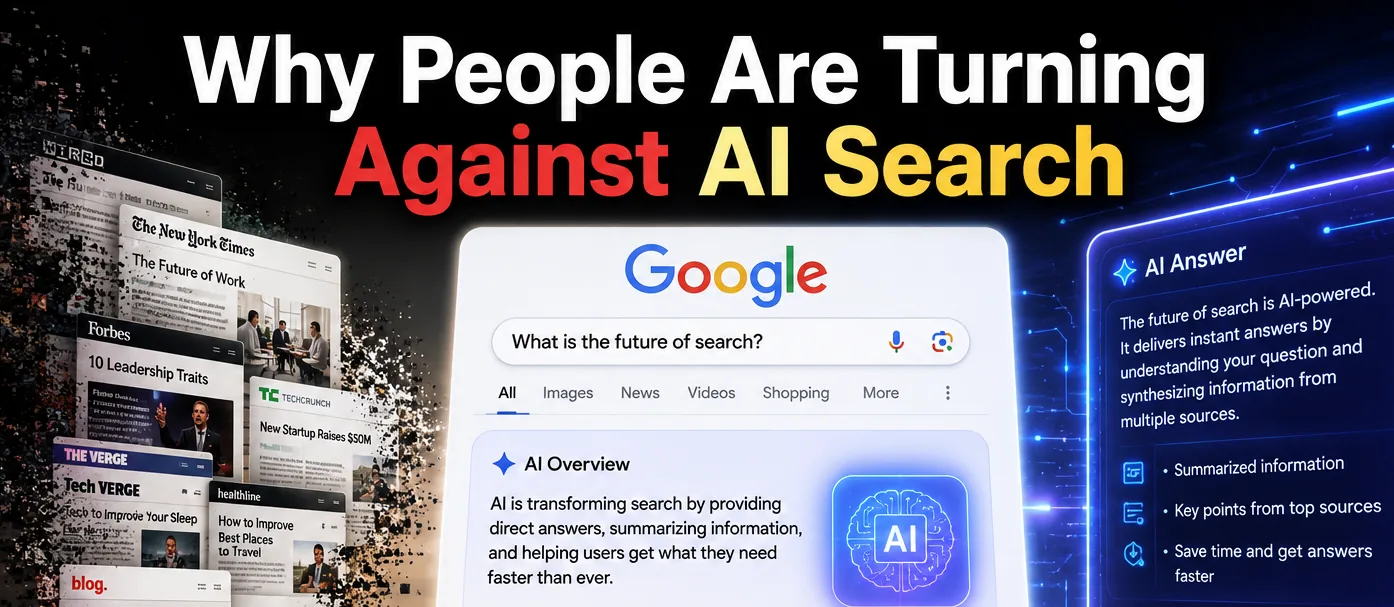
Search for almost anything on Google today.
A product recommendation. A health question. A coding problem. A travel plan.
Before you even see a list of websites, there’s a good chance Google’s AI will try to answer the question for you.
For many people, that’s exactly what they want. Faster answers. Less clicking. Less time spent digging through search results.
But a growing number of users are starting to push back.
Publishers say their traffic is disappearing.
Creators worry their work is being summarized instead of discovered.
Some users feel Search is becoming less transparent.
Others simply miss the feeling of exploring the web rather than being handed a single answer.
What began as an effort to make Search more helpful has sparked one of the biggest debates in technology today.
The question is no longer whether AI belongs in Search.
The question is whether AI is changing Search in ways people never asked for.
And the answer could shape the future of the internet itself.
What Is Google’s AI Search?
Google’s AI Search is part of a broader shift in how people find information online.
Traditionally, Google acted as a gateway to the web.
You searched for something, Google provided relevant links, and you explored the sources yourself.
AI Search changes that experience.
Instead of primarily directing you to websites, Google increasingly generates answers directly within Search results. Using information gathered from across the web, AI creates summaries designed to answer your question before you ever click a link.
The goal is simple: make Search faster and more useful.
Instead of opening five websites to compare information, you can often get a summary in seconds.
For users, that convenience is appealing.
Traditional Search | AI Search |
|---|---|
Multiple website visits | Direct answers |
Manual research | AI summaries |
User compares sources | AI synthesizes information |
Exploration-focused | Convenience-focused |
Link-based experience | Answer-based experience |
At first glance, it sounds like an obvious improvement.
So why is there so much resistance?
The Shift From Discovery to Answers
The backlash against AI Search is often framed as a rejection of AI.
In reality, most people are not opposed to artificial intelligence itself.
Millions of people use AI tools every day.
The deeper concern is how AI is changing the nature of Search.
For decades, Google helped people discover information.
You could compare sources, explore different perspectives, and decide which information was most useful.
AI Search encourages a different behavior.
Instead of discovering information, you consume a synthesized answer.
That distinction may seem small, but it fundamentally changes your relationship with information.
Search becomes less about exploration and more about interpretation.
Rather than helping you navigate the web, AI increasingly decides how information should be presented before you see it.
For some users, that feels efficient.
For others, it feels like losing control.
And that tension sits at the center of today’s backlash.
The Trust Problem
Google’s greatest asset has never been its algorithms.
It has been trust.
People use Google because they believe it can help them find reliable information.
AI Search complicates that relationship.
When Google’s AI provides a direct answer, most users naturally assume that answer is accurate.
But AI systems are not perfect.
They can:
- Misinterpret context
- Oversimplify complex subjects
- Present incomplete information
- Combine conflicting sources
- Generate incorrect conclusions
The problem is not that mistakes happen.
The problem is visibility.
With traditional Search, you could immediately see where information came from.
With AI Search, you often see the answer first and the sources second.
That subtle difference changes how people evaluate information.
Trust becomes harder to maintain when users cannot easily see how an answer was formed.
As AI becomes more integrated into Search, transparency may become just as important as accuracy.
The Open Web Has an Incentive Problem
The internet runs on a simple exchange.
People create content.
Search engines help people find it.
Websites earn traffic.
Users gain knowledge.
Everyone benefits.
AI Search has the potential to disrupt that balance.
Imagine spending weeks researching and writing an article.
Someone searches for the topic.
Google’s AI summarizes your work.
The user gets the answer.
But never visits your website.
You created the information.
Google delivered it.
The traffic never arrives.
For creators, publishers, educators, and independent websites, this creates a serious concern.
Many online businesses depend on:
- Advertising revenue
- Affiliate income
- Memberships
- Subscriptions
- Lead generation
Less traffic means fewer opportunities to sustain quality content.
And that leads to a larger question.
If creators receive less value from publishing online, what incentive remains to continue creating?
What Happens If Nobody Clicks?
This may be the most important question in the entire debate.
Google’s AI Search depends on information created by websites.
But websites depend on visitors.
If AI increasingly keeps users within Google’s ecosystem, the long-term consequences could be significant.
Independent publishers may struggle to survive.
Niche experts may stop sharing knowledge publicly.
Smaller websites could disappear altogether.
Journalism may become harder to fund.
The result could be an internet with fewer original sources and more recycled information.
Ironically, that creates a problem for AI itself.
AI systems rely on a constant supply of fresh, high-quality content.
Without creators producing that content, there is less valuable information available to summarize.
In other words, AI Search depends on an ecosystem that it may also be weakening.
That is why many experts see this as more than a traffic issue.
It is a sustainability issue.
Why Some Users Are Looking Elsewhere
The backlash is not just coming from website owners.
Some users are actively exploring alternatives.
Not because they hate AI.
Because they want choice.
Many people appreciate AI tools when they choose to use them.
What frustrates some users is feeling like AI has become unavoidable.
Common complaints include:
- AI answers appearing when they were not requested
- Difficulty finding direct website results
- Reduced visibility of original sources
- Less control over the search experience
This has contributed to growing interest in alternative search engines and AI-optional search experiences.
Google remains dominant.
But for the first time in years, some users are asking a question that once seemed unthinkable:
Is Google still giving me the search experience I want?
Could AI Search Be Manipulated?
Every major information system eventually attracts attempts at manipulation.
Search engines have dealt with SEO abuse, spam, and misinformation for years.
AI Search introduces new challenges.
As businesses, marketers, and bad actors learn how AI-generated answers work, new forms of optimization will inevitably emerge.
Potential risks include:
- Content created specifically to influence AI summaries
- Coordinated misinformation campaigns
- Manipulative AI-focused SEO tactics
- Biased information presented as objective fact
The more people rely on AI-generated answers, the more valuable it becomes to influence those answers.
This does not mean AI Search is doomed.
But it does mean trust cannot be taken for granted.
Maintaining quality will require constant oversight, transparency, and improvement.
What This Means for SEO and Businesses
The rise of AI Search is forcing businesses to rethink how they approach visibility online.
For years, SEO often focused on ranking pages and earning clicks.
That model is evolving.
AI can easily summarize generic information.
What it struggles to replace is genuine expertise.
The websites most likely to succeed in the AI era are those that offer:
- Original research
- First-hand experience
- Unique perspectives
- Expert analysis
- Strong brand authority
In many ways, AI Search may accelerate a trend that was already happening.
Quantity matters less.
Quality matters more.
Businesses that provide real value may ultimately benefit, even if the rules of visibility continue to change.
The Bigger Question: Who Controls Knowledge?
Most discussions about AI Search focus on traffic, rankings, and technology.
But there is a deeper issue beneath all of them.
Who controls access to information?
Traditional Search presented multiple sources and allowed users to explore them.
AI Search increasingly presents a synthesized version of reality.
In many cases, that can be useful.
It can save time, simplify research and make information more accessible.
But it also concentrates influence.
The company controlling the AI system gains greater power over:
- Which sources are highlighted
- How information is framed
- What gets simplified
- What gets omitted
As AI becomes the primary interface between people and information, these questions become increasingly important.
The debate is no longer just about Search.
It is about how knowledge itself is delivered.
Is the Backlash Justified?
The answer depends on what you value most.
AI Search offers clear benefits.
What AI Search Gets Right
- Faster answers
- Reduced research time
- Improved accessibility
- Better handling of complex questions
- More conversational interactions
Why Critics Are Concerned
- Reduced transparency
- Less traffic for creators
- Potential misinformation
- Increased platform control
- Long-term risks to the open web
Both perspectives have merit.
AI Search is not inherently good or bad.
It is a powerful technology introducing new opportunities while creating new challenges.
The real question is whether the industry can find a balance between convenience and openness.
The Future of Search Will Be Decided by Trust
Google’s AI Search may ultimately make finding information faster than ever.
But speed is not the only thing people value.
People value trust.
They value transparency.
They value the ability to explore, compare, and think for themselves.
The debate surrounding AI Search is not really about artificial intelligence.
It’s about who controls access to information in an increasingly AI-driven world.
Google is betting that people want answers.
The backlash suggests many still want something more:
The freedom to discover those answers for themselves.
Read next

Nothing Phone 3 in 2026: The Best Nothing Bargain, With 1 Painful Catch
Is the Nothing Phone 3 worth buying 15 months on? Android 17, a 3x zoom camera and 7 years of patches, plus the one price rule that decides it.

The Best Laptops Under Rs 50,000: How to Get 16GB RAM for Less
We checked live prices on laptops under Rs 50,000. One 16GB MSI costs Rs 43,219, less than its 8GB twin. Here is what to buy and what to skip.

All 9 RTX Spark Laptops Ranked: Best and Worst Value
We ranked all 9 RTX Spark laptops on price, battery and game support. Buy the ASUS ProArt, skip the Dell XPS 16, and gamers should wait.