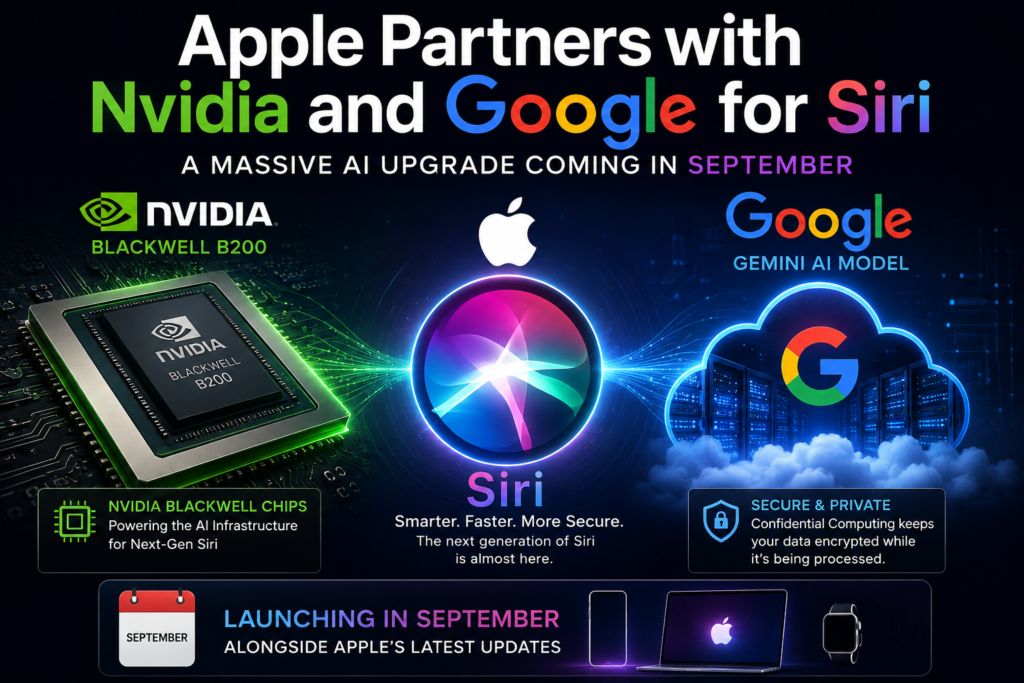

Apple partners with Nvidia and Google for Siri, and this could be the biggest change to Apple’s voice assistant since its launch. According to a report from The Information, Apple is working with Google and Nvidia to power the next generation of Siri using Google’s Gemini AI model and Nvidia’s Blackwell B200 chips.
The upgraded Siri is expected to arrive in September alongside Apple’s latest software updates. If the report is accurate, Apple users could finally experience a much smarter and more capable Siri.
Why Apple Partners with Nvidia and Google for Siri
For years, Siri has been one of the most recognizable voice assistants in the world. However, competitors such as Google’s Gemini, OpenAI’s ChatGPT, and Microsoft’s Copilot have moved ahead in conversational AI.
As a result, Apple appears to be accelerating its AI strategy.
The decision that Apple partners with Nvidia and Google for Siri is surprising because Apple usually develops key technologies in-house. Nevertheless, artificial intelligence requires enormous computing power and advanced language models. Therefore, partnering with industry leaders could help Apple deliver better AI experiences much faster.
Google’s Gemini Could Make Siri Smarter
One of the most interesting parts of the report is Google’s involvement.
Apple reportedly plans to use a licensed version of Gemini for certain Siri requests. Gemini is Google’s flagship AI model and is designed to understand complex questions, context, and natural language.
Because of this partnership, Siri may soon be able to:
- Understand longer conversations
- Answer more complex questions
- Summarize emails and documents
- Assist with research
- Generate text and content
- Handle multi-step tasks
In other words, Siri could finally become a true AI assistant rather than a simple voice command tool.
Nvidia Blackwell Chips Will Power the AI Infrastructure
While Google provides the AI model, Nvidia supplies the hardware.
Reports suggest Google’s cloud infrastructure will use Nvidia Blackwell B200 chips to process AI requests for Siri. These chips are among the most advanced AI processors available today.
Faster Performance
Nvidia’s Blackwell architecture is built specifically for artificial intelligence workloads. As a result, Siri could respond much faster than before.
Better Scalability
Apple serves billions of devices worldwide. Therefore, the AI infrastructure must handle enormous traffic volumes. Nvidia’s hardware is designed for exactly that purpose.
Improved Efficiency
Modern AI models consume significant resources. However, Blackwell chips deliver better performance while improving efficiency.
Simply put, Google’s Gemini provides the intelligence, while Nvidia’s Blackwell chips provide the computing power.
Apple Still Prioritizes Privacy
Whenever cloud-based AI is involved, privacy becomes a major concern.
Fortunately, Apple appears to be addressing this issue carefully.
According to the report, Google’s data centers will use Nvidia Blackwell chips featuring confidential computing technology. This technology encrypts data while it is actively being processed.
As a result, user information remains protected even when requests are handled outside Apple’s own infrastructure.
This approach aligns with Apple’s long-standing commitment to privacy and security.
What New Siri Features Could Arrive in September?
If Apple partners with Nvidia and Google for Siri successfully, users could see several new AI-powered features.
Natural Conversations
Instead of using rigid commands, users may speak naturally with Siri.
Context Awareness
Siri could remember previous questions and maintain context throughout conversations.
Productivity Assistance
The assistant may summarize emails, notifications, meeting notes, and documents.
Better App Control
Users could ask Siri to complete complex tasks involving multiple apps.
Personalized Recommendations
Siri may provide more relevant suggestions based on user behavior while maintaining privacy protections.
Why This Partnership Matters
The fact that Apple partners with Nvidia and Google for Siri highlights how important AI has become.
Until recently, smartphone manufacturers focused on hardware improvements such as cameras, displays, and processors. Today, artificial intelligence is becoming the main battleground.
Companies including Google, Microsoft, OpenAI, Meta, and Anthropic are investing billions into AI technologies. Therefore, Apple must compete aggressively if it wants to remain a leader in consumer technology.
This partnership could help Apple close the gap while delivering advanced AI features to millions of users.
What It Means for the Future of iPhone Users
For iPhone users, the benefits could be significant.
A smarter Siri could reduce the need to manually search for information, switch between apps, or complete repetitive tasks.
Instead, users may simply describe what they need and allow Siri to handle the rest.
Consequently, everyday smartphone interactions could become faster, easier, and more intuitive.
Final Thoughts
Apple partners with Nvidia and Google for Siri at a time when artificial intelligence is reshaping the technology industry. By combining Google’s Gemini AI model, Nvidia’s Blackwell chips, and Apple’s privacy-focused ecosystem, the company may finally deliver the intelligent Siri that users have wanted for years.
Although Apple has not officially confirmed every detail, all signs suggest that September could mark the beginning of a new era for Siri.
If the launch meets expectations, this AI-powered upgrade may become one of the most important developments in Apple’s recent history.


