

Artificial intelligence is no longer something reserved for tech companies, data centers, or futuristic movies. It has quietly become part of our daily lives. Whether you use Copilot to draft an email, ask an AI assistant to summarize notes, or generate images for social media, AI is increasingly becoming a tool that ordinary people use every day.
Now, Nvidia wants to bring that experience even closer to home.
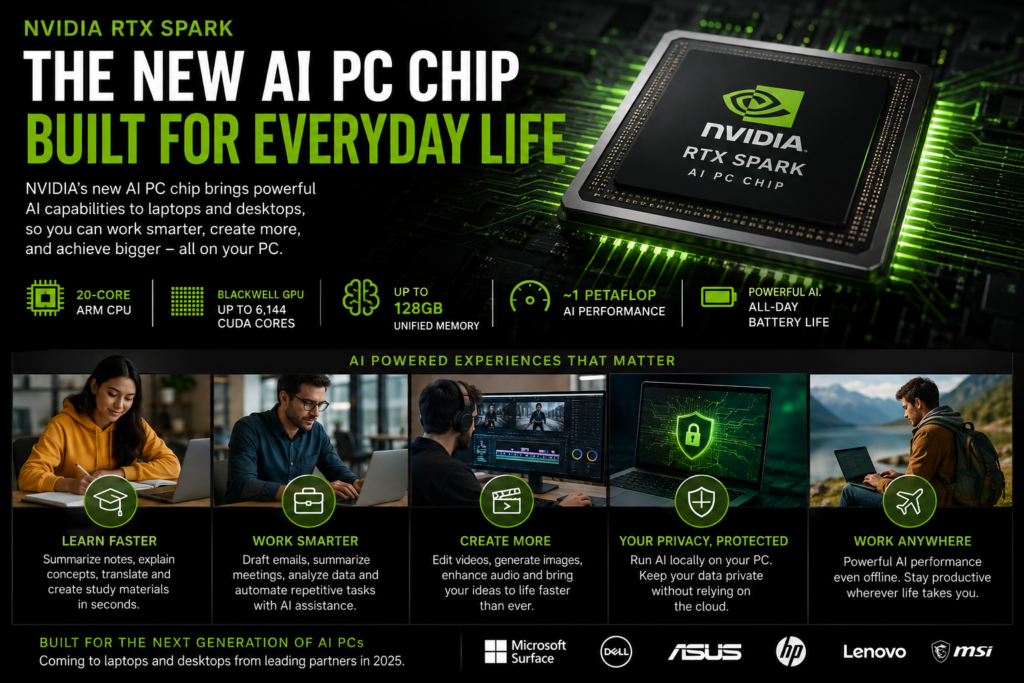
The company recently unveiled its new AI-focused PC platform, known as RTX Spark, marking one of the biggest shifts in personal computing in recent years. While the announcement may sound like another technical upgrade, its real impact could be felt by students, office workers, creators, and even families who simply want their computers to be faster, smarter, and more useful.
So what exactly is Nvidia’s new AI PC chip, and why should everyday users care?
A New Direction for Personal Computers
For years, Nvidia has been known as the company behind powerful graphics cards used in gaming PCs, workstations, and AI servers. If you’ve played modern games or followed the AI boom, you’ve probably heard Nvidia’s name more than once.
However, the company’s latest move goes beyond graphics.
With its new AI PC chip, Nvidia is entering a space traditionally dominated by Intel, AMD, and more recently, Apple. Instead of simply providing graphics power, Nvidia now wants to help power the entire computing experience.
The goal is simple: make AI run directly on your computer.
Rather than sending every request to a cloud server somewhere in the world, future AI-powered laptops could process many tasks locally. This means faster responses, greater privacy, and better performance even when internet connectivity is limited.
For users, that could be a much bigger change than a simple processor upgrade.
Why AI Needs a New Kind of Computer
Many people already use AI tools today. Students use them for research, professionals use them for productivity, and creators use them for content generation.
But there is one common limitation.
Most AI tools rely heavily on cloud computing. Every time you ask a question or generate an image, your request often travels to a remote server before the result comes back.
This process works well, but it has drawbacks:
- Internet dependency
- Potential privacy concerns
- Server congestion during peak usage
- Delays in response times
Nvidia believes future PCs should handle many of these tasks themselves.
Imagine opening your laptop and having an AI assistant that can summarize documents, organize files, translate languages, generate presentations, and help with coding without constantly needing cloud access.
That vision is exactly what Nvidia is trying to enable.
How Everyday Users Could Benefit
Whenever new technology is announced, people naturally ask one question:
“How does this help me?”
The answer may be more practical than many expect.
Students Could Learn Faster
Students today juggle assignments, presentations, online research, and exam preparation.
A laptop powered by Nvidia’s AI PC chip could:
- Summarize lengthy study materials
- Create revision notes instantly
- Translate educational content
- Help generate presentation outlines
- Assist with coding projects
Instead of spending hours organizing information, students could focus more on understanding concepts and developing skills.
For many young learners, AI may become as important as search engines were a decade ago.
Professionals Could Save Valuable Time
Office workers often spend significant portions of their day performing repetitive tasks.
Future AI PCs may help automate:
- Email drafting
- Meeting summaries
- Data analysis
- Report generation
- Document organization
Imagine finishing administrative work in minutes rather than hours.
This doesn’t necessarily replace human workers. Instead, it allows people to focus on creative thinking, problem-solving, and decision-making rather than routine tasks.
Content Creators Could Work Smarter
Content creators constantly need tools that improve productivity.
Whether someone runs a YouTube channel, manages a blog, creates social media content, or edits videos, AI-powered PCs could significantly reduce workload.
Tasks such as:
- Video editing
- Thumbnail generation
- Image enhancement
- Script creation
- Audio cleanup
could become faster and more accessible.
For small creators who don’t have large teams, this could be particularly valuable.
Better Privacy Could Be a Major Advantage
One of the most overlooked benefits of local AI processing is privacy.
Today, many AI interactions involve sending data to cloud servers. While major companies invest heavily in security, some users remain uncomfortable sharing sensitive information online.
With AI running directly on the device, certain tasks may never need to leave the computer.
This could be beneficial for:
- Businesses handling confidential data
- Students working on private projects
- Healthcare professionals
- Financial advisors
- Everyday users who value digital privacy
In a world where data protection is becoming increasingly important, local AI processing may become a significant selling point.
Faster Performance Without Constant Internet
Most people have experienced poor internet connections at some point.
Whether traveling, working remotely, or dealing with network issues, internet dependency can be frustrating.
AI PCs could help reduce that reliance.
Imagine being able to:
- Generate notes on a flight
- Edit AI-enhanced videos while traveling
- Use AI productivity tools in areas with weak connectivity
- Access smart assistants without waiting for cloud responses
The result would be a smoother and more reliable experience.
For many users, convenience matters just as much as performance.
The Growing Competition in AI Computers
Nvidia is not entering an empty market.
Apple has already demonstrated the benefits of combining powerful processors with AI capabilities through its Apple Silicon chips.
Microsoft is pushing its AI-powered Copilot ecosystem.
Qualcomm has introduced AI-focused Snapdragon processors for Windows laptops.
AMD and Intel are also investing heavily in AI acceleration technologies.
This competition is good news for consumers.
When major technology companies compete, users often benefit from:
- Better products
- Faster innovation
- Lower prices
- Improved performance
The race to build the best AI PC may ultimately lead to more capable and affordable computers for everyone.
What This Means for Businesses
Small and medium-sized businesses stand to gain significantly from AI-powered computers.
Many companies cannot afford large IT departments or expensive AI infrastructure.
Local AI processing could allow businesses to:
- Analyze documents faster
- Improve customer service workflows
- Automate repetitive operations
- Increase employee productivity
- Reduce reliance on cloud subscriptions
For growing businesses, these advantages could translate into real cost savings.
The technology may help level the playing field between smaller companies and larger enterprises.
Could This Change the Way We Use Computers?
Perhaps the biggest takeaway isn’t the chip itself.
It’s the shift in expectations.
For decades, computers have largely been tools that wait for instructions.
AI changes that dynamic.
Future computers may proactively help users organize information, suggest actions, automate workflows, and solve problems.
The relationship between humans and computers could become far more collaborative.
Instead of simply opening programs and performing tasks manually, users may increasingly work alongside AI assistants integrated into the operating system itself.
That transformation may happen gradually, but Nvidia clearly believes it is coming.
The Bigger Picture
Technology announcements often focus on specifications, performance benchmarks, and technical achievements.
Those details matter, but the real story is how technology improves people’s lives.
Nvidia’s new AI PC chip is not just about faster processors or impressive performance numbers.
It’s about making powerful AI tools available to ordinary users.
Students may learn more efficiently.
Professionals may work more productively.
Creators may produce better content.
Businesses may operate more effectively.
And everyday users may enjoy smarter, more helpful computers.
Whether Nvidia ultimately dominates the AI PC market remains to be seen. What is clear, however, is that personal computing is entering a new chapter.
The next generation of computers won’t just help people complete tasks.
They may actively help people think, create, learn, and achieve more than ever before.
And that could be the most important upgrade of all.


