
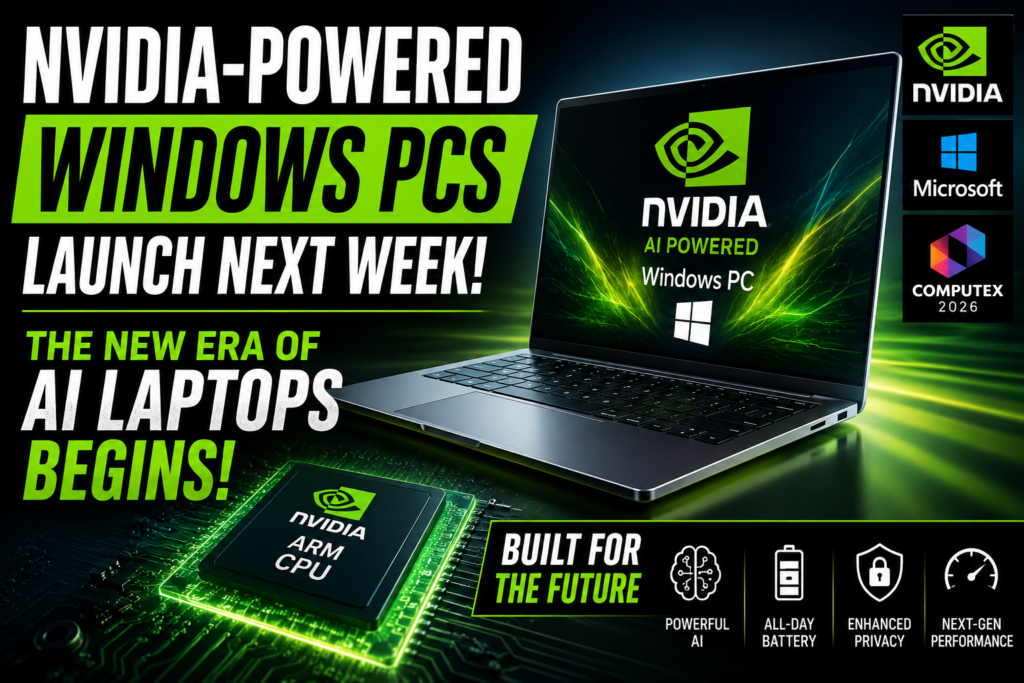

Nvidia-powered Windows PCs could soon become one of the biggest stories in the technology industry. According to multiple reports, Nvidia is preparing to unveil its first Windows PCs powered by Nvidia-designed processors during Computex 2026 and Microsoft’s Build developer conference. If the reports are accurate, this launch could significantly reshape the Windows laptop market and create a stronger challenge to Apple’s MacBook lineup.
For years, Nvidia has dominated the graphics processing market. However, the company now appears ready to expand far beyond GPUs and enter the CPU space with processors designed specifically for next-generation AI laptops.
What Are Nvidia-Powered Windows PCs?
Unlike traditional Windows laptops that rely on Intel, AMD, or Qualcomm processors, Nvidia-powered Windows PCs are expected to use Nvidia-designed chips as their primary processor.
Industry insiders believe these chips will be based on Arm architecture, the same technology that powers Apple’s successful M-series processors. Arm-based chips are known for delivering impressive performance while consuming less power, making them ideal for modern laptops.
The move could help Microsoft strengthen its Windows-on-Arm ecosystem and offer users a compelling alternative to MacBooks.
Why Nvidia Is Entering the PC Processor Market
Nvidia’s growth over the past few years has been fueled by artificial intelligence. The company has become the leading supplier of AI hardware for data centers, cloud providers, and enterprise applications.
However, the future of AI is not limited to servers. AI is increasingly moving directly onto personal computers, smartphones, and other consumer devices.
By launching Nvidia-powered Windows PCs, the company can bring its AI expertise directly to everyday users. This strategy allows Nvidia to expand its influence beyond graphics cards and participate in the growing AI PC market.
As AI becomes a standard feature in laptops, Nvidia wants to ensure its technology powers the next generation of computing experiences.
Microsoft and Nvidia Are Teasing a Major Announcement
Both Nvidia and Microsoft have been building excitement ahead of their upcoming events.
The companies recently shared messages hinting at “A New Era of PC,” leading many industry observers to believe a major Windows-on-Arm announcement is imminent.
Reports suggest that the first Nvidia-powered Windows PCs could arrive through Microsoft’s Surface lineup as well as devices from major manufacturers such as Dell.
This broad support would demonstrate Microsoft’s confidence in Nvidia’s new processor platform and help accelerate adoption among consumers and businesses.
How Nvidia-Powered Windows PCs Could Challenge Apple
Apple transformed the laptop market when it introduced its custom M-series chips. The transition from Intel processors allowed Apple to dramatically improve battery life, performance, and efficiency.
Since then, Windows manufacturers have struggled to provide a comparable experience.
Nvidia-powered Windows PCs may finally change that situation.
Because Nvidia has extensive experience designing high-performance and energy-efficient processors, the company could deliver laptops that rival Apple’s MacBooks in both speed and battery life.
If successful, Windows users may finally enjoy the same combination of portability, power, and efficiency that Apple users have experienced for years.
AI Features Expected in Nvidia-Powered Windows PCs
Artificial intelligence will likely be the biggest focus of these new devices.
Microsoft is expected to reveal additional on-device AI capabilities that can run locally instead of relying entirely on cloud servers. Local AI processing offers several advantages:
- Faster responses
- Better privacy protection
- Reduced internet dependency
- Lower cloud computing costs
- Improved efficiency for AI workloads
Nvidia already leads the AI hardware market, making it uniquely positioned to power advanced AI features directly on laptops.
This could benefit students, content creators, software developers, professionals, and businesses that increasingly depend on AI-powered tools.
The Biggest Challenge for Windows on Arm
While the potential is exciting, Nvidia-powered Windows PCs still face a significant challenge.
Historically, Windows-on-Arm devices have struggled with software compatibility. Many popular applications were originally designed for x86 processors from Intel and AMD.
Although Microsoft’s emulation technology has improved dramatically, some applications still encounter compatibility issues or performance limitations.
For Nvidia’s platform to succeed, users must be able to run traditional Windows software without frustration. Smooth compatibility will be essential for widespread adoption.
Fortunately, Microsoft has invested heavily in improving Windows-on-Arm support, and the upcoming launch may showcase the company’s progress in this area.
Why This Matters for the Entire PC Industry
The launch of Nvidia-powered Windows PCs could have far-reaching consequences for the technology industry.
Intel and AMD have dominated PC processors for decades, while Qualcomm recently emerged as a serious competitor in the Windows-on-Arm space.
Nvidia’s entry introduces another powerful player into the market. Increased competition often benefits consumers through:
- Better innovation
- Faster technological progress
- More choices
- Improved performance
- Competitive pricing
The arrival of Nvidia-powered Windows PCs could also accelerate the adoption of AI-powered computing across the entire industry.
What to Expect Next Week
Technology enthusiasts will closely watch Computex 2026 and Microsoft’s Build conference for official details.
Key information expected during the announcements includes:
- Processor specifications
- AI capabilities
- Battery life estimates
- Performance benchmarks
- Device availability
- Pricing information
- Software compatibility improvements
These details will determine whether Nvidia-powered Windows PCs represent a true breakthrough for the Windows ecosystem.
Final Thoughts
Nvidia-powered Windows PCs have the potential to become one of the most important technology launches of 2026. By combining Arm-based efficiency, advanced AI capabilities, and Microsoft’s Windows platform, Nvidia could help redefine the future of personal computing.
The company has already revolutionized graphics and artificial intelligence. Now, it appears ready to transform the PC market as well.
If Nvidia can deliver strong performance, excellent battery life, and seamless compatibility with Windows applications, these devices could finally provide Windows users with a serious alternative to Apple’s MacBook lineup.
The official announcement is only days away, and the technology world is watching closely.


