

You unlock your phone to check one message.
Ten minutes later, you are watching a video you never planned to open.
Then another one.
By the time you notice, the original message is not even the reason you are holding your phone anymore.
That small loss of control is exactly why phones like Light Flip are starting to make sense.
Light Flip is not trying to beat the smartphone. It is not trying to compete with the latest iPhone, Galaxy, or Pixel on camera, display, AI features, or gaming power.
That may sound old-fashioned. But in a world where every app wants your attention, a phone that does less can suddenly feel fresh.
What Is Light Flip?
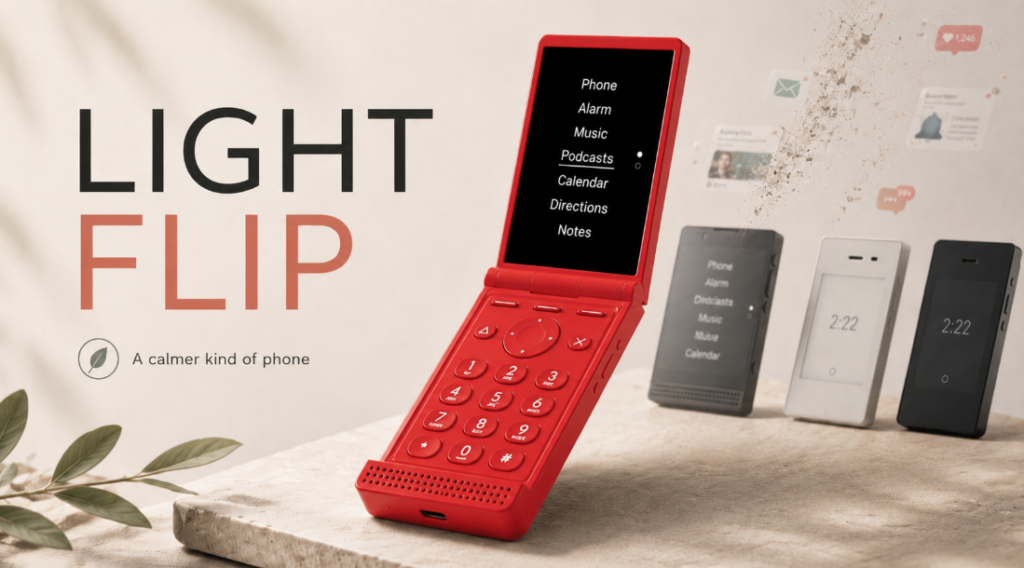
Light Flip is a minimalist flip phone from Light, the company behind the Light Phone series.
It is designed for people who want a calmer phone experience. Not no technology. Not no connection. Just less noise.
The phone has no front screen and no touchscreen. It uses a 2.8-inch OLED display inside, physical buttons, old-school T9 typing with predictive text, 5G, USB-C, a rear camera, and a replaceable battery. Wired reports that Light Flip is expected to ship in April 2027 and cost $299, or $39 per month with a service plan.
Reports say that Light Flip runs LightOS, the same minimalist operating system used on Light Phone III. It includes basic tools like navigation and notes, but it does not have NFC, so tap-to-pay is not available.
Here is the simple idea:
Light Flip feature | What it means |
|---|---|
No front screen | Fewer quick-check loops |
No touchscreen | Less swipe-and-scroll behavior |
Flip design | Open when needed, close when done |
LightOS | Basic tools instead of app overload |
Replaceable battery | Better long-term practicality |
Why Are People Tired of Smartphones?
Smartphones are some of the most useful devices ever made.
You use them for payments, maps, photos, messaging, work, study, travel, banking, music, shopping, and emergencies. For many people, a smartphone is not optional anymore. It is part of daily life.
But that is also the problem.
Smartphones have become too many things at once.
Your phone is your wallet, camera, entertainment, shopping mall
Your social life.
And Your escape.
That much convenience comes with a cost.
The phone is always ready to pull you back in. Notifications, reels, feeds, messages, ads, and app alerts all compete for your attention.
The problem is not that smartphones are powerful.
The problem is that they rarely know when to stop.
People are not tired of technology itself.
They are tired of technology that keeps asking for more attention.
The Flip Design Is More Than Nostalgia
Flip phones are nostalgic.
They remind people of older phones, early 2000s design, and a time before every device became a glass rectangle full of apps.
But Light Flip is not only about nostalgia.
The flip design changes behavior.
You open the phone when you need it. You close it when you are done. That physical action creates a start and stop.
A smartphone is always open to you. Even when it is locked, the screen can light up. Notifications can appear. You can check the time and accidentally end up somewhere else.
Light Flip removes some of that temptation, matching Light’s goal of making the device feel more intentional rather than constantly available.
There is no outer display.
There is no touchscreen.
There is no endless feed waiting one swipe away.
That friction is the point. The flip is not just a design choice. It is a boundary.
What Light Flip Gives You That Smartphones Often Take Away
Light Flip is not trying to give you more.
It is trying to give you less of what drains you.
That may sound strange in tech, where every new device usually promises more power, more cameras, more apps, and more screen time.
But less can be useful when your attention is already overloaded.
That is why Light Flip feels different. It is not selling speed. It is selling space.
Mental space.
Time space.
Attention space.
And for many people, that is starting to feel valuable.
But a Dumb Phone Also Means Fewer Conveniences
A calmer phone also means fewer shortcuts. That is the tradeoff.
Light Flip is not trying to be a full smartphone. So you should not expect it to behave like one.
You may not get the same app-heavy experience for things like payments, social media, work apps, banking, food delivery, full maps, or high-end photography.
This matters because modern life is built around smartphone apps.
In many countries, and especially in India, your phone is not just a phone. It is your payment device, OTP device, WhatsApp hub, map, cab-booking tool, banking tool, document scanner, and daily digital ID helper.
So a dumb phone can feel peaceful.
But it can also feel limiting.
This device is not designed to replace every modern phone function.
It is designed to reduce the number of things your phone can pull you into.
A phone with fewer distractions also asks you to live with fewer conveniences.
That may be worth it for some moments. It may not be worth it all the time.
Light Flip May Work Best as a Second Phone
The most realistic way to think about Light Flip may not be as a full smartphone replacement.
It may work better as a second phone.
A focus phone.
That framing makes more sense for today’s world.
You may still need your smartphone for payments, banking, travel, work, college groups, documents, and emergency apps. But you may not need all of that during every hour of your day.
Maybe you use your smartphone during work hours. Then switch to a calmer phone at night.
Maybe you carry Light Flip on a short trip when you want to be present.
You could use it while studying, writing, or working on a deep thinking project.
That is where this idea becomes practical.
You do not have to delete your digital life to want a break from it.
Is Light Flip Worth $299?
At $299, Light Flip is not competing with cheap feature phones.
You can buy basic phones for far less. You can also buy budget smartphones that do much more. So the value is not in the spec sheet.
You are paying for design, software philosophy, and a calmer phone experience.
But $299 is still a lot for a device that does less.
That is why the question is personal.
If you want the most features for the money, Light Flip is probably not the answer.
If you want a stylish phone that helps you reduce screen time, create boundaries, and stay away from endless apps, the price may make more sense.
That is either meaningful or unnecessary depending on what you need from your phone.
The Dumb Phone Comeback Is Not Anti-Tech
The dumb phone comeback is often misunderstood.
It is not about hating technology.
It is not about pretending smartphones are useless.
And not about going back to the past completely.
It is about choosing limits.
People still want maps, payments, cameras, messaging, and useful tools.
But they also want distance from algorithmic feeds, notification overload, and the feeling of being always reachable.
That is why minimalist phones, analog hobbies, wired headphones, digital cameras, and phone-free travel are getting attention again.
It is not just nostalgia.
It is a reaction to too much digital noise.
Dumb phones are not replacing smartphones. They are exposing what smartphones became.
They show that the best device is not always the most advanced, the one with the most features. Sometimes, a better device is one that helps you stay in control.
What This Says About the Future of Smartphones
Light Flip may stay niche.
Most people will not fully give up smartphones. The app ecosystem is too important. Payments, work, maps, identity, entertainment, and communication all depend on smartphones now.
But the mood behind Light Flip matters. It suggests that phone brands may need to take attention seriously.
Not as a hidden settings page. As a real product feature.
Future smartphones may need:
- stronger focus modes
- calmer notification design
- better app boundaries
- simpler home screens
- more honest screen-time tools
For years, phone brands competed on cameras, chips, displays, charging speed, and AI features.Those things still matter.
But attention may become part of the competition too.
A phone that helps you use it less may sound strange today.
But for people tired of being pulled into screens, that may become a selling point.
Final Takeaway
Light Flip is interesting because it captures a mood.
People still need phones. But many are tired of phones becoming everything.
The dumb phone comeback is not really about going backward. It is about wanting control again.
People do not want to disappear from technology. They want technology that knows when to stop.


