
OpenAI’s First Device And it might not have a Screen

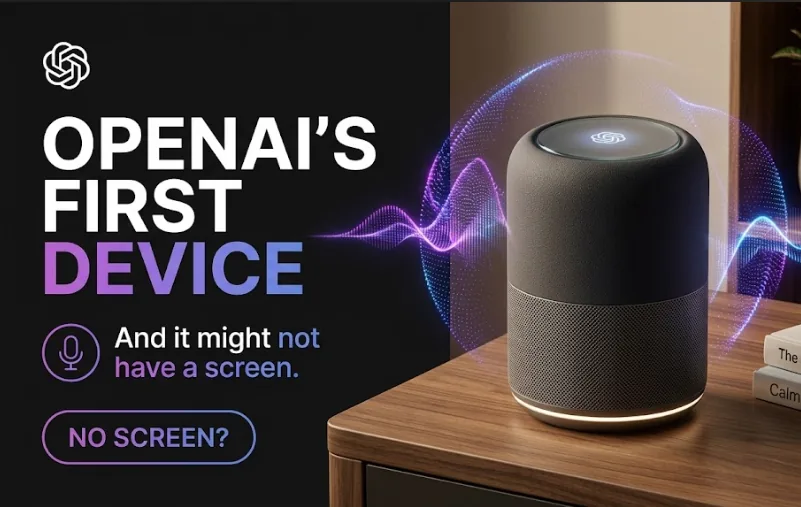
If OpenAI’s first AI device really arrives without a screen, that may sound strange at first.
But it may also be the whole point.
According to recent reports, OpenAI’s first consumer hardware device could be a portable, screen-free smart speaker. It may connect with ChatGPT, include camera and sensor-based context, and support tasks like smart home control, media playback, messaging, and questions. Reuters reported this based on Bloomberg’s coverage.
That sounds simple. Maybe even boring.
The bigger idea is
OpenAI may be trying to make AI feel less like an app you open, and more like a presence around you.
That is what makes this approach interesting.
What Is OpenAI’s First AI Device Expected to Be?
OpenAI has not officially revealed the final product yet.
So we should be careful.
Current reports suggest that the first device may be a rechargable, portable and screen-free smart speaker. It could work with ChatGPT, use voice as the main interface, and include cameras or sensors to understand its surroundings. Reuters also reported that the device could support smart home control, media playback, messaging, and general Q&A with GPT-Live integration.
So, no, this does not sound like a phone.
A phone still asks you to pick it up, unlock it, open an app, and look at a screen.
A screenless AI device may try to remove those steps.
You speak.
It listens.
It responds.
And Maybe, it acts too
Why a Screenless AI Device Actually Makes Sense
A screenless AI device may look limited.
But the lack of a screen could be its strategy.
Most gadgets fight for your eyes. Phones want your attention. Apps want your taps. Social media wants your scrolling. Even smartwatches keep pulling you back to tiny notifications.
OpenAI may be trying something different.
Instead of asking you to look at one more display, a screenless AI device could sit in the background and help through voice.
This could be useful when you are working, cooking, studying or just want a reminder or a message sent.
A screenless device could reduce the need to pick up your phone for small tasks.
That matters because once you pick up your phone, one small task often becomes ten minutes of distraction.
You open it to check a reminder, then its that message, then Instagram and then you forget why you picked it up.
A voice-first AI device could avoid that loop.
The screenless design is not necessarily a weakness. It may be OpenAI’s way of making AI feel less like software and more like a calm assistant in your space.
Jony Ive’s Role Makes This Bigger Than a Speaker
This story is also getting attention because of Jony Ive.
Jony Ive is known for his design work at Apple, including products that shaped modern consumer tech. OpenAI announced that the io Products team had officially merged with OpenAI, while Jony Ive and LoveFrom remained independent and took on deep design and creative responsibilities across OpenAI.
Here the challenge is not just to build a nice-looking object, it’s is to design how AI should physically exist in your life.
That is hard.
Laptops feels like work, phones feel personal.
A smartwatch feels close to your body and smart speaker feels like part of your home.
But an AI companion with cameras, sensors, and memory should feel very different.
It has to be useful without feeling invasive and smart without feeling creepy. That’s presence without feeling like surveillance.
That is a design problem as much as a technology problem.
How This AI Device Could Be Different From Alexa, HomePod and Google Nest
The obvious question is simple:
Isn’t this just another smart speaker?
Not necessarily
Traditional smart speakers are useful. They can play music, set timers, answer basic questions, control smart lights, and give weather updates.
But many people do not use them for deep conversations or complex tasks.
They are mostly command-based. An OpenAI device may try to go beyond that, built around ChatGPT-style conversation, reasoning, and context.
OpenAI may be trying to build something closer to a physical AI assistant.
The shape may look familiar. The purpose may not be.
GPT-Live Could Be the Missing Piece
A screenless AI device depends on voice. If the voice experience feels slow, robotic, or awkward, the whole product becomes frustrating.
This is where GPT-Live matters. Reuters reported that OpenAI launched GPT-Live, a new family of voice models that can listen and speak at the same time.
And Real conversations are not clean.
People interrupt, they pause, change direction, correct themselves.
Old voice assistants were not great at handling these. They often felt like machines waiting for fixed commands. A screenless AI device needs needs conversation to feel natural.
That is why OpenAI’s voice work may be central to this device.
But this is also where expectations must stay realistic.
Voice AI is improving fast, but it still needs to handle accents, background noise, emotion, interruptions, and unclear requests. If it fails often, users will go back to the phone.
So, What’s the Catch?
The idea sounds exciting. But there are serious questions.
Privacy
A screenless AI device with cameras and sensors inside your home will raise privacy concerns.
- Is it always listening?
- Is it watching?
- What does it remember?
- Can I delete its memory?
- Does it send data to the cloud?
A screenless device may look calm.
But it needs very visible privacy controls.
Trust
The more personal an AI device becomes, the more trustworthy it has to be.
It may help with messages, reminders, smart home devices, and personal questions.
That means users need clarity.
When is it only suggesting?
When is it acting?
What data is it using?
Can you review its actions?
Can you stop it easily?
Usefulness
Is this better than using ChatGPT on your phone?
Most people already own a phone. They may not want another device unless it solves a real problem.
Many AI gadgets have struggled because they looked interesting but did not become necessary.
OpenAI’s device needs to become useful during ordinary moments.
Dependency
A screenless AI device could reduce screen time.
But less screen time does not automatically mean less dependence.
If AI becomes easier to access from every room, people may ask it for more things.
More answers, decisions and thinking support.
As much as it’s useful, AI becomes even more central to daily life.
So the real question is not only whether this device reduces screen use. The question is whether it helps you live better, or just makes harder it to leave AI when wanted,
Is This the Next Tech or Just a Smarter Speaker?
This device is unlikely to replace your phone soon. Phones are still better for visual tasks like maps, media, browsing or editing.
A screenless AI device cannot replace all of that.
But it may create a new category.
It could become a home-based AI companion that handles quick questions, simple tasks, conversations, reminders, and smart home control.
Although it could test what comes after app-based interaction.
For years, you used apps to reach information. Now you might reach information through conversation.
Why This Matters for the Future of AI Hardware
OpenAI currently lives mostly inside apps, websites, APIs, and integrations.
A physical device changes that. It gives OpenAI a direct place in your home.
Amazon has Alexa devices.
Apple has the iPhone, Apple Watch, AirPods, HomePod, and ecosystem trust.
Google has Android, Search, Gemini, Nest, and smart home reach.
OpenAI has ChatGPT and massive user habit.
So the next battle may not be only about who has the smartest AI model, but about who becomes the assistant you trust every day.
Reuters earlier reported that OpenAI was developing AI devices including a smart speaker, with the speaker expected first and smart glasses possibly later. Though these details are still reports, not confirmed final product information, it suggests the screenless speaker may be only the beginning.
If it works, OpenAI could explore more AI hardware later.
So yeah, AI is trying to leave the browser.
What We Still Don’t Know
There is still a lot we do not know.
Reported | Still unclear |
|---|---|
Portable screen-free smart speaker | Final design |
ChatGPT integration | Official name |
Camera and sensors | Exact launch date |
Smart home/media/messaging features | Final price |
Jony Ive/io involvement | Global availability |
Possible 2027 timeline | India availability |
Rechargeable design | Battery life |
GPT-Live style voice potential | Privacy controls |
Broader AI hardware plans | Real-world usefulness |
Final Words
OpenAI’s first AI device might suggest a future where you do not always open an app, tap a menu, or stare at a display.
You simply ask.
That could be freeing.
Could also be uncomfortable.
A camera-and-sensor AI device inside your home needs strong privacy, clear control, and real usefulness. It has to earn trust before it earns a place in daily life.
If AI is moving beyond apps and screens, the next big device may not ask you to tap at all. It may simply wait for you to speak.
The list of companies that define the AI era is being redrawn too. MANGO is the shorthand tech has started using in place of FAANG.
The real question is whether that feels helpful or a little too close.
Read next

Will Gemini 4 Argon Make You Pay? 5 Big Facts
Gemini 4 Argon is now in the Gemini app, but not for free users. See who gets it in India, what it costs in Rs, and whether it is worth paying for.
Is Meta Muse AI in India Now? The Privacy Warning
Meta Muse AI now shows up on Instagram in India, but it will not install. Here is what it does, what it costs, and the privacy risks to weigh.

Is the Gemini Free Plan Still Good Now? What You Lose in the New Cut
The Gemini free plan is now limited to Flash-Lite. See what you lose, what AI Plus and AI Pro cost in India, and whether you should pay.