
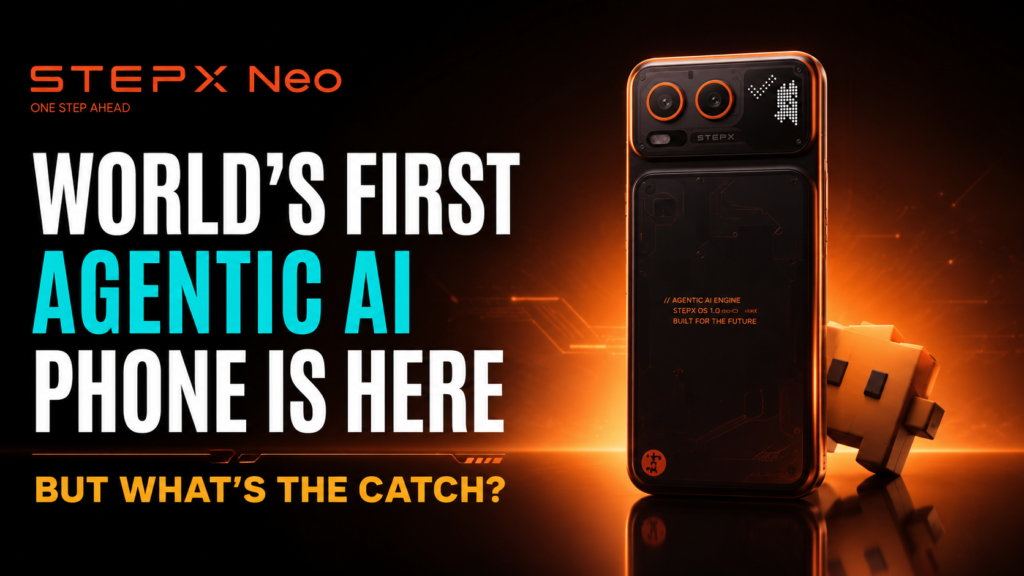

For years, your phone has waited for you to tap.
You open an app, search, fill forms, save details.
That is how smartphones have worked for more than a decade.
But China’s StepX Neo is trying to change that idea.
Instead of making you open apps one by one, this new AI phone wants you to simply say what you want. Then the AI agent tries to complete the task for you.
Imagine telling your phone…
“Plan my weekend trip, find the cheapest morning flight, book a hotel near the venue, add everything to my calendar, and remind me when to leave.”
A normal smartphone gives you apps.
An agentic AI phone tries to do the work.
That is exciting. But it also raises a bigger question.
How much control are you ready to give your phone?
What Is the StepX Neo AI Phone?
StepX Neo is a new AI-focused smartphone unveiled by Chinese AI startup StepFun. It has been reported as the world’s first mass-market agentic smartphone. The phone runs on Step AOS and uses a system-level AI agent called Amoo.
The important part is not just that it has AI.
Many phones already have AI features.
Samsung has Galaxy AI.
Google has Gemini on Android.
Apple has Apple Intelligence.
Many Chinese brands also have AI editing, translation, search, and writing tools.
StepX Neo is different because it is being presented as an AI-native phone.
That means AI is not just another feature inside the phone. It is supposed to become the main way you interact with the device. An AI interface if you’d say so.
It is not only about a new device. It is about a possible new direction for smartphones.
What Does “Agentic AI Phone” Actually Mean?
The word “agentic” sounds technical, but the idea is simple.
An agentic AI system does not only answer your question. It can understand your goal, plan the steps, and try to act on your behalf.
A normal AI assistant may tell you how to book a trip.
An AI agent tries to book it for you.
That is the difference.
For years, phones have been built around apps. Every task starts with opening the right app.
But an agentic AI phone tries to put your intention first.
You ask for the outcome.
The phone handles the process.
At least, that is the promise.
Step AOS and Amoo: The AI System Behind the Phone
StepX Neo runs on Step AOS, which StepFun describes as an operating system designed for AI agents. The phone also includes Amoo, a system-level AI agent that can reportedly work across apps, system functions, and web services using natural language commands.
Some reports say Step AOS is built using Android, Linux, and RTOS layers, but redesigned around AI agent capabilities.
And Amoo is the assistant inside the AI-focused operating layer.
But Amoo is not meant to work like a basic chatbot. It is supposed to understand what you want, break the task into steps, and move through the phone’s functions to complete it.
That is a big claim.
If it works well, your phone could become less like a screen full of apps and more like a personal operator. But if it does not, it could become frustrating very quickly.
Because the more power an AI agent gets, the more accurate it needs to be.
A wrong answer is one thing. A wrong action is another.
StepX Neo vs Regular AI Phones
Most AI phones today still work in a familiar way.
You open an app.
Then AI inside that app helps you edit, summarize, search or translate.
These features are useful, but StepX Neo is trying to move from app-first to agent-first.
Phone with AI features | Agentic AI phone |
|---|---|
AI is added to existing apps | AI is built into the system experience |
You still do most steps | AI tries to handle the steps |
Feature-based | Goal-based |
Works inside limited areas | Works across apps and services |
You control every tap | AI may act on your behalf |
Safer and familiar | More powerful, but riskier |
That is why StepX Neo is interesting.
It is not only competing with phones. It is competing with the way phones currently work.
What Can StepX Neo Actually Do?
According to reports, StepX Neo can perform workflows across apps, system functions, and web services using fewer natural language commands. It is also reported to support features like live translation in 32 languages and some offline AI capabilities.
The claimed use cases include:
- planning trips
- booking travel
- organizing details
- working across apps
- using system functions
- accessing web services
- live translation
- handling multi-step workflows
- using AI even when some tasks are offline
But there is a big difference between a controlled demo and daily life.
App interfaces change, internet drops, forms fail.
Even User preferences are not always clear.
So the real test for StepX Neo is desired working when people use it every day.
Why App Partnerships Matter More Than Specs
For most smartphones, people ask about the processor, camera, display, battery, and storage.
Those things still matter.
But for an agentic AI phone, app permission would be as important as RAM.
If the AI cannot work with the apps and services it becomes limited.
It may be smart, but it cannot do much.
That is why app partnerships are important.
Reports say StepFun is working with major Chinese services, including Alipay, Meituan, Amap, Trip.com, CapCut, JD.com, Didi, Baidu, Weibo, and WPS.
This gives StepX Neo a strong China-first ecosystem advantage.
So, What’s the Catch?
This is where the excitement needs balance. StepX Neo sounds like the future. But every powerful technology comes with tradeoffs.
The catch is not one single thing.
It is trust, privacy, reliability, control, and availability.
Trust First
Would you trust your phone to act for YOU?
It is one thing to ask AI for travel suggestions.
It is another thing to let AI book the ticket.
If an AI phone sends the wrong message, books the wrong hotel, changes the wrong setting, or pays the wrong amount, there’s real world impact .
So agentic AI phones need strong safeguards and accountability.
Payments need approval, messages need review, bookings should show clear details.
So Users should be able to:
- approve important actions
- see what the AI did
- undo mistakes
- limit permissions
- stop the agent anytime
- check action history
Privacy is the next big Question
An agentic AI phone becomes more useful when it knows more about you.
Your calendar, location, messages, contacts..
Personal context helps the AI agent act better. But it also increases the privacy risk.
If the phone is going to act on your behalf, it needs access to sensitive information. At the same time Private data must be protected.
On-device AI can help with privacy. But not every task can happen offline.
Complex bookings, live prices, maps, payments, and web services may still need internet access.
So Privacy controls must be clear.
You should know what the AI can access, when it can access it, and whether the data stays on the device or goes to the cloud.
The third catch is Reliability
Everyday use is unpredictable.
That is why reliability matters more than hype.
Flight price can change halfway through.
What happens if the payment fails?
Two hotels may have similar names.
What happens if the AI misunderstands your budget?
As smart as an AI phone gets it should also be reliably boring when the task is important.
Who is in Control
Automation is useful only when users still feel in control.
AI phone should not treat every task the same way.
It should ask for confirmation when needed and explain what it is about to do.
It should let users choose how much freedom the agent gets.
The future of AI phones will depend on how well they balance automation with user control.
A long way to Availability
StepX Neo appears to be China-first right now.
Global launch details are still unclear. India launch information is also not confirmed from the reports reviewed so far.
So for most readers, StepX Neo is more of a signal than an option.
What We Still Don’t Know About StepX Neo
StepX Neo is exciting, but it is too early for every claim.
A lot still needs to be tested.
Can it protect private data?
Can it save time without creating new problems?
Because Real value only appears after people use the product outside the launch stage.
Reported or claimed | Still unknown |
|---|---|
StepX Neo unveiled by StepFun | Final consumer price |
Runs Step AOS | Global launch plans |
Uses Amoo AI agent | India availability |
Agentic workflows across apps | Full hardware specs |
Some offline AI ability | Battery impact |
Translation features | Long-term privacy reviews |
China app ecosystem support | Real-world reliability |
AI-first system design | Independent hands-on reviews |
Why This Matters for Apple, Samsung, Google and OpenAI
The next major shift in Smartphone space could be intent-first.
You tell the phone what you want, and the AI tries to handle the steps.
Apple, Google, and Samsung are already moving AI deeper into their ecosystems. Google is pushing Gemini into Android. Samsung is expanding Galaxy AI. Apple is building Apple Intelligence into iOS. But StepX Neo points to a more aggressive idea: build the phone around the AI agent from the start.
This also matters because AI companies may not want to stay trapped inside apps forever.
If AI becomes the main interface, the company controlling that interface becomes very powerful.
So StepX Neo raises the question…Who controls the next smartphone experience?
The app store or OS?
The AI ecosystem or the hardware?
Why Should Global Users Care?
There’s a huge app ecosystem out there…Payment Interface, food delivery, shopping & bookings, edtech and more
An agentic AI phone becomes useful only when it works with these local services. But it also needs strong safety.
So yes, global users should care, because the idea may spread and shape the phones you use in the next few years.
Final Takeaway : Future of Smartphones or Just AI Hype?
The idea is strong but execution will decide everything.
People do not need another AI buzzword.
They need a phone that makes daily life easier without making them feel unsafe.
The biggest question is not only whether AI can act for you.
The real question is whether you will trust it enough to let it act.


