
AI Can Summarize the News. But Can It Tell the Full Story?

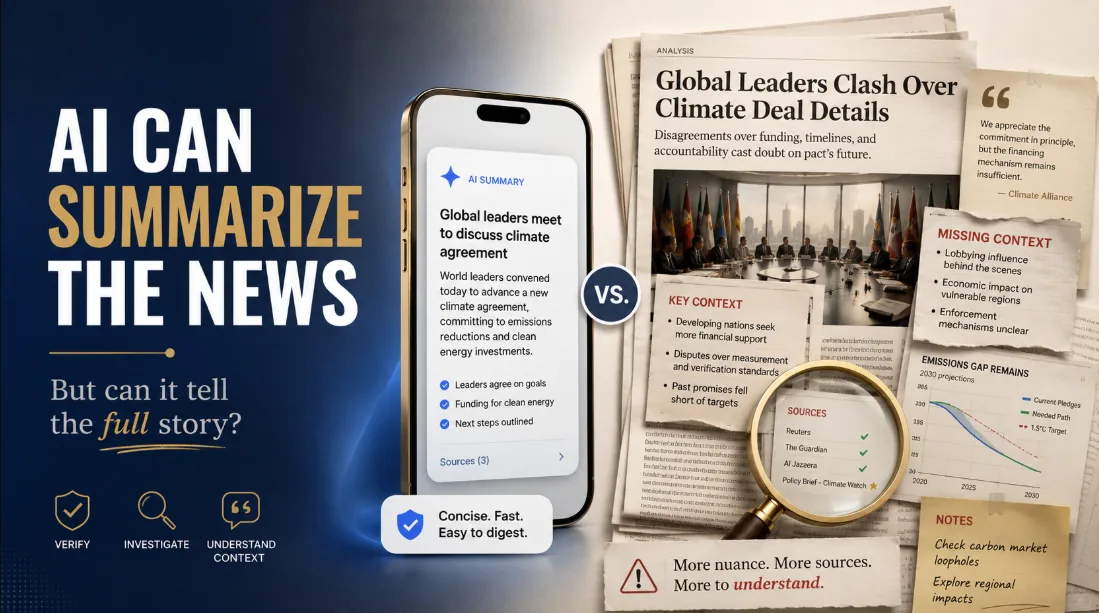
You do not always read the full article anymore.
Sometimes, you read the headline. More often, you read the AI summary.
It feels fast and neat. It feels like someone has already done the hard work for you.
But that is also the danger.
News is not only about what happened. It is also about what is confirmed, what is still unclear, who reported it, what context matters, and what may change later.
AI can make the news feel easier to understand.
But easier does not always mean more accurate.
But they can also leave things out, flatten uncertainty, and make you feel informed before you have seen the full story.
AI Is Becoming Your News Shortcut
AI is moving into search results, phones, browsers, apps, notification systems, and social feeds. For many people, AI is becoming the first layer between them and the news.
Instead of opening five articles, you may ask a chatbot.
Instead of reading a full report, you may read an AI Overview.
And your phone may summarize all notifications for you.
The Reuters Institute’s Digital News Report 2026 found that weekly use of AI chatbots for news rose from 7% to 10% globally. Among people under 35, usage was higher at 16%.
That may still sound small. But for a new way of consuming news, it is a clear signal.
More people are not just searching for news. They are asking AI to explain it.
Many users said they use them to summarize complicated stories, ask questions, collect information from different outlets, or translate news into a preferred language.
That makes sense.
The modern news cycle is exhausting. Stories break quickly. Updates come from everywhere. Headlines compete for your attention. Social media adds speed, emotion, and confusion.
But is that the best practice everyday?
Why AI News Summaries Feel So Useful
Let’s be fair.
News can be overwhelming. A single story may involve history, politics, economics, technology, science, or legal details. Not everyone has the time to read five long articles before understanding the basics.
AI can help you get a quick starting point.
It can explain a complex topic in plain language. It can summarize a long article. It can compare basic points across different reports. It can help you catch up when you are busy.
For students, professionals, and casual readers, that can be valuable.
AI summaries are useful when you want to know:
- what happened
- why people are talking about it
- what the basic background is
- what key terms mean
- what to read next
But all that usefulness comes with a condition.
A summary is not the same as the full story.
It is a compressed version of the story. And compression always removes something.
The Problem: A Summary Can Feel More Complete Than It Is
A good summary should make a story easier to understand.
But it can also make a story feel more settled than it really is.
That is the core problem.
News often includes uncertainty. Early reports may be incomplete. Officials may disagree. Experts may use careful language. Journalists may say “alleged,” “reportedly,” “according to,” or “not yet confirmed” for a reason.
Those words matter.
They show what is known and what is still unclear.
But AI summaries often try to make information clean and simple. That can remove the messiness that makes news accurate.
The risk is not only misinformation. It is false confidence.
You may read an AI summary and feel like you understand the story. But what you actually understand may be only the easiest version of it.
That is dangerous because news shapes opinions.
It affects how you think about politics, companies, health, money, technology, safety, and society.
When AI Gets the News Wrong
The risk is not theoretical.
Apple’s AI-generated news alert summaries became a major warning sign in 2025. Apple paused the feature for news and entertainment apps after complaints from the BBC and other news organizations about inaccurate summaries.
This mattered because the summaries appeared as notifications.
A notification is already short. It has very little room for nuance. If AI compresses it badly, the meaning can change completely.
This is exactly why news is hard to summarize.
Names, dates and legal status matters. Deaths, arrests, elections, financial results, public health claims, and conflict updates cannot be “almost right.”
A small mistake can make a person look guilty.
A missing word can make an allegation sound confirmed.
An outdated update can make a developing story look finished.
That is why AI summaries need more caution than a summary of a recipe, product review, or casual blog post.
Why Links and Citations Are Not Enough
Many people trust AI summaries more when they see links under them.
That is understandable.
Links are better than no links. They let you check where the answer came from.
But citations do not automatically make every sentence correct.
A 2026 study measuring Google AI Overviews looked at more than 55,000 trending queries and broke AI Overview responses into 98,020 atomic claims. It found that 11% of those claims were unsupported by the cited pages, with omission being the dominant failure mode.
It means the AI may show a real source, but still say something the source does not fully support.
This can happen when AI blends information, over-compresses the story, or pulls from nearby context without preserving the exact meaning.
Even though the link may be useful. But the summary still needs judgment.
And most people do not click the link. They read the AI answer and move on. That is where the risk grows.
AI Can Flatten the Uncertainty in News
Good journalism does not only tell you what happened.
It also tells you what is still unclear.
A strong news article may explain:
- what is confirmed or alleged
- who is making the claim
- what evidence exists
- what experts disagree on
AI summaries often compress those layers into a clean paragraph.
This matters especially in stories about politics, war, crime, business, science, and public health. In these areas, the details are not extra. They are the story.
AI summaries often try to make things sound settled. That does not mean AI is always wrong.
It means you should notice when a summary sounds too clean for a messy story.
The Bias Problem Is Not Always Obvious
Bias in AI news summaries is not always loud.
It may not look like one side openly attacking another side.
Sometimes, bias appears through source selection.
Which outlet did the AI use?
Did it search in local language?
Which region did it understand best?
Are some voices left out?
Which facts were treated as central?
These choices shape the summary.
A 2026 study evaluating commercial AI chatbots as news intermediaries tested six AI chatbots on 2,100 factual questions based on same-day BBC News reporting across multiple regional services. It found that every model had its lowest accuracy on Hindi queries, with 79% accuracy compared with 89–91% elsewhere. The study also found signs of Anglophone retrieval bias, such as Hindi queries citing English Wikipedia more than any Hindi outlet.
India is not one news market. It is many news markets at once.
A story may appear in English, Hindi, Bengali, Marathi, Tamil, Telugu, Malayalam, Assamese, and many other languages. Local context can change how a story should be understood.
If an AI tool mostly retrieves English sources, it may miss regional reporting.
If it summarizes a local story using weak or distant sources, the answer may look neutral while still being incomplete.
That is why you should be extra careful with regional news, local politics, and language-specific stories.
AI Summaries May Change What News Survives
There is another problem that goes beyond accuracy.
AI summaries may change the business of news itself.
If users get the answer directly from AI, they may not click the original article. That may feel convenient for readers. But it creates a serious problem for publishers.
Original reporting costs money.
If summaries reduce traffic to original sources, publishers may lose ad revenue, subscribers, and reader relationships.
A 2026 Wall Street Journal report said several major publishers saw large drops in Google search traffic from U.S. users between June 2025 and June 2026, with some publishers considering whether to block Google’s bot because of AI summaries and traffic declines.
Research also points to this pressure. A 2026 study on Google AI Overviews estimated about a 15% reduction in daily traffic to exposed English Wikipedia articles.
This creates a strange tension.
AI summaries need journalism.
But they may also make journalism harder to fund.
When You Should Be Extra Careful With AI News
You do not need to panic every time you see an AI summary.
But you should know when to slow down.
Be extra careful when the news involves:
- breaking updates
- elections or politics
- health, money, or law
- conflict, crime, or safety
- local or regional reporting
These are high-stakes areas.
A mistake here can affect what you believe, how you vote, what you share, where you invest, or how safe you feel.
There are already warning signs. The Guardian reported on research about AI chatbot election advice in Hungary, where responses were found to be inaccurate and unreliable, including inconsistent recommendations and references to parties not on the 2026 ballot.
A wrong answer about a movie release is annoying.
A wrong answer about voting, health, crime, or money can cause real harm.
The higher the stakes, the less you should rely on a summary alone.
How to Use AI News Summaries Without Being Misled
The answer is not to stop using AI summaries completely.
AI can be a good doorway into the news. It can help you understand the basics, find background, and decide what to read next. But it should not be the final destination for serious stories.
Before trusting an AI news summary, ask yourself:
Check | Question to ask |
|---|---|
Source | Who reported this first? |
Timing | Is this breaking or already confirmed? |
Stakes | Could this affect health, money, safety, law, or voting? |
Context | What details may be missing? |
Cross-check | Are trusted outlets saying the same thing? |
A simple rule helps:
For low-stakes topics, an AI summary may be enough to get the gist. For serious topics, click through. Read at least one full article. Compare multiple trusted sources when the issue is political, financial, medical, legal, or safety-related.
Also, be careful before sharing AI-generated summaries.
AI should help you start understanding the news, not finish thinking about it.
So, Can AI Tell the Full Story?
A full story needs more than compression.
It needs original reporting. It needs verification. It needs source judgment. It needs context. It needs uncertainty. It needs updates. It needs human editors who understand what must not be simplified too far.
AI can tell you what a story appears to say. But it may not always tell you what the story means.
Final Takeaway
AI news summaries are here to stay.
They are too useful to ignore. They save time, reduce information overload, and help people understand complicated stories faster.
But they are not the same as reading the news.
They can miss context. They can flatten uncertainty. They can make errors. They can hide source quality. They can reduce clicks to original reporting. And they can make incomplete information feel complete.
So use them. But do not surrender your judgment to them.
Read next

Nothing Phone 3 in 2026: The Best Nothing Bargain, With 1 Painful Catch
Is the Nothing Phone 3 worth buying 15 months on? Android 17, a 3x zoom camera and 7 years of patches, plus the one price rule that decides it.

The Best Laptops Under Rs 50,000: How to Get 16GB RAM for Less
We checked live prices on laptops under Rs 50,000. One 16GB MSI costs Rs 43,219, less than its 8GB twin. Here is what to buy and what to skip.

All 9 RTX Spark Laptops Ranked: Best and Worst Value
We ranked all 9 RTX Spark laptops on price, battery and game support. Buy the ASUS ProArt, skip the Dell XPS 16, and gamers should wait.