

The semiconductor industry has become one of the most important sectors in the global economy. From powering smartphones and laptops to enabling artificial intelligence systems that can generate text, images, and code, chips are now at the center of modern technology.
When discussing the future of computing, one comparison continues to dominate conversations among investors, technology enthusiasts, and business leaders alike: NVIDIA vs Intel.
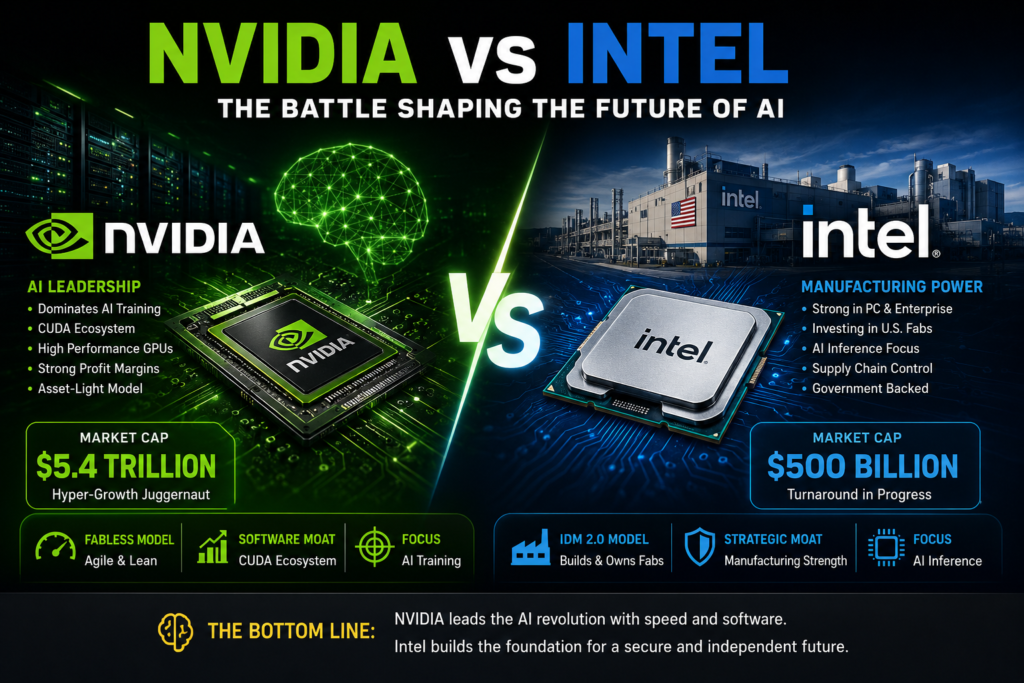
While both companies are giants in the semiconductor space, they are taking very different paths. NVIDIA has emerged as the face of the AI revolution, while Intel is rebuilding itself around manufacturing strength and long-term infrastructure investments.
So, which company is better positioned for the future? The answer depends on what part of the technology landscape you’re looking at.
NVIDIA vs Intel: Two Different Visions
At first glance, NVIDIA and Intel may seem like direct competitors. Both design advanced chips and supply technology to major industries worldwide.
However, their business models are fundamentally different.
NVIDIA focuses on designing high-performance chips and software while outsourcing manufacturing to specialized foundries. Intel, on the other hand, designs and manufactures its own processors using its global network of fabrication plants.
This difference shapes nearly every aspect of how the two companies operate.
NVIDIA’s AI Dominance Continues to Accelerate
Over the last few years, NVIDIA has transformed from a graphics card company into one of the most valuable technology firms in the world.
Its explosive growth has been driven largely by artificial intelligence.
Companies building large language models, AI assistants, image generators, and enterprise AI systems rely heavily on NVIDIA’s GPUs. These chips have become the industry standard for training advanced AI models.
But hardware alone is not NVIDIA’s biggest advantage.
The company’s CUDA software ecosystem has created a powerful competitive moat. Developers, researchers, and enterprises have spent years building tools and applications optimized for NVIDIA hardware. Switching to another platform often requires significant time, effort, and cost.
This software lock-in has helped NVIDIA maintain leadership even as competitors attempt to challenge its position.
Why NVIDIA Is Winning
Several factors continue to support NVIDIA’s growth:
- Strong demand for AI infrastructure
- Industry-leading GPU performance
- CUDA software ecosystem
- High profit margins
- Asset-light business model
- Rapid product innovation
Because NVIDIA outsources manufacturing, it can focus more resources on research, development, and software innovation rather than factory construction.
This approach has allowed the company to scale quickly while maintaining exceptional profitability.
Intel’s Turnaround Story Is Gaining Attention
For years, Intel dominated personal computing.
Its processors powered millions of desktops, laptops, and enterprise systems worldwide. However, the company struggled to keep pace with competitors in advanced manufacturing and AI acceleration.
Today, Intel is attempting one of the largest turnarounds in technology history.
Instead of trying to copy NVIDIA’s strategy, Intel is focusing on its unique strengths.
The company is investing heavily in semiconductor manufacturing facilities across the United States and other Western markets. These investments align with growing government efforts to reduce dependence on overseas chip production.
Intel’s strategy revolves around becoming both a technology provider and a manufacturing powerhouse.
Intel’s Key Strengths
Intel still possesses several significant advantages:
- Established PC processor leadership
- Deep enterprise relationships
- Global manufacturing footprint
- Government support for domestic chip production
- Strong engineering talent
- Expanding AI inference capabilities
While AI training currently receives most of the attention, AI inference is expected to become a massive market over the next decade.
Inference refers to running already-trained AI models rather than creating them. Every chatbot response, recommendation engine, and AI-powered application depends on inference workloads.
Intel sees this market as an opportunity to leverage its existing presence in enterprise computing.
Manufacturing: The Biggest Difference Between NVIDIA and Intel
One of the most important aspects of the NVIDIA vs Intel debate is manufacturing.
NVIDIA’s Fabless Model
NVIDIA follows a fabless approach.
This means the company designs chips but relies on external manufacturers to produce them. The most important partner in this process is TSMC.
Advantages include:
- Lower capital expenses
- Faster innovation cycles
- Reduced operational complexity
- Higher profit margins
However, there is a trade-off.
NVIDIA depends heavily on third-party manufacturing capacity and global supply chain stability.
Intel’s IDM 2.0 Strategy
Intel follows an Integrated Device Manufacturing model.
The company owns and operates its own fabrication plants, giving it direct control over production.
Benefits include:
- Greater manufacturing independence
- Enhanced supply chain control
- Strategic value for governments
- Long-term competitive flexibility
The downside is cost.
Building advanced semiconductor facilities requires billions of dollars in investment, making profitability more challenging in the short term.
Financial Performance Comparison
The financial gap between NVIDIA and Intel has widened dramatically during the AI boom.
NVIDIA has benefited from unprecedented demand for AI hardware, resulting in remarkable revenue growth and industry-leading profit margins.
Its business model resembles a software company more than a traditional hardware manufacturer, allowing it to generate strong returns from every dollar of revenue.
Intel’s financial picture is different.
The company is balancing investments in future growth with efforts to stabilize existing operations. While profits have been pressured by manufacturing expenses and restructuring costs, investors are increasingly watching for signs that the turnaround strategy is gaining traction.
This makes NVIDIA a growth story and Intel a recovery story.
Risks Investors Should Not Ignore
No technology company is risk-free.
Risks Facing NVIDIA
Despite its dominance, NVIDIA faces several challenges:
- High valuation expectations
- Growing competition
- Dependence on external manufacturing
- Geopolitical tensions involving Taiwan
- Potential AI spending slowdowns
Because expectations are already extremely high, even small disappointments can have a significant impact on investor sentiment.
Risks Facing Intel
Intel’s challenges are different:
- Expensive manufacturing expansion
- Fierce competition in AI
- Long turnaround timeline
- Pressure on margins
- Execution risk
The success of Intel’s strategy depends heavily on management’s ability to deliver new products and manufacturing milestones on schedule.
Who Is Better Positioned for the Future?
The answer depends on the timeframe.
In the near term, NVIDIA remains the clear leader in artificial intelligence infrastructure. Its combination of hardware performance, software ecosystem, and market momentum creates an advantage that competitors have yet to overcome.
Intel, however, is playing a different game.
Rather than focusing solely on AI training, the company is building manufacturing capabilities and targeting broader opportunities in AI inference, enterprise computing, and domestic semiconductor production.
NVIDIA is leading today’s AI boom.
Intel is positioning itself for the next phase of the industry’s evolution.
Final Thoughts
The NVIDIA vs Intel comparison is not simply a battle between two chip companies. It represents two distinct approaches to the future of technology.
NVIDIA has become the driving force behind the AI revolution through innovation, software integration, and operational efficiency.
Intel is betting on manufacturing independence, infrastructure investment, and long-term strategic importance.
For businesses, investors, and technology enthusiasts, both companies remain crucial to the future of computing.
One is building the brains of artificial intelligence.
The other is helping build the factories that may power the next generation of technological progress.
The real winner may not be NVIDIA or Intel alone—it may be the broader technology ecosystem that benefits from competition, innovation, and continued advancement in semiconductor technology.


