
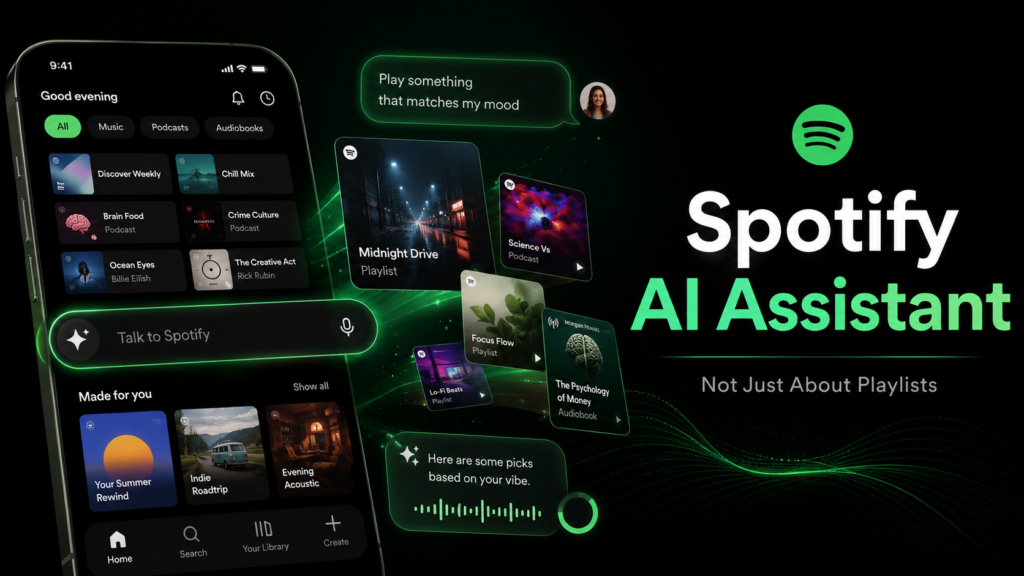

Your next playlist may not start with a search. It may start with a conversation.
That is the bigger story behind the new Spotify AI Assistant. Spotify is testing a feature called Talk to Spotify, which lets eligible Premium users speak or type inside the app to find music, explore listening history, and go deeper on podcasts and audiobooks.
At first, this sounds like another AI playlist tool. But it is bigger than that.
Spotify is not only trying to help you make a better playlist. It is trying to change how you discover audio. Instead of scrolling, searching, skipping, and waiting for the algorithm to guess your mood, Spotify wants you to tell the app what you want.
That could make music discovery feel more personal.
It could also make Spotify even harder to leave.
What Is the Spotify AI Assistant?
The Spotify AI Assistant is officially called Talk to Spotify.
It is a beta feature that lets users ask Spotify for music, podcasts, audiobooks, and listening history using voice or text. Spotify says users can have a back-and-forth conversation inside the app to choose what plays, learn about music, revisit listening history, and explore podcasts and audiobooks without leaving Spotify.
Spotify’s support page says you can ask follow-up questions to refine what you hear. You can also ask about music, podcasts, or audiobooks while using the app.
Reports say that Talk to Spotify appears in the Home and Now Playing sections of Spotify’s mobile app. It is being tested with Premium users in selected markets.
So the idea is simple.
You do not just search Spotify.
You talk to it.
And Spotify plays the answer.
Why This Is Bigger Than Playlists
Most people will hear “Spotify AI Assistant” and think of playlist generation.
That makes sense.
Spotify has already worked on AI playlists and AI DJ features. Playlists are a huge part of how people use the app.
But Talk to Spotify goes beyond playlists.
Spotify says users can explore music, artists, genres, listening history, podcasts, and audiobooks through conversation.
That changes the feature from a simple playlist maker into something wider.
It can help you ask things like:
- Which songs did I play last summer?
- What podcasts explain this topic?
- Which other books has this author written?
- What artists sound like the music I keep replaying?
That is audio discovery.
The playlist is only one part of the story. Spotify wants the whole discovery process to become conversational.
How Spotify Wants to Change Music Discovery
For years, Spotify discovery has worked mostly like this:
Spotify guesses your taste.
You scroll through playlists.
You skip songs.
The algorithm learns from your behavior.
Sometimes your recommendations feel too familiar. Sometimes Spotify keeps pushing the same kind of music because you had one phase, one playlist, or one repeated song. And sometimes you might know the feeling you want, but you do not know the artist, genre, or keywords to search.
The new model could work more like this:
Old Spotify discovery | Spotify AI Assistant |
|---|---|
Search by song or artist | Ask by mood, memory, or intent |
Scroll playlists | Talk through what you want |
Skip until it fits | Refine with follow-up questions |
Algorithm guesses | You guide the session |
You could ask:
Play something like my 2022 summer playlist, but calmer.
Or:
Find beginner-friendly podcasts about AI.
Or:
Play songs I loved last year but stopped listening to.
That feels different from typing “chill songs” into search.
It is more personal. It uses mood, memory, and context.
Spotify AI Assistant vs AI DJ and AI Playlists
Spotify already has AI features. So what makes this one different?
The easiest way to understand it is this:
Spotify feature | What it mainly does |
|---|---|
AI DJ | Plays music and gives spoken commentary |
AI Playlist | Creates playlists from prompts |
Daylist | Updates playlist moods based on habits |
Spotify AI Assistant | Lets you ask, refine, and explore audio |
AI DJ feels like a radio host. AI Playlist feels like a prompt-based playlist maker.
Talk to Spotify feels more like an assistant that sits inside the app and helps you shape what happens next.
That gives the user more control.
Why Spotify Wants You to Stay Inside the App
There is also a business reason behind this.
Spotify does not want you leaving the app to ask ChatGPT, Gemini, Reddit, TikTok, or Google what to listen to.
It wants those questions to start inside Spotify.
If Spotify becomes the place where you ask, discover, save, and listen, it becomes more than a streaming app.
It becomes the front door for audio.
That includes music, podcasts, audiobooks, artist discovery, listening history, and maybe even personal taste.
What This Could Mean for Your Music Taste
The Spotify AI Assistant could make listening easier.
You may spend less time scrolling and discover music that better matches your mood. You may revisit forgotten songs from your own history.Also find podcasts and audiobooks without jumping between apps.
That is the good side.
But there is a more complicated side too.
A chatbot can make recommendations feel more human. But that does not automatically make them more transparent.
You may ask for something personal, and Spotify may respond with suggestions shaped by your listening history, recommendation systems, catalog priorities, and platform goals.
That does not mean the feature is bad. It means users should remember one thing:
AI discovery is still discovery through a platform.
The assistant may feel like it understands your taste. But it is still part of Spotify’s recommendation system.
That raises important questions.
Will it help you discover new sounds?
Or will it keep you inside a safer version of what you already like?
Will it challenge your taste?
Or make your taste more predictable?
A better recommendation system should not only know your taste.
It should know when to gently expand it.
What This Could Mean for Artists
For listeners, the Spotify AI Assistant sounds useful.
For artists, it may feel more complicated.
If AI becomes the guide between listeners and music, artists will care about how that guide works.
They may ask:
- Will smaller artists be recommended fairly?
- Will AI describe songs accurately?
- Can artists control how their music is explained?
- Will listeners discover more music or stay in familiar loops?
Pitchfork reported that Lorde criticized Spotify’s AI-generated “About the Song” description after it misrepresented one of her songs. She also argued that artists should be able to opt out of the feature.
So AI is not only choosing songs, it may also start explaining them.
And when AI explains art, accuracy matters. Context matters. Artist control matters.
Music is not only data.
It is personal, emotional, and often open to interpretation.
When AI becomes the guide, artists will care about who gets guided toward them and how their work is described.
The AI Music Problem Spotify Cannot Ignore
There is another issue Spotify cannot ignore.
AI music spam.
Spotify AI Assistant is about helping people discover audio. But Spotify is also dealing with the rise of AI-generated filler content.
In 2025, Spotify said AI can help artists create and listeners discover music, but bad actors can also use AI and content farms to deceive listeners, push low-quality “slop,” and interfere with real artists. Spotify said it had removed more than 75 million spammy tracks in the previous 12 months.
A 2026 research paper on AI slop in music streaming found that most AI music examined on Spotify received few or no listener plays. It also warned that mass-generated AI music could grow if the industry does not address it properly.
If AI helps us find music, it also has to help us avoid drowning in AI-made filler.
That may become one of Spotify’s biggest challenges.
The assistant cannot only be good at finding songs. It has to be good at finding songs worth hearing.
Who Can Use Spotify AI Assistant Right Now?
For now, it is a beta feature.
Spotify says Talk to Spotify is available to eligible Premium users. The Verge reports that it is being tested with Premium subscribers aged 18 and older in the US, Ireland, and Sweden.
It works on mobile through areas like Home and Now Playing.
Availability may expand later, but Spotify has not made it available everywhere yet.

