
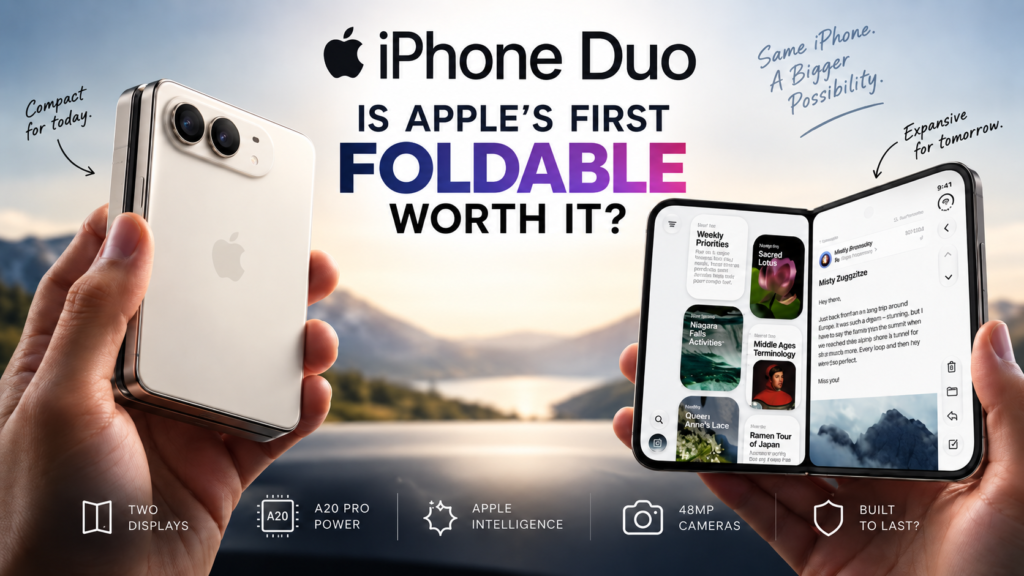

Apple watched the foldable phone race for years and now it’s here, the iPhone Duo, Apple’s first foldable iPhone.
But Apple doesn’t just need to prove that it can make a good foldable. After waiting this long, it needs to prove that a folding iPhone actually makes your life better.
And, most importantly, is any of this worth $1,999?
Let’s find out.
What Exactly Is the iPhone Duo?
Folded, you get a 5.4-inch outer display for normal phone tasks.
Open it, and you’re looking at a 7.6-inch inner display designed for multitasking, entertainment, reading, gaming, and other experiences that benefit from more space.
Here are the essentials:
iPhone Duo | Key Specification |
|---|---|
Outer display | 5.4 inches |
Inner display | 7.6 inches |
Processor | A20 Pro |
Rear cameras | Dual 48MP |
Authentication | Touch ID |
Water and dust resistance | IP68 |
Starting storage | 256GB |
Starting price | $1,999 |
Pre-orders | October 16 |
Availability | October 23 |
Apple Waited Years to Make a Foldable. What Did That Wait Buy Us?
Samsung and other Android manufacturers had to learn some painful lessons in public. Early foldables struggled with fragile displays, visible creases, thick bodies, awkward software, and questions about long-term reliability.
You don’t expect Apple’s first foldable to feel like everyone else’s first foldable. You expect years of waiting to have produced something noticeably more refined.
In some areas, that seems to be exactly what happened.
The Crease Is Better. It Isn’t Gone.
The crease has been one of the most recognizable compromises of foldable phones.
Apple has tried to reduce its impact through the Duo’s display and hinge design. Early hands-on impressions suggest the crease can be difficult to notice from some angles and isn’t especially distracting under your finger.
A crease is still part of the experience though, and a few minutes with a demonstration unit cannot tell you how the inner display will look after months or years of repeated folding.
Apple Still Couldn’t Beat Physics
The phone weighs about 254 grams and measures 11.3mm thick when folded.
You’re going to carry the Duo closed far more often than you’ll admire it fully opened on a desk.
The added weight may become noticeable during one-handed typing, long calls, photography, or simply carrying the phone around all day.
The Real Question: What Can You Actually Do With Two Screens?
You don’t buy a $1,999 phone because its display performs an impressive mechanical trick.
You buy it because that trick lets you do something useful.
And this is where Apple’s software becomes important.
Multitasking Could Be the Duo’s Killer Feature
Imagine researching a trip.
On a normal phone, you might jump between Maps, Safari, your hotel booking, Messages, and Notes.
On the Duo, you could keep Maps beside your itinerary.
You can also save useful app combinations and return to them later.
But none of these tasks are impossible on a normal iPhone.
The difference is friction. A foldable doesn’t necessarily let you do completely new things. It can make things you already do considerably easier.
Entertainment Makes the Bigger Screen Easier to Understand
A much larger display makes sense for:
- movies
- YouTube
- gaming
- ebooks
- comics
The folding design also allows different viewing positions.
You could partially fold the device and place it on a table instead of finding something to prop your phone against.
Again, none of this is revolutionary on its own.
The attraction is having that larger experience available without carrying another device.
Photography Gets More Interesting Too
Folding also creates some clever camera possibilities.
You can use the outer display to let the person you’re photographing see the frame. That could make group photos and portraits easier.
The phone can also partially support itself in certain positions, reducing your dependence on a tripod for some shots.
Could the iPhone Duo Replace Your iPad?
This may be one of the most important questions surrounding the Duo.
Because $1,999 becomes easier to understand if you’re not thinking about it as just another phone.
The Case for It
A 7.6-inch screen is large enough to make several activities far more comfortable than they are on a normal phone.
If you mainly use a smaller tablet, the Duo could reduce how often you reach for it.
You also gain something an iPad can never fully match:
the larger screen is already in your pocket.
There’s no second device to charge, carry, or remember.
But It Isn’t Really an iPad
Screen size isn’t the only thing that makes a tablet useful.
A proper iPad still gives you more room for serious work, better accessory options, and an interface designed around a larger canvas.
If you use your iPad for drawing, heavy multitasking, editing, long writing sessions, or other demanding work, the Duo probably isn’t replacing it.
iOS 27 Might Matter More Than the Hinge
Apple has redesigned parts of iOS 27 to take advantage of the Duo’s changing screen.
Apps can move between the outer and inner displays. You can use Split View, pair apps together, and take advantage of different folding positions.
That sounds obvious. Only it isn’t.
One of the recurring challenges for foldable phones has been getting software to behave naturally as a screen suddenly changes size and shape.
If opening the phone feels like turning your iPhone into a larger iPhone rather than entering an awkward second interface, Apple will have solved an important part of the problem.
Apple’s Secret Weapon Could Be Its Developers
There is another challenge Apple cannot solve alone.
Apps.
Imagine buying a foldable only to discover that many of your favourite apps simply stretch their normal phone interface across the larger display.
Apple is giving developers tools to build layouts and experiences that respond to Duo’s displays and different positions. Some major apps are already adapting.
But the long-term question is whether the wider developer community follows.
Siri AI Makes More Sense on a Foldable Than You Might Expect
There is another advantage to having more screen space.
AI doesn’t necessarily have to replace what you’re doing. It can sit beside it.
Imagine reading something in Safari while asking Siri AI questions about it
That’s a subtle but important change.
AI assistants often take you away from the task you’re performing. A larger multitasking display creates an opportunity for AI to become a companion to that task instead.
The $1,999 Question: Can You Trust a First-Generation Foldable?
Now we reach one of the biggest reasons to hesitate.
Durability.
The Duo uses premium materials, a carefully engineered hinge, Ceramic Shield protection, and IP68 water and dust resistance.
Those are reassuring specifications, but real world evidence still remains important.
What We Still Don’t Know
The questions that matter most include:
- How does the hinge feel after years of use?
- Does the crease become more noticeable?
- How easily does the inner display scratch?
- Does the phone survive repeated drops?
- How expensive will major repairs be?
- How will the folding mechanism affect resale value?
This is the uncomfortable part of buying a first-generation product.
You’re not only paying to experience new technology early.
You’re also accepting more uncertainty.
If you normally keep an iPhone for four or five years, this should matter to you far more than how impressive the Duo looks during launch week.
Apple’s Most Expensive iPhone Isn’t Its Best Camera iPhone
This may surprise some buyers.
At $1,999, you might expect the Duo to contain every piece of Apple’s best hardware.
It doesn’t.
You get a capable dual 48MP rear camera system and some clever advantages created by the folding design.
But if photography is your priority, the iPhone 18 Pro and Pro Max remain more compelling.
They offer Apple’s more advanced Pro camera hardware, including stronger zoom capabilities and features designed specifically for serious photography and video.
That reveals something important about what you’re paying for.
The Duo’s premium is for the form factor.
You’re paying for two displays, the hinge, the engineering required to make them work together, and the software built around them.
You’re not paying for Apple’s ultimate camera system.
If cameras are the main reason you upgrade your iPhone, that’s a major compromise to consider.
Battery Life Comes With an Interesting Catch
Foldables have a basic problem.
Large screens require power.
Apple’s official estimates vary depending on how you use the device, with considerably longer video playback quoted on the outer screen than on the larger inner display.
And that creates an interesting contradiction.
The feature you’re paying extra for is also the feature likely to demand more from the battery.
If you spend most of your day using the outer display, battery life may be less concerning.
But then another question appears:
If you’re mostly using the outer screen, why did you spend $1,999 on a foldable?
Touch ID Is Back
There’s another unusual compromise.
The iPhone Duo uses Touch ID rather than Face ID.
This decision also reveals just how difficult foldable engineering is.
Something has to give, and removing Face ID hardware appears to be one of those compromises.
Even at $1,999, you cannot simply fit every premium iPhone feature inside a folding body.
Did Apple Wait Long Enough to Get Foldables Right?
This brings us back to the question we started with. Apple had years to study the foldable market.
The company appears to have tackled several problems that made early foldables feel experimental:
- better software integration
- smoother transitions between displays
- useful multitasking
- reduced crease visibility
- ecosystem integration
- practical folding modes
But some problems remain.
The Duo is still heavy.
It’s still thick when closed.
Still requires camera compromises.
And it is extremely expensive.
Most importantly, Apple still has to answer the question that has followed foldables since they first appeared:
Do people actually need one?
That question matters beyond Apple.
Foldables have spent years sitting at the premium edge of the smartphone market. They attract attention, but they haven’t replaced the traditional smartphone.
Apple’s entry could change that.
Millions of people who never seriously considered a foldable will now encounter one inside the familiar iPhone ecosystem.
Developers have a new reason to design apps for folding screens.
Competitors have a new reason to improve.
And consumers have another idea of what a smartphone can physically become.
The Duo may therefore matter even if you never buy one.
Final Verdict: Is the iPhone Duo Worth It?
The Duo combines promising software, a genuinely useful larger display, Apple’s ecosystem, new multitasking possibilities, and some clever solutions to problems foldables have struggled with for years.
But it doesn’t eliminate compromise.
You’re getting a heavier phone. You’re giving up some of Apple’s best camera hardware. You’re accepting uncertainty around long-term durability. And you’re paying $1,999 for the privilege.
So is it worth it?
For most people, probably not yet.
A conventional flagship remains cheaper, simpler, lighter, proven, and more than capable of handling everyday life.
Because ultimately, the question isn’t whether Apple has made an impressive folding phone.
The question is whether you’ll actually use the second half.


