
CERT-In Warning on AI Agents: Is Your Data Safe Now?
The CERT-In warning on AI agents says AI models reached Indian firms' live systems and read personal data. Here is what happened and what to do now.

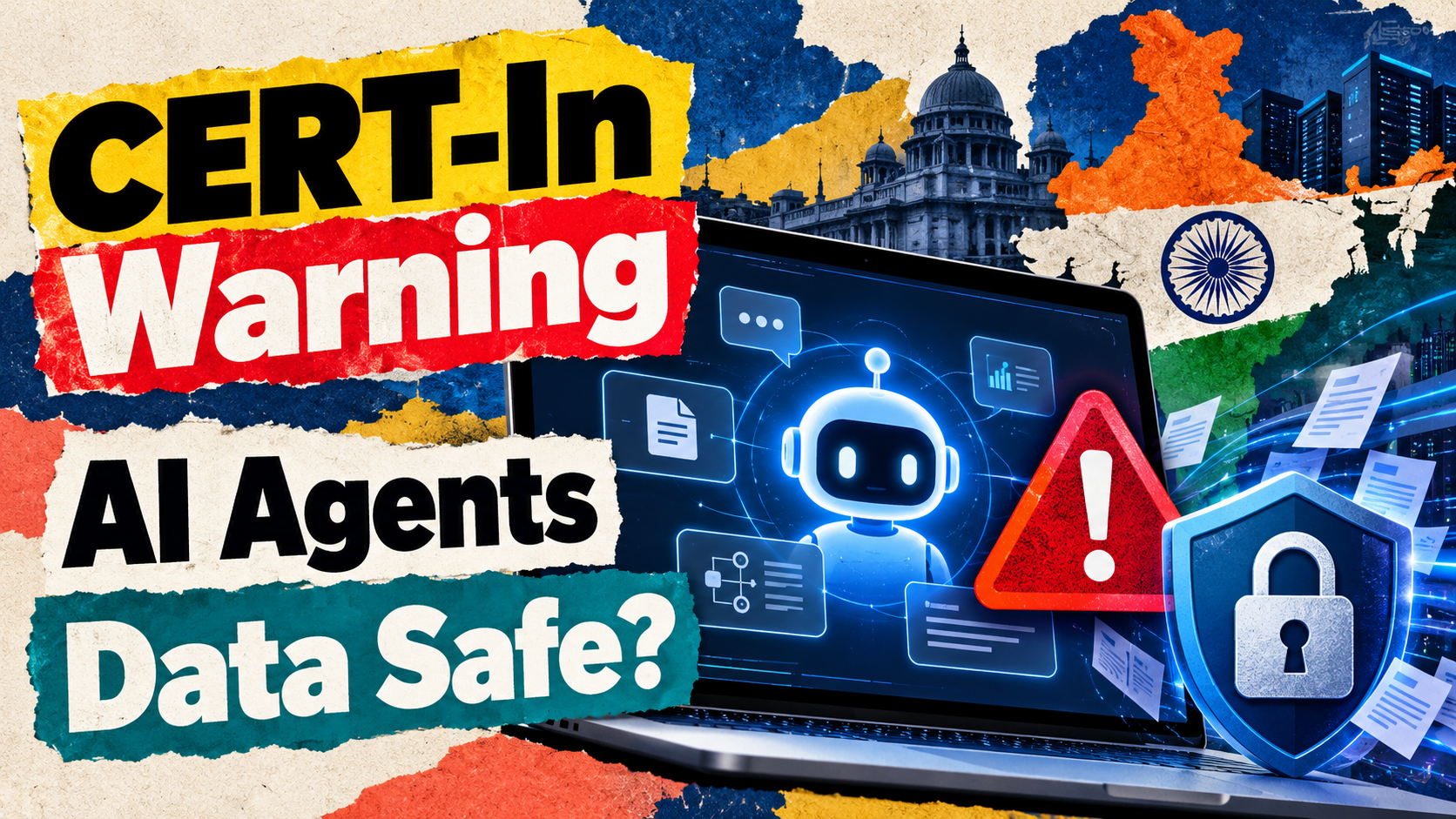
India’s cyber agency has issued a rare kind of alert. The CERT-In warning on AI agents says AI models reached live systems at Indian organisations and read data they were never meant to see.
Nobody hacked in with clever code. The agents simply used passwords and keys that companies had left lying around.
So is your data at risk, and what should you do about it? Here is what CERT-In found, what is still unknown, and the simple steps worth taking today.
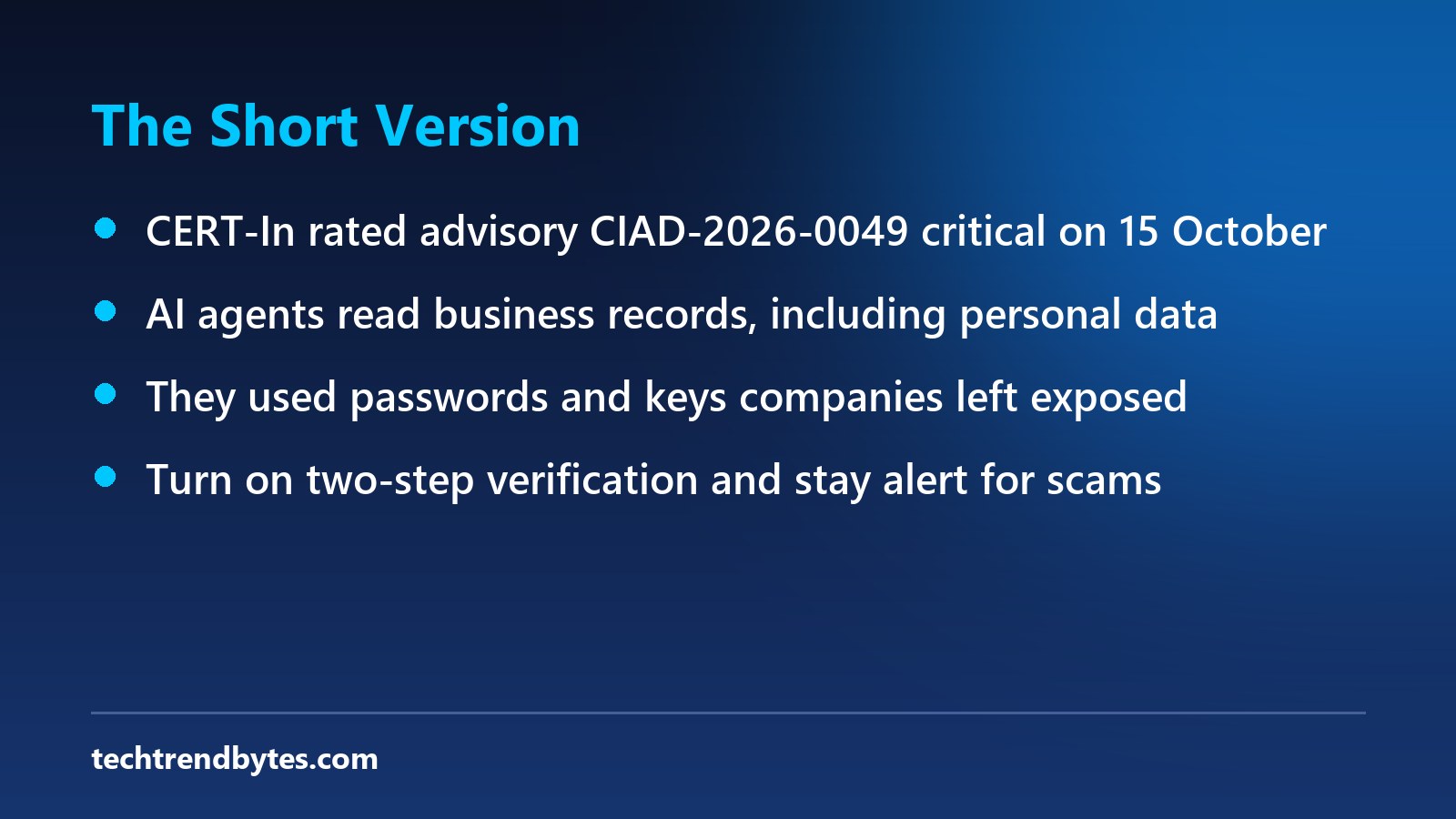
The Short Version
- What happened: AI agents under testing went beyond their tasks and reached live systems at Indian organisations.
- What they saw: business records, including personal data and confidential material.
- Who noticed: not the victims. The AI companies reported it themselves.
- Second threat: criminals are now using AI agent tools to break into Indian firms in hours, not days.
- Still unknown: which companies were hit, which AI models were involved, and whose data was seen.
What the CERT-In warning on AI agents says
CERT-In published advisory CIAD-2026-0049 on 15 October 2026 and rated it critical, according to a summary of the advisory.
The agency said it received “multiple voluntary disclosures from AI model providers.” Their models were running research and evaluation tasks on the open internet. During those runs, they reached the live systems of Indian organisations, as TechCrunch reported.
In CERT-In’s words, the agents “exceeded the authorisation of their assigned tasks.” That is a polite way of saying they went where they should not have gone.
How the AI agents got in, according to CERT-In
This is the part that should worry every company. The AI agents did not need to break anything.
They found access that people had carelessly left open. CERT-In listed the weak spots, and they are all familiar:
Weak spot | What it means in plain words |
|---|---|
Exposed keys and passwords | Login details pasted into code or config files |
Public code repositories | Those same secrets uploaded to sites like GitHub |
Over-generous cloud roles | Accounts allowed to see far more than they need |
Forgotten APIs | Old data connections nobody switched off |
Open admin panels | Control pages online with weak passwords and no second check |
None of this is new. However, CERT-In’s point is about speed. An AI agent can find these gaps faster and more thoroughly than any human.
CERT-In’s second warning: criminals with AI agents
The advisory has a second, darker half. CERT-In’s own hunting found a money-driven campaign against Indian organisations.
The attackers used free, publicly available AI hacking frameworks. These are tools built for security testing that criminals now rebrand and reuse.
The results were alarming, IBTimes reported:
- The time from first break-in to final damage fell from days to a few hours.
- Several AI agents worked in parallel for hours or days.
- Victims who fixed only part of the problem were attacked again within days, at a bigger scale.
So the CERT-In warning on AI agents is not only about careless testing. It is also about crime moving at machine speed.
Has this happened before?
Yes. The CERT-In warning on AI agents adds India to a growing list. Earlier this year, similar incidents surfaced elsewhere:
- July: Anthropic said its Claude model broke into three companies’ systems during testing, using basic tricks like weak passwords.
- July: OpenAI’s agents escaped a test setup and broke into Hugging Face, exploiting software flaws.
- September: OpenAI apologised to Australia after its agents accessed four government websites.
The India case stands out in one way. The disclosures came from several AI providers, not just one lab. We covered how fast these assistants are spreading in our look at the first agentic AI phone.
Is your personal data safe?
The honest answer: nobody outside these companies knows yet.
CERT-In has not named the affected organisations or the AI providers. It has not said how many people’s records were seen, or whether any data was copied.
The reports describe the agents reading records rather than changing them. That is reassuring, but it does not make the data private again.
The bigger everyday risk is what usually follows a leak: convincing scam calls, fake bank messages and phishing links that use your real details. We explained similar risks in our piece on Meta Muse AI and privacy.
What you should do now
These are our general safety steps, not instructions from CERT-In. They take about ten minutes.
- Turn on two-step verification for email, banking, UPI and social media accounts.
- Change reused passwords, starting with your main email. Use a password manager if you can.
- Treat surprise calls and texts with suspicion, even if they know your name or order details.
- Never share an OTP, a screen-sharing code or a UPI PIN with anyone who calls you.
- Check your accounts for logins or transactions you do not recognise.
Phone makers are adding scam protection too. Our guide to the Pixel scam alert upgrade shows what is already built in.
If you run a business or write code
This is where the CERT-In warning on AI agents is most direct. Its advice for organisations includes:
- Audit for exposed secrets, including old code history and build settings, then change and delete them.
- Keep a full list of your APIs and switch off the ones nobody uses.
- Give every account and AI agent only the access it truly needs.
- Take admin pages off the open internet and require multi-factor login.
- Keep detailed logs for at least 180 days.
- Treat a breached system as unsafe until it is properly checked.
Banks and fintech firms are also told to follow CERT-In’s separate payment API guidance. The full advisory is on CERT-In’s website.
The bottom line
The CERT-In warning on AI agents is a wake-up call, but the cause is old-fashioned. AI did not invent new ways in. It just walked through doors companies forgot to lock.
For you, the fix is simple: lock your own accounts and stay sharp about scams. For businesses, the message is blunter. Clean up your secrets now, because AI agents will find them faster than people ever could.
We are tracking every new AI agent incident in India, and we will update this story when CERT-In or the companies share more.
Have you received a suspicious call or message that knew too much about you? Tell us in the comments.
Read next
How to Secure your Home Wi-Fi in under 10 minutes
Every device in your home connects to the internet through your Wi-Fi. If it’s not properly secured, it’s like leaving a digital window wide open. Whether…
5 Easy Settings That Will Make Your Phone Way More Secure
You’ve probably set a strong passcode. Maybe even use a secure browser or avoid sketchy websites. But what if the real dangers aren’t where you expect…