

AI video used to look sometimes amazing and sometimes broken.
And Sometimes it looked funny for the wrong reasons.
But either way, it felt like a demo.
A cool clip is not the same as a useful video. And one impressive generation is not the same as a finished story.
That is why Google Flow matters.
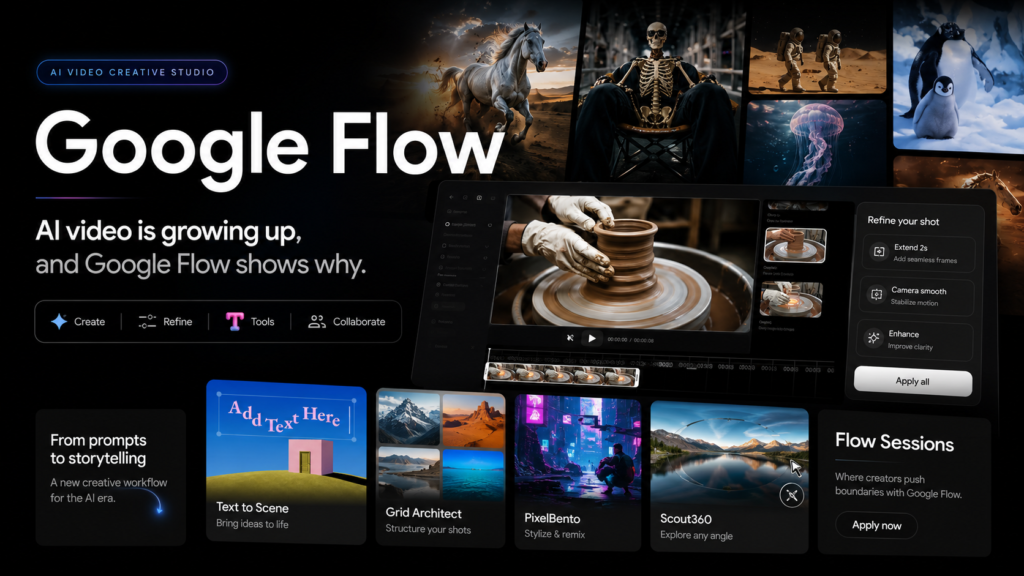
Google Flow shows that AI video is starting to move beyond one-off prompt experiments. It is becoming a creative workflow. A place where you can build scenes, guide visuals, organize ideas, and think more like a director than just a prompt writer.
AI video is no longer only asking:
What can this model generate?
It is starting to ask:
What can you direct?
What Is Google Flow?
Google Flow is Google’s AI filmmaking tool.
Google describes it as built with and for creatives. It brings together some of Google’s most advanced generative AI models, including Veo, Imagen, and Gemini, to help users create cinematic clips, scenes, and stories.
Flow is not just a blank box where you type one prompt and hope for the best.
It is more like a creative workspace for AI video.
Part of Google Flow | What it does |
|---|---|
Veo | Generates video |
Imagen | Helps create or edit visual assets |
Gemini | Helps with prompts, ideas, and language |
Flow | Brings the creative process together |
A useful video needs structure. It needs a scene. The mood. Continuity. It needs a reason to exist.
Google Flow is trying to help with that full creative process.
Google’s own YouTube description says Flow lets creators make cinematic clips, scenes, and stories with character and object consistency, while managing ingredients and prompts in one place. Also the outputs generated using Veo and Imagen include SynthID watermarking.
Why Google Flow Feels Different From a Normal AI Video Generator
A basic AI video generator usually works like this.
You write a prompt.
You get a result.
Then you regenerate.
But it is not always practical.
The problem is control.
A single AI video clip can look impressive, but creators need more than one good clip. They need a sequence. Same character should look similar. They need a mood that carries across scenes. They need camera movement, setting, lighting, and action to stay somewhat consistent.
Google Flow is built around that bigger challenge.
The Big Shift: From Prompting to Directing
The most important change in AI video is not only better resolution or more realistic motion.
It is the shift from prompting to directing.
Prompting is when you ask the model for something and wait.
Directing is when you guide the idea.
You decide what the scene should feel like and what needs to change.
You decide which version is worth keeping.
It suggests that AI video is growing up. The next phase is not just “make me a video.”
It is closer to:
Help me shape this idea into a visual story.
That is a very different kind of tool.
Why Creators Should Care About Google Flow
Google Flow could matter a lot for creators.
Not only professional filmmakers.
Also YouTubers. Students. Bloggers. Marketers. Designers. Small business owners. Startup teams. Teachers. Anyone who needs visuals but does not always have a full production setup.
You need cameras, locations, actors, lighting, editing, animation, stock footage, or a lot of time. Even a simple visual concept can take effort.
Google Flow could reduce that barrier.
It may help you create:
- YouTube B-roll
- short film concepts
- ad mockups
- product explainers
- college project visuals
- blog and social media video assets
It only means more people may be able to show their ideas visually.
A creator who has only a rough concept can turn it into a visual draft. A student can make a project presentation feel more alive. A blogger can create short visual clips around a tech story. A small brand can test an ad idea before spending money on production.
Google Flow could help small creators see an idea before they spend money producing it.
That is a big deal.
Google Flow Could Make Visual Prototyping Easier
One of the most realistic uses of AI video is not replacing full production.
It is pre-production.
Flow could help with early creative work like:
- moodboards
- concept trailers
- storyboards
- pitch videos
- ad testing
- scene planning
This is where AI video becomes useful even if it is not perfect.
Before tools like this, visual prototyping often needed design skills, editing skills, or a budget.
Now it can become more like a draft.
You try an idea. Review it. And improve it.
That can make creative work faster.
But it can also make it more competitive.
If more people can create visual drafts, then the difference will not be who can generate something. The difference will be who has the better idea.
What Google Flow Still Cannot Solve
Google Flow is powerful, but AI video still has limits.
The Verge reported that Flow uses Veo 3.1 to generate eight-second clips from text prompts or images, with Google expanding audio support to image prompts, scene transitions, and clip extension.
That is impressive, but it also shows where the technology still is.
Short clips are not the same as full films. A useful video still needs selection, editing, timing, pacing, and judgment.
Some limits still matter:
- outputs may vary
- credits and plan limits matter
- complex scenes may need many attempts
- physics and continuity can still break
- access may depend on region or subscription
- final editing may still be needed
Google’s original Flow announcement said Google AI Pro offered key Flow features and 100 generations per month, while Google AI Ultra offered higher usage limits and early access to Veo 3 with native audio generation. Google’s later Flow credits help page says Google AI Pro subscribers receive 1,000 Flow credits each month, while Google AI Ultra $100 subscribers receive 10,000 credits each month, with credit costs counted per generation.
AI video can be expensive in credits. You may need several attempts to get the scene right. A short clip that looks effortless may have taken many generations behind the scenes.
The Trust Problem: Deepfakes, Copyright, and Watermarks
As AI video gets better, the trust problem gets bigger.
A realistic AI-generated clip can entertain people.
It can also mislead them.
This is why AI video is different from AI text or AI images. Video feels more convincing. People often believe what they see, even when they know editing exists.
The risks are serious:
- fake clips can look believable
- synthetic ads can confuse viewers
- political misinformation can spread faster
- creators may copy styles too closely
- audiences may not know what is AI-generated
Google says outputs generated in Flow using Veo and Imagen include invisible SynthID watermarks. It also says videos generated in Google One Free, Plus, and Pro tiers include a visible watermark that indicates the content was made with Veo.
But watermarking is not a complete solution.
Google DeepMind describes SynthID as a watermarking and detection technology for AI-generated content, but also states that it is not a silver bullet for identifying AI-generated content.
That means viewers still need media literacy.
Creators still need responsibility.
Platforms still need rules.
The Real Opportunity Is for Small Creators
Big studios already have teams.They have cameras, editors, VFX artists, designers, sound teams, producers, and budgets.
Small creators do not.
That is why Google Flow could be especially important for independent creators and small teams.
It could help people who have strong ideas but limited resources.
This does not remove the need for skill. It changes the kind of skill that matters.
Instead of only asking, “Can you shoot this?” creators may ask:
Can you imagine it clearly enough to guide the tool?
That is a new creative advantage.
The Hidden Risk: More Video Does Not Always Mean Better Video
There is another side to this.
If AI video becomes easy, the internet will get more video.
A lot more.
Some of that will be creative, useful, and beautiful.
Others will be low-effort.
Some of it will be fake.
Others will look polished but feel empty.
That is a real risk.
This matters because your attention is already under pressure. Social feeds are full. Platforms reward speed. Short videos already compete for every spare minute.
If AI makes video cheap to produce, the volume of content could rise even more.
That means viewers will need sharper judgment.
Creators will need stronger originality.
Brands will need better taste.
What Google Flow Means for the Future of AI Video
The future may not be only about single viral clips.
It may be about systems that help you build a full creative process.
That could mean:
- reusable characters
- consistent worlds
- longer workflows
- better audio control
- visual ingredients
- story-level editing
- integration with creator tools
AI video is becoming less like a novelty and more like a production layer.
Not a replacement for creativity, but a new layer inside it.
This could change how videos are planned, pitched, drafted, tested, and produced.
If the tools become good enough, more people will be able to turn ideas into visuals. But the best work will still come from people who understand story, emotion, pacing, and audience.
Final Takeaway
Google Flow shows that AI video is becoming a creative workflow.
That does not mean every AI-generated clip will be good, original, or trustworthy. It does not mean filmmakers and editors suddenly stop mattering. It does not mean one prompt can replace a full creative process.
But it does mean the barrier to making visual ideas is falling fast.
That could help students, small creators, bloggers, marketers, and independent filmmakers.
It also brings new risks around deepfakes, copyright, synthetic media, content overload, and trust.
So the next question is not only what AI can generate.
It is what humans choose to create with it.


