
Xiaomi 17 Ultra vs Galaxy S26 Ultra: The Painful Truth About Rs 1,39,999 You Need to Know Now
Xiaomi 17 Ultra vs Galaxy S26 Ultra at the same Rs 1,39,999. One gives 512GB, the other 7 years of updates. Here is who should buy which.

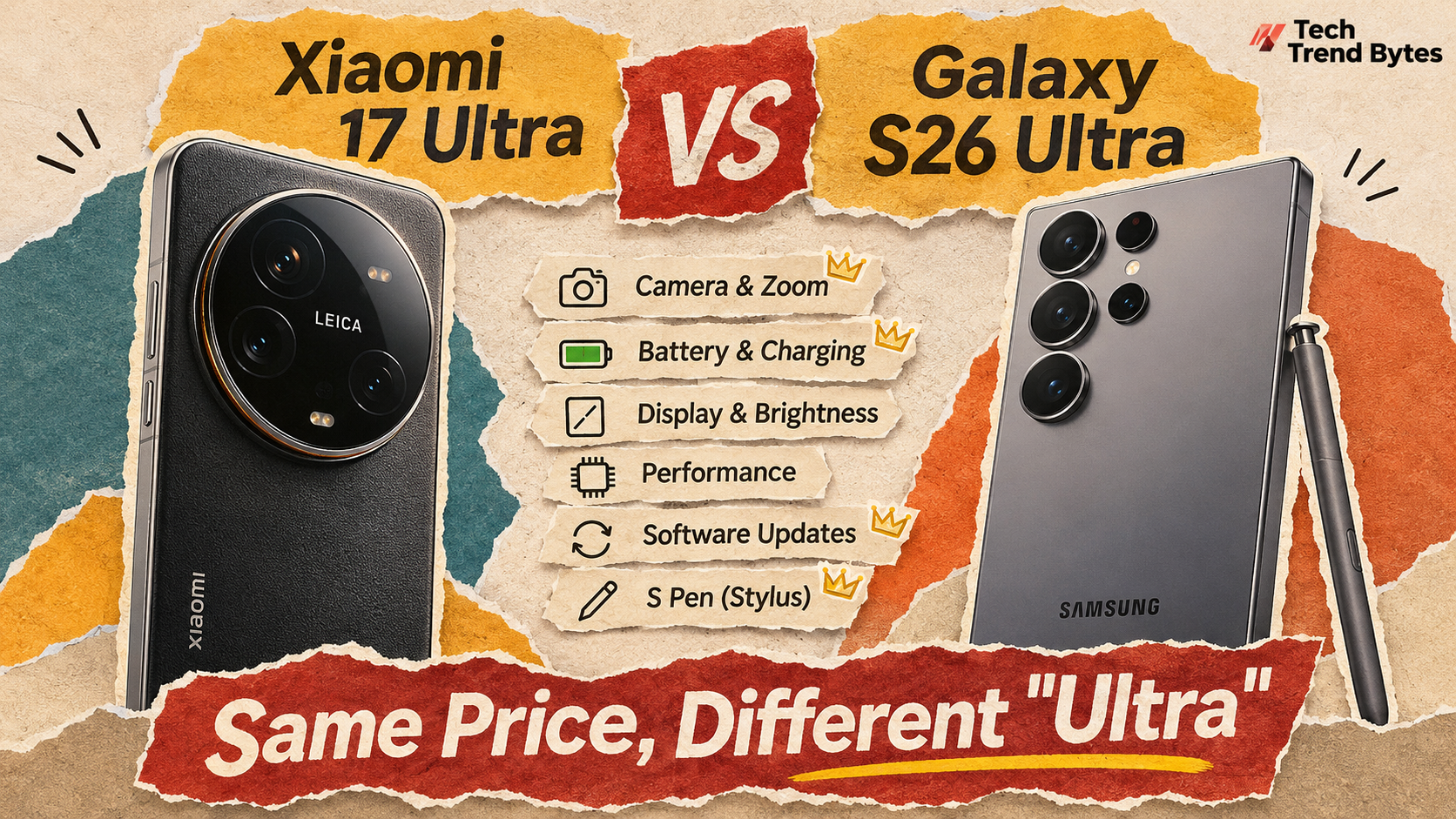
The Xiaomi 17 Ultra vs Galaxy S26 Ultra choice just got harder. Today, on 23 November 2026, both phones list at Rs 1,39,999 on 91mobiles and Smartprix, but the boxes are not the same.
The Xiaomi gets you 512GB of storage at that price. However, the Samsung gets you only 256GB. That one fact changes the whole comparison.
Here is what each phone does better, where reviewers disagree, and who should buy which.
The Short Version
- Buy the Xiaomi 17 Ultra if you care most about photos, zoom, battery and storage.
- Buy the Galaxy S26 Ultra if you want the S Pen, seven years of updates and a lighter body.
- Price today: Both Rs 1,39,999, but the Xiaomi is 16GB and 512GB. The Samsung is 12GB and 256GB.
- Matching storage: A 512GB Galaxy S26 Ultra costs Rs 1,59,999, which is Rs 20,000 more.
- Our pick: The Xiaomi, if you keep phones for four years or less. The Samsung, if you keep them longer.
Xiaomi 17 Ultra vs Galaxy S26 Ultra: Price and Storage
Start with the money, because it is the surprise. 91mobiles lists the Xiaomi 17 Ultra, in its only 16GB and 512GB version, at Rs 1,39,999 on Amazon and Croma. Flipkart shows it at Rs 1,27,997.
The Galaxy S26 Ultra starts at Rs 1,39,999 for 12GB and 256GB. Smartprix agrees on both figures. The 512GB model is Rs 1,59,999, and the 1TB model is Rs 1,74,999.
Xiaomi 17 Ultra | Galaxy S26 Ultra | |
|---|---|---|
Base price | Rs 1,39,999 | Rs 1,39,999 |
Base storage | 512GB | 256GB |
512GB price | Rs 1,39,999 | Rs 1,59,999 |
Lowest listing seen | Rs 1,27,997 (Flipkart) | Rs 1,39,999 |
So the honest comparison is not price against price. It is Rs 1,39,999 for 512GB against Rs 1,59,999 for 512GB. Prices change daily, so check the live listing before you pay.
Camera: The Xiaomi Has the Bigger Hardware
The Xiaomi has a 50MP main camera with a one-inch sensor and Leica tuning. It also has a 200MP telephoto with continuous optical zoom between 75mm and 100mm, according to 91mobiles.
On the other side, the Samsung has a 200MP main camera, a 50MP ultrawide, a 50MP telephoto at 5x and a 10MP telephoto. That is four rear cameras to the Xiaomi’s three.
Android Central says the Xiaomi “kicks the Galaxy S26 Ultra’s butt” on cameras, display colour and battery life. Notebookcheck expects the larger sensor to help in low light. Tom’s Guide found the gap closer in side-by-side photos, with Samsung’s vivid colours still appealing.
Overall, the Xiaomi wins on zoom and low light. The Samsung holds up well on colour and on having more lenses. We have not tested either phone, so this rests on the reviews linked here.
Battery and Charging
First, the biggest spec gap. The Xiaomi has a 6,000mAh battery with 90W wired charging. The Samsung has 5,000mAh and 60W charging, per 91mobiles.
Android Central says the Xiaomi has a “massive battery with much faster charging”. However, real tests are closer than the spec sheet suggests. For example, in our Xiaomi 17 Ultra long-term post, two outlets disagreed on which phone lasts longer.
So the fair reading is that the Xiaomi charges much faster and has more capacity. Whether it lasts longer on a given day depends on the test.
Display, Speed and Weight
Next, the screens. Both phones have a 6.9-inch screen at 120Hz. Android Central says the Xiaomi uses a 12-bit AMOLED panel with up to 3,500 nits of peak brightness. Samsung’s tops out at 2,600 nits.
Still, Samsung’s screen has a trick the Xiaomi lacks. Its Privacy Display darkens the screen when someone looks from an angle. 91mobiles calls it the key highlight of the phone.
But there is a catch on the Samsung side. Android Central reports the panel is 8-bit and uses dithering to fake 10-bit colour. That can cause slight flicker for sensitive eyes.
Meanwhile, both use the Snapdragon 8 Elite Gen 5. 91mobiles measured over 3.9 million on AnTuTu for the Samsung and over 3.6 million for the Xiaomi. Neither will feel slow in daily use.
In weight, the Samsung is the lighter phone. Android Central lists it at 7.9mm and 214 grams, and says the Xiaomi is a little thicker and heavier. The Samsung also has a built-in S Pen, which the Xiaomi does not.
Software Updates: Samsung’s Biggest Edge
Android Central lists seven years of software support for the Galaxy S26 Ultra. It also says the Xiaomi’s OS upgrades fall a little short of Samsung’s.
Likewise, 91mobiles makes the same point about the Xiaomi. It lists the update policy as a weak spot.
So if you keep a phone for six or seven years, this matters more than any camera test. But if you upgrade every three or four years, it barely matters. For how the next Android release is shaping up, see our Android 17 update guide.
Which Should You Buy?
Buy the Xiaomi 17 Ultra if you shoot a lot of photos, zoom often and want fast charging. You also get double the storage for the same money.
Buy the Galaxy S26 Ultra if you want a stylus, a lighter phone and the longest update promise. It is also the safer pick for anyone who values the Privacy Display.
Wait if, instead, you want to see the Galaxy S27 Ultra. So far it is only a leak, and Samsung has not announced it.
Skip both if you do not need Ultra-level cameras. Our Galaxy S26 Ultra verdict covers who is better off with a cheaper Samsung.
Finally, before you decide, our Galaxy S26 Ultra price history shows how far prices have climbed since 2021. A flat Rs 1,39,999 is not cheap, even if it is fair.
Quick Answers
Which is cheaper, the Xiaomi 17 Ultra or the Galaxy S26 Ultra?
Both list at Rs 1,39,999. The Xiaomi includes 512GB. The Samsung includes 256GB.
Which has the better camera?
Reviewers favour the Xiaomi for zoom and low light. Samsung is competitive on colour.
Which has the better battery?
The Xiaomi has more capacity and faster charging. Real-world run time is closer.
Which gets updates for longer?
The Galaxy S26 Ultra, with seven years listed by Android Central.
The Bottom Line
Therefore, at the same Rs 1,39,999, the Xiaomi 17 Ultra is the better value. It gives you more storage, a bigger battery and faster charging, and reviewers rate its cameras higher.
On the other hand, the Galaxy S26 Ultra is the better long-term phone. It has the S Pen, a lighter body and seven years of updates.
What we do not know is how the Galaxy S27 Ultra will change this. We also have not held either phone, so the verdict rests on the reviews and listings linked below.
Sources: 91mobiles Galaxy S26 Ultra, 91mobiles Xiaomi 17 Ultra, Smartprix Galaxy S26 Ultra, Smartprix Xiaomi 17 Ultra, Android Central comparison, Tom’s Guide.
Read next
vivo X500 Sale Offers: The One Big Trap in the New 2 December Sale, and What It Is Worth
The vivo X500 sale offers are not announced yet. Sale is tipped for 2 December, and vivo's last two launches show the 10% cashback does not stack.
Pixel 11 Pro XL vs Galaxy S26 Ultra: The Painful Truth About the 200MP Camera You Need to Know Now
"Pixel 11 Pro XL vs Galaxy S26 Ultra on camera, battery, speed and price. See who should buy the Pixel, who needs the Ultra and who should skip both."
Pixel 11 Pro Worth It? The Best Camera Has 3 Painful Catches You Need to Know Now
Is the Pixel 11 Pro worth buying? The best compact camera, a slow 30W charger and a weak chip. Who should buy, wait or skip, with the reviews compared.