
Free AI Tools Are Not Really Free

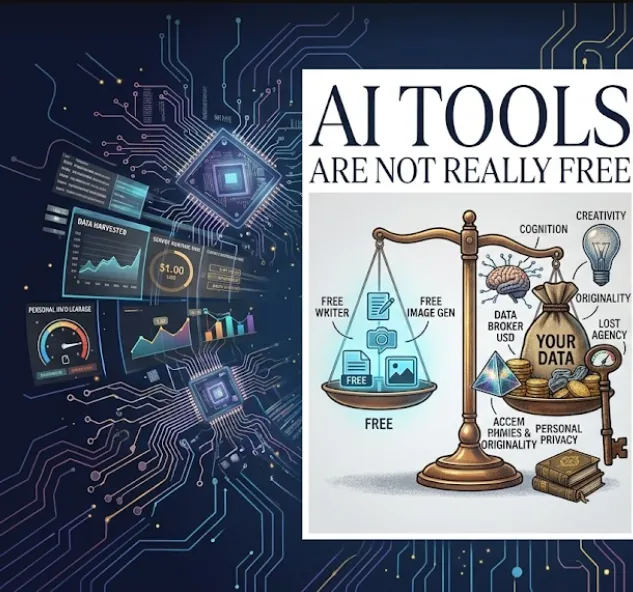
You describe a problem, and it gives you ideas.
You paste messy notes, and it turns them into a clean summary.
You are stuck on code, an essay, a business plan, or a college assignment, and AI helps you move forward.
It is fast.
It is easy.
And it’s almost free.
In fact, not using AI today can be a real disadvantage. AI can improve efficiency and help compete with people who are already using it well.
But free does not always mean costless.
You may not always pay with money.
The Problem is not AI. It’s dependency.
Why Free AI Tools Feel So Powerful Right Now
Free AI tools are popular because they solve a very real problem.
They make difficult tasks EASIER TO START.
Most people do not struggle only because a task is hard. They struggle because the first step feels heavy.
Writing the first line is hard.
Planning a project is hard.
Explaining your thoughts clearly is hard.
AI reduces that starting friction.
It gives you direction, structure and a “draft” to start with. AI can save time and assist people who do not have expert help around them.
That is why so many people use AI, the fact that OpenAI and Anthropic have 900million+ weekly users is a testimony to this.
This is useful. There is no point pretending otherwise.
But there is a catch.
The same thing that makes AI powerful also makes it risky.
IT IS TOO EASY.
The danger begins when helpful support becomes your default starting point for every thought.
Are Free AI Tools Really Free?
Many tech products start with free access. Social media and Search engines did it. Cloud tools and Apps do it all the time.
Free access helps companies grow, and AI companies are no exception.
It helps them get users, collect feedback, build habits around them and become your default choice.
That is no evil….It simply means free products often have a business reason behind them.
Companies want adoption. They want students, creators, developers and other businesses using their tools.
Once a tool becomes part of your daily workflow, leaving it becomes harder.
That is where profits build for the company.
But No, we are not pointing to the conclusion that AI is bad….at least not yet.
Free AI tools can be useful. But they are not always “free” in the deeper sense.
The price may show up later as a subscription.
But if a tool is getting you real value and efficiency what’s the harm in paying this price too, right?
The Hidden Costs of Free AI Tools
The hidden cost of free AI tools is not only money.
It can be much deeper than that.
Your attention
AI tools are designed to be useful, fast, and easy to return to.
That means you may start using them for more tasks than you planned.
So eventually you stop sitting with a problem, struggling for the first idea, and giving your brain time to work.
Your brain needs time and space. Silence is not the absence of thought. It is often where creativity, clarity, and innovation begin.
Your habits
When AI gives you fast answers, slow thinking starts feeling annoying.
You may begin to think:
Why write this myself?
Why read the full article?
Why solve this error manually?
Why spend time brainstorming?
AI can do it, often faster (but not necessarily the better)
That thought is convenient. But it is also dangerous.
Because skills do not grow only from results and reading. They grow from effort and experience.
Your data and feedback
When you use AI tools, your prompts, choices, corrections, ratings, and usage patterns can help companies understand what users want.
This is not always bad. Feedback can improve products.
But it is still part of the value exchange.
You may not be paying with money, but your usage is the payment.
Your workflow
You build your routine around it. Your notes, workflow, planning and even your learning style start depending on it.
This is called lock-in.
The more useful the tool becomes, the harder it is to stop using it.
Your patience
AI gives instant output.
But deep thinking is slow.
Learning is slow.
Building skill is slow.
Changing your mind after reflection is slow.
When you get used to instant answers, slow thinking can start feeling like a waste of time.
That is one of the most serious costs.
Because some of the most important thinking in life cannot be rushed.
The Free Trap: A Pattern Worth Noticing
History has plenty of examples where “free” access helped build long-term dependence on a product. And eventually, leaving gets harder than staying.
AI tools aren’t the same as those older examples. The stakes, the harm, and the context are all different. So we shouldn’t stretch the comparison too far.
But one question is still worth asking:
When something powerful is made free, are you just trying it? Or are you being trained to need it?
This isn’t about bad intentions. Companies need revenue, and dependency is simply good business. That’s not a conspiracy it’s a business model.
The part that matters more is this: when a product is free, the payment is often you.
Not your money. Sometimes it’s your ability to think without the tool.
So ask yourself what you’re actually trading and you will notice when a habit has quietly become a dependency.
The Real Risk Is Not AI. It Is Cognitive Offloading
Cognitive offloading means using an outside tool to reduce mental effort.
You already do this all the time.
You use a calculator instead of doing every calculation in your head. GPS instead of remembering every road, and search engines instead of memorizing every fact.
This is not bad.
Tools exist because humans have always tried to reduce unnecessary effort and increase efficiency.
The problem begins when you offload from the roots.
A calculator is useful. But if you never understand basic math, you become weak.
GPS is useful. But if you use it for every route, your sense of direction may fade.
AI is useful. But if it thinks for you every time, your own thinking gets less practice.
Research has started raising similar concerns. A 2025 study in Societies found that cognitive offloading played a role in the relationship between AI tool use and lower critical thinking skills. The study does not mean every AI user becomes less intelligent. But it does support a serious point: how you use AI matters.
AI should reduce unnecessary effort.
It should not remove your ability to make effort.
It could guide your thinking not think for you.
How AI Dependency Slowly Forms
AI dependency does not happen overnight.
It happens through small daily choices.
At first, you ask AI for help because you are stuck. That is fine.
Then you ask AI because you are tired. That is understandable.
Then you ask AI because it is faster. That might be convenient.
Then you ask AI before even trying.
That is where the problem begins.
This loop is powerful because it does not feel harmful at first.
It feels productive.
Student gets the assignment done.
Creator gets the caption ready.
Coder gets the error fixed.
Worker sends the email faster.
Reader gets the summary without reading the full article.
The output is there. But…
Can the student explain the assignment?
Can the creator still write in their own voice?
Can the coder understand the fix?
Can the worker think clearly without a draft?
Can the reader form their own view?
The problem is not that AI gives answers.
The problem begins when you stop forming your own first answer.
AI Can Make You Faster, But It Can Also Make You Mentally Lazy
AI creates speed, which feels like progress.
But faster output does not always mean better learning.
This is one of the biggest traps of AI.
You can produce more while understanding less.
Create faster while learning less.
Write faster while thinking less.
You can reply faster while feeling less connected to your own words.
A 2026 study on human-AI interaction found that people expected AI assistance to save more time than it actually did on simple cognitive tasks. The study also found that people reported lower effort with AI, even when completion time was not actually better.
AI can make work feel easier. But easier is not always better.
Learning often requires friction.
You need to struggle with an idea, make that bad first draft, sit with confusion. Test your own solution and notice what you do not understand.
That effort is not wasted.
It is how your brain gets stronger.
If AI removes every hard part, you may still get the final output. But you may miss the growth that should have happened along the way.
Why Avoiding AI Completely Is Also a Mistake
Now let us be clear.
This article is not saying you should stop using AI. That would be bad advice.
Avoiding AI completely in this age is not wisdom. It is a disadvantage.
AI is already changing how people learn, work, code, write, research, design, market, and build businesses. Even Startups are using it.
If you refuse to use AI at all, you may fall behind people who use it well.
AI can help you learn faster, get feedback, plan better and compare options quickly.
And yes it can improve your productivity and explore ideas you may not have considered.
The answer is not “AI is bad.”
But the answer is also not “AI should do everything.”
AI should be your assistant, not your identity.
It should support your thinking, not replace it.
AI is a Tool, Not a Replacement
A good tool makes you more capable.
A bad habit makes you more dependent.
AI can become either one. It depends on how you use it.
A simple Rule: Think First, AI Second, Verify Third
This is easy to remember.
Think first
Before asking AI, try the task yourself.
Your first attempt does not need to be perfect.
AI second
After that, use AI.
Ask it to improve your idea, explain, compare, simplify or challenge weaknesses.
Verify third
Check the facts, logic, whether it matches your goal and can you explain it to yourself.
This matters because AI can sound confident even when it is wrong or incomplete.
The goal is to use AI in a way that leaves you smarter, clearer, and more capable.
A good AI session should end with you understanding more than before.
How to make the best use of AI without becoming dependent
Use the 2-minute rule to Ask yourself:
What do I already know?
What’s confusing me?
What would my first answer be?
Where exactly am I stuck?
Then ask AI.
Your prompt will be better because your thinking has already started.
Make a rough outline.
Your first draft can be ugly.
But write the rough version yourself. Then ask AI to improve it.
When you make the first draft, the thought begins with you.
AI becomes the editor, not the author of your mind.
Ask AI to challenge you
Do not only ask:
“Write this for me.”
Ask better questions:
- Am I missing somehting here?
- What are the weak points and counterarguments?
- Where is my logic unclear and How can I make this simpler?
- What would an expert question here?
- What assumptions am I making?
Rewrite in your own voice
Never use AI output blindly.
Improvise the wording.
Add your own examples.
Remove lines that sound fake.
Fix the tone.
Make it sound like you.
This matters more than people think.
If everyone copies AI-style writing, everyone starts sounding the same.
Your voice becomes your advantage.
Practice without AI sometimes
You do not need to use AI for every task.
Sometimes, solve the problem yourself.
Write without AI.
Read without summaries.
Debug manually.
Think through a decision alone.
Study from your own notes.
Try a project without constant prompting.
This keeps your mental muscles active.
You do not need to reject AI.
Just make sure, you can still think without it.
Verify important information
This is non-negotiable.
Always verify AI output when the topic matters.
Especially for health, finance, law, technical information etc.
AI can help you find direction.
But it should not be your only source of truth.
Keep learning the basics
AI is more useful when you understand the subject.
A beginner with AI may get answers but not know what is good.
A skilled person with AI can judge, improve, and apply the output.
That is the real difference.
AI does not remove the need to learn.
It increases the value of people who know how to judge.
Halos and Horns of AI
Avoid using AI to:
- write every message for you
- form every opinion for you
- complete assignments you do not understand
- generate code you cannot explain
- summarize everything so you never read deeply
- make personal decisions without reflection
- replace your own creativity completely
- avoid every hard part of thinking
Comparing AI’s useful traits these may feel good in the moment. But over time, it can damage your learning, creativity, and confidence.
There is a big difference between help and escape.
The more you use AI to escape effort, the more dependent you become.
Signs You Are Becoming Too Dependent on AI
AI dependency can be hard to notice because it feels productive.
But there are warning signs…
- You cannot start writing without it.
- Ask AI before trying to understand the problem.
- Cannot explain the final output in your own words.
- Use AI for every small decision.
- Your work starts sounding generic.
- You feel productive but are not actually learning.
- Avoiding difficult thinking because AI is easier.
- Trust polished answers too quickly.
- You ask AI what to think instead of forming your own view.
If AI disappears for a day and your brain feels helpless, that is a warning sign.
What This Means for Students, Creators and Workers
For students
AI can be a great learning tool.
Use it to explain, simplify and understand, quiz yourself and practice
But do not use it to blindly complete work you do not understand.
That may help you submit faster. But it will hurt you later.
In exams, interviews, projects, and real life, you will need your own understanding.
AI can help you learn, not replace learning.
For creators
AI can help you brainstorm faster.
It can improve titles, captions create outlines and help plan content.
But your taste still matters.
Your voice matters, experience matters.
Audience trust and POV matters.
In a world full of AI-generated posts, originality becomes more valuable.
For workers
It can help with emails, reports, summaries, meeting notes, research, planning, and automation.
But human judgment still matters.
Relationships need judgment. Important decisions should concern your Ethics, Leadership and Strategy
If you only become a copy-paste operator, AI will not make you more valuable. It makes you easier to replace.
Final Takeaway: The Future Belongs to People Who Can Think With AI
The future will not belong to people who blindly reject AI.
It will also not belong to people who blindly depend on AI.
It will belong to people who can think clearly and use AI wisely.
So use AI.
Learn it.
Experiment with it.
Build with it.
Let it improve your speed and quality.
But keep your own mind active.
Because in the future, the most valuable skill may not be prompting AI.
If you are using these tools to write code rather than text, that way of working has its own name now. Here is what vibe coding actually means.
It may be knowing when not to.
Read next

All 9 RTX Spark Laptops Ranked: Best and Worst Value
We ranked all 9 RTX Spark laptops on price, battery and game support. Buy the ASUS ProArt, skip the Dell XPS 16, and gamers should wait.
Apple October 28 Event: Will You Pay More Money Now?
The Apple October 28 event is confirmed, with a touchscreen MacBook Pro tipped. See the IST time, India prices and whether to buy a Mac now or wait.
Is the Pixel 11 Really Better Than the iPhone 17? The Truth You Need to Know
iPhone 17 vs Pixel 11, judged on lab tests: speed, cameras, battery and updates. Then a clear call on who should buy, who should wait and who should skip.