NVIDIA Robotics: Why Physical AI Is the Next Big Revolution

The first AI boom felt digital. You typed a prompt, and a chatbot replied. You asked for code, text, images, summaries, or ideas, and AI gave you something on a screen.
But the next AI wave may not stay inside browsers and apps.
It may move through factories, vehicles, hospitals and homes
That is where NVIDIA wants to power this.
NVIDIA is already known as one of the biggest winners of the AI boom because its GPUs power many large AI systems. But the company’s next story may not only be about chatbots. It is pushing something called physical AI, AI that can understand and act in the real world.
Why NVIDIA Is Looking Beyond Chatbots
NVIDIA became central to the AI boom because modern AI needs huge computing power.
Training large models takes powerful chips. Running AI services also needs powerful infrastructure. That is why NVIDIA’s GPUs became so important.
But once AI can understand language, images, video, space, and motion, the next question is:
Can AI help machines act in the real world?
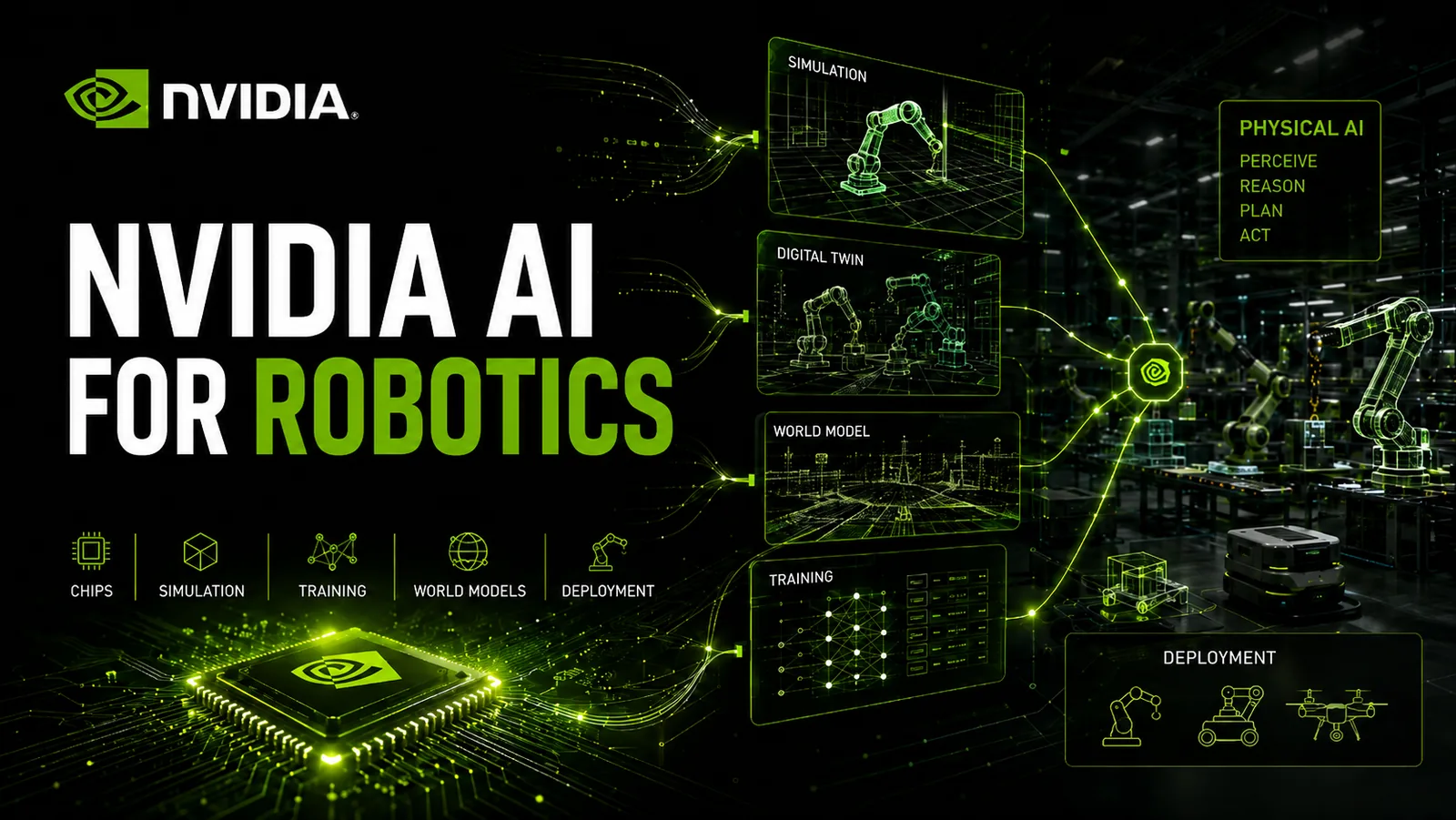
NVIDIA says it is working with robotics companies and industrial partners to develop, train, and deploy intelligent robots using tools such as NVIDIA Isaac simulation frameworks, NVIDIA Cosmos world models, and Isaac GR00T models. NVIDIA says these tools are aimed at production-scale physical AI across robotics, factories, and intelligent machines.
What Exactly Is Physical AI?
Physical AI means AI that can understand and act in the physical world. Unlike a chatbot works mostly with words, and the software on your device. If generative AI creates text, images, and videos, physical AI helps machines take action.
A physical AI system works with space, objects, motion, and real-time decisions.
That last point is important.
A chatbot can make a mistake, and you can ignore it. A robot can make a mistake, and the result may be physical.
Why Robots Are Much Harder Than Chatbots
Chatbots live in a controlled digital world. But robots have to deal with the real world, and the real world is messy.
A robot must understand things like gravity, friction, lighting, movements, timing, fragility and safety
A chatbot can be confidently wrong. A robot cannot afford to be physically wrong.
Think about the difference.
If a chatbot gives you a wrong summary, you can check the source.
But If a robot arm drops a part in a factory, it can stop production.
When a robot is working near people, safety becomes non-negotiable.
That is why robots need more than a language model. They need vision, motion planning, world understanding, sensors, safety systems, and reliable hardware.
This is also why NVIDIA’s robotics push is important. The company is not only talking about AI models. It is building the computing and simulation tools that robots need before they can work safely in the real world.
NVIDIA’s Robotics Stack Explained Simply
NVIDIA is not just selling chips for robots. It is building a full robotics stack.
That means hardware, software, simulation, AI models, and developer tools that companies can use to build intelligent machines.
Here is the simple version:
NVIDIA piece | What it does |
|---|---|
GPUs | Train large AI models and process huge data |
Cosmos | Helps AI understand and predict physical worlds |
Isaac Sim | A virtual training ground for robots |
Isaac GR00T | A platform for humanoid and general robot models |
Jetson / Thor | Onboard computing for robots, vehicles, and machines |
Omniverse | A platform for building and simulating digital worlds |
NVIDIA describes Isaac GR00T as a development platform for robot foundation models and data pipelines, built to speed up humanoid robotics development.
The larger idea is simple.
GPUs train the AI.
Cosmos helps model the world.
Isaac Sim lets robots practice.
GR00T supports humanoid robot learning.
Jetson and Thor give robots computing power.
Omniverse helps create simulated worlds.
Why Simulation Is the Secret Weapon
Robots need practice. But real-world practice is expensive, slow, and risky.
You cannot let a robot fail millions of times inside a real hospital, factory, or warehouse. It could damage equipment, waste money, or hurt someone.
That is why simulation matters.
Before robots work in the real world, they may need to grow up in fake worlds.
In simulation, robots can practice tasks again and again. They can learn how to pick up objects, move through spaces, avoid obstacles, and respond to unusual situations.
This is where NVIDIA’s Isaac and Omniverse platforms become important. They help create virtual environments where robots can learn before being deployed physically.
NVIDIA’s Cosmos work also points in this direction. A recent paper describes Cosmos 3 as an “omnimodal world model” for physical AI, designed to help AI systems understand and reason about physical environments.
Where NVIDIA-Powered Robots May Show Up First
When people hear “AI robots,” they often imagine humanoid robots walking around homes.
That may happen one day.
But it is probably not where the first big impact will happen.
The first major wave of AI robots is more likely to appear in:
- factories
- warehouses
- logistics centers
- electronics assembly
- construction sites
- hospitals
- agriculture
- autonomous vehicles
- industrial inspection
- dangerous work environments
These places make sense because they are more controlled than homes.
Factories have repeated tasks.
Warehouses have structured layouts.
Construction sites have clear work goals.
Hospitals have support tasks that need reliability.
Industrial sites often need inspection in risky areas.
Homes are much harder.
Every home is different. Objects are messy. People behave unpredictably. Safety expectations are high. And consumer robots must be affordable enough for normal buyers.
Why Japan Is a Big Part of the Physical AI Story
Japan is becoming an important part of this story.
The country has a long history in robotics, manufacturing, automation, and precision engineering. It also faces a serious aging population and labor shortage.
That makes physical AI more than a futuristic idea. It becomes a practical need.
AP reports that Fujitsu and major Japanese robotics companies, including Fanuc, Yaskawa Electric, and Kawasaki Heavy Industries, are collaborating with NVIDIA on physical AI for robots that can work safely with humans in factories, hospitals, and homes.
This gives the robotics story a human angle. They may help countries deal with shrinking workforces, elder care needs, hospital support, and industrial productivity.
Japan is also investing heavily in AI infrastructure. A reported Japanese AI computing hub for the Noetra consortium is expected to use 27,500 next-generation NVIDIA AI chips and support domestic AI ambitions, including physical AI for factories, robots, and vehicles.
NVIDIA Is Not Just Selling Chips Anymore
NVIDIA is still known for chips.
But its real strength is becoming the full system around those chips.
A company building robots does not only need one chip. It needs training tools, simulation systems, deployment hardware, software frameworks, and a way to test safely.
NVIDIA wants to provide much of that environment, where the robot can be trained, tested, and deployed.
That is why its robotics strategy is bigger than hardware.
What This Could Mean for Jobs and Daily Life
At first, it may affect jobs that are repetitive, dangerous, or physically demanding.
Robots could take over dangerous jobs.
They could help with labor shortages.
Improve productivity.
They could support doctors, nurses, and caregivers.
But there are also real concerns.
Some jobs may be disrupted. Workers may need new skills. Companies with more automation may move faster than those without it. The impact will not be equal for everyone.
New jobs may also appear in:
- robot maintenance
- AI supervision
- robotics safety
- simulation design
- field support
- human-robot operations
- system monitoring
The future may not be simply humans versus robots.
Optimists would say it may be humans who know how to work with robots versus those who do not.
Robots Need Trust Before They Need Hype
Physical AI has huge potential. But it also has serious limits.
The biggest challenges include:
- safety
- cost
- energy use
- regulation
- cybersecurity
- repair and maintenance
Before robots enter homes, hospitals, and public spaces, people will ask important questions.
Can it stop safely?
Can it avoid accidents?
Could it be hacked?
Who is responsible if it makes a mistake?
Can ordinary people afford it?
Would it work every day without constant support?
Is This the Next Big AI Revolution?
Physical AI could become the next big AI revolution. But it will not happen overnight.
Physical AI becomes real if… | It stays hype if… |
|---|---|
Robots work safely | Demos fail in real life |
Costs fall | Hardware remains expensive |
Simulation improves training | Robots cannot handle messy environments |
Businesses see value | Use cases stay limited |
People trust robots | Safety concerns grow |
Chatbots could spread quickly because they needed mostly software and cloud infrastructure. Robots need hardware, sensors, motors, safety systems, physical testing, regulation, and maintenance.
That makes robotics slower.
But if it works, the impact could be deeper.
Chatbots changed how we write, search, code, and learn.
Robots could change how machines build, move, inspect, care, and work.
Final Takeaway
NVIDIA is pushing physical AI through chips, simulation, world models, robot foundation models, and robotics platforms. It is working with industrial partners because the future of AI may not only be about smarter chatbots. It may be about smarter machines.
This does not mean humanoid robots will suddenly enter every home. But the direction is clear. AI is leaving screens.
And NVIDIA wants to power the machines that carry it into the real world.
Read next

Will Gemini 4 Argon Make You Pay? 5 Big Facts
Gemini 4 Argon is now in the Gemini app, but not for free users. See who gets it in India, what it costs in Rs, and whether it is worth paying for.

Is Meta Muse AI in India Now? The Privacy Warning
Meta Muse AI now shows up on Instagram in India, but it will not install. Here is what it does, what it costs, and the privacy risks to weigh.

Is the Gemini Free Plan Still Good Now? What You Lose in the New Cut
The Gemini free plan is now limited to Flash-Lite. See what you lose, what AI Plus and AI Pro cost in India, and whether you should pay.