
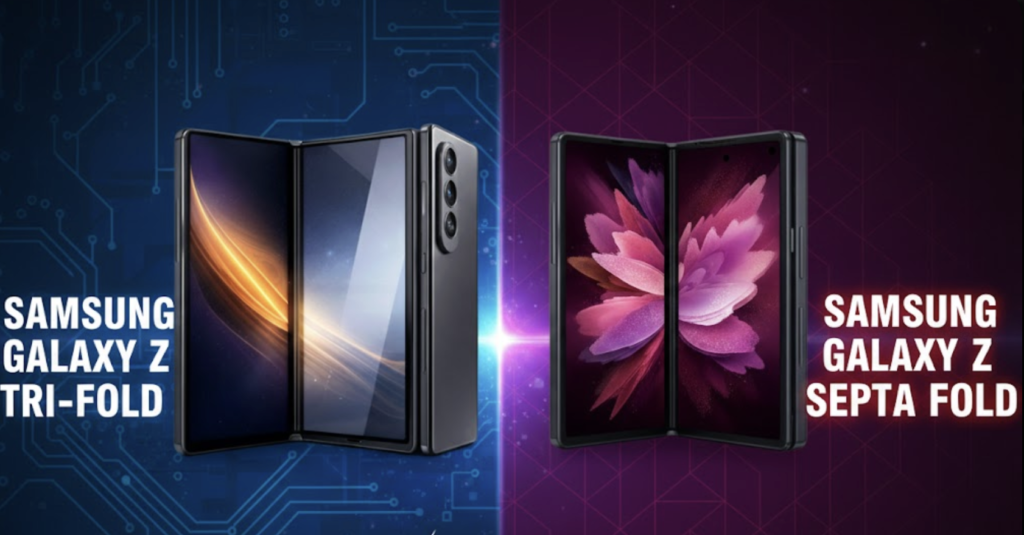

The Samsung Galaxy Z TriFold vs Z Fold series comparison shows how foldable smartphones are entering a new phase. Earlier Fold devices focused on portability while offering a larger screen when unfolded. The TriFold takes a different direction. It prioritises screen size, multitasking capability, and long-session usability, even if that means accepting a thicker and less phone-like design.
This comparison is not about which device is newer. It is about understanding how the purpose of foldable devices is changing. One product continues the idea of a folding phone. The other moves closer to a tablet-first experience that still folds down when not in use.
Product Overview and Positioning
Samsung Galaxy Z Fold 7 represent the mature phase of Samsung’s traditional foldable lineup. These devices aim to deliver a balance between portability and screen expansion. When folded, they behave like conventional smartphones. When unfolded, they provide a larger internal display suitable for multitasking and media use.
Samsung Galaxy Z TriFold introduces a new form factor. The triple-fold mechanism allows the device to unfold into a much wider display area. This design shifts the focus from pocket convenience to screen usability. The TriFold is positioned less as a phone replacement and more as a compact, foldable computing device.
Folding Mechanism and Structural Design
The Fold series relies on a single central hinge. This design simplifies folding mechanics and keeps the device slim. It also limits the maximum internal display size because the screen expands only once.
The TriFold uses a two-hinge system. This allows the display to fold in three sections and unfold into a larger continuous panel. The additional hinge increases mechanical complexity but also unlocks significantly more usable screen space. From a structural perspective, the TriFold distributes stress across multiple fold points rather than concentrating it in a single hinge.
This design difference influences how each device feels during use. The Fold series feels lighter and easier to handle with one hand. The TriFold feels more stable and balanced when opened on a desk or held with both hands.
Display Size and Screen Area Statistics
Display size is the most critical factor in the Samsung Galaxy Z TriFold vs Z Fold series comparison.
The TriFold offers an unfolded screen size of approximately 10 inches. This places it closer to compact tablets than smartphones. The increased width allows applications to use larger layouts, improved spacing, and clearer text presentation.
The Fold series provides an unfolded display of approximately 8 inches. While this is larger than standard smartphones, it remains limited when multiple applications are used side by side.
From a surface area perspective, a 10-inch display offers roughly 25–30% more usable screen space than an 8-inch display, depending on aspect ratio. This difference becomes especially noticeable during document editing, spreadsheet viewing, and multitasking scenarios where horizontal space matters.
Resolution and Visual Comfort
Both the TriFold and Fold series are expected to use high-resolution AMOLED panels. However, the larger panel of the TriFold allows content to appear at a more comfortable scale. Text does not require frequent zooming. Images and charts appear clearer without resizing.
The Fold series still delivers sharp visuals, but content density increases when multiple apps are active. This can result in smaller text and tighter layouts, especially when three apps are displayed simultaneously.
Over extended usage, the TriFold’s larger display reduces visual strain and improves reading comfort, particularly for long-form content.
Thickness and Physical Dimensions
Thickness plays a significant role in daily handling.
- Samsung Galaxy Z TriFold: approximately 12.9 mm when folded
- Samsung Galaxy Z Fold series: approximately 8.9 mm when folded
This makes the TriFold around 4 mm thicker, or roughly 45% thicker, than the Fold series when folded.
The Fold series benefits from its slim profile, making it easier to carry in pockets and use one-handed. The TriFold sacrifices some portability to support its larger display and additional hinge structure.
In practical terms, the TriFold feels closer to carrying a small tablet that folds, while the Fold series feels closer to carrying a large smartphone.
Multitasking Capabilities and App Limits
Multitasking performance is a key differentiator in the Samsung Galaxy Z TriFold vs Z Fold series comparison.
The TriFold supports up to four apps running simultaneously on the unfolded screen. The Fold series typically supports three apps at the same time.
This difference may appear minor on paper, but it changes workflow efficiency. With four apps open, users can combine editing, reference reading, communication, and browsing without switching windows. On the Fold series, one of these tasks usually requires closing or minimizing an app.
The TriFold’s wider display also allows each app window to retain a usable size, avoiding overly narrow or compressed layouts.
Productivity-Oriented Usage
The TriFold’s design clearly favours productivity-focused tasks. The larger display supports side-by-side document editing, easier file management, and more comfortable spreadsheet usage. Drag-and-drop actions feel more natural due to the increased screen width.
For professionals or students who rely on their device for extended reading, writing, or research sessions, the TriFold provides a more efficient workspace. The Fold series remains capable but requires more frequent app switching and zooming during similar tasks.
This difference positions the TriFold as a device that can reduce dependency on laptops for light productivity work.
Media Consumption Experience
Media consumption benefits significantly from larger screens. On the TriFold’s 10-inch display, videos appear more immersive, and subtitles remain readable without covering content. Aspect ratios feel more balanced, especially for widescreen video formats.
The Fold series delivers a strong media experience but feels more compact in comparison. The smaller screen can feel limiting for long viewing sessions, particularly when watching movies or reading graphic-heavy content.
For users who consume a large amount of video or digital reading material, the TriFold offers a more relaxed viewing experience.
Battery Capacity and Thermal Considerations
Although exact battery specifications vary by model, the TriFold’s larger chassis allows more internal volume for battery cells and cooling solutions. This can support longer screen-on time and improved thermal stability during extended multitasking.
The Fold series houses powerful hardware in a slimmer body. While it performs well in everyday use, prolonged heavy workloads may result in faster heat buildup due to limited internal space.
The TriFold’s form factor provides better potential for sustained performance over longer periods.
Portability and Everyday Practicality
Portability remains an advantage of the Fold series. Its slimmer profile and lighter feel make it easier to carry daily and use quickly for short interactions.
The TriFold, while still portable, requires more deliberate use. It is better suited for scenarios where the device is opened and used for extended periods rather than quick interactions.
This difference highlights that the two devices serve slightly different user needs rather than directly replacing one another.
Longevity and Future Direction
The Samsung Galaxy Z TriFold vs Z Fold series comparison reflects a broader shift in foldable device design. The Fold series represents the refinement of folding phones. The TriFold represents an expansion toward foldable computing devices.
This suggests that future foldables may prioritize screen usability and multitasking over extreme thinness. The TriFold signals a move toward devices that bridge the gap between smartphones and tablets more effectively.
Final Comparison Summary
Feature | Samsung Galaxy Z TriFold | Samsung Galaxy Z Fold Series |
|---|---|---|
Unfolded Screen Size | ~10 inches | ~8 inches |
Folded Thickness | ~12.9 mm | ~8.9 mm |
Simultaneous Apps | 4 | 3 |
Productivity Focus | High | Moderate |
Portability | Moderate | High |
Usage Style | Tablet-first | Phone-first |
Conclusion
The Samsung Galaxy Z TriFold vs Z Fold series comparison highlights two different interpretations of foldable technology. The Fold series continues to offer a balanced smartphone experience with added screen flexibility. The TriFold moves beyond this balance to deliver a larger, more productive workspace in a foldable form.
For users who value multitasking, reading comfort, and extended screen usage, the TriFold provides a clear advantage. For users who prioritize portability and quick interactions, the Fold series remains a practical option.
This comparison shows that foldable devices are no longer evolving in a single direction. Instead, they are branching into distinct categories designed to meet different usage priorities.


